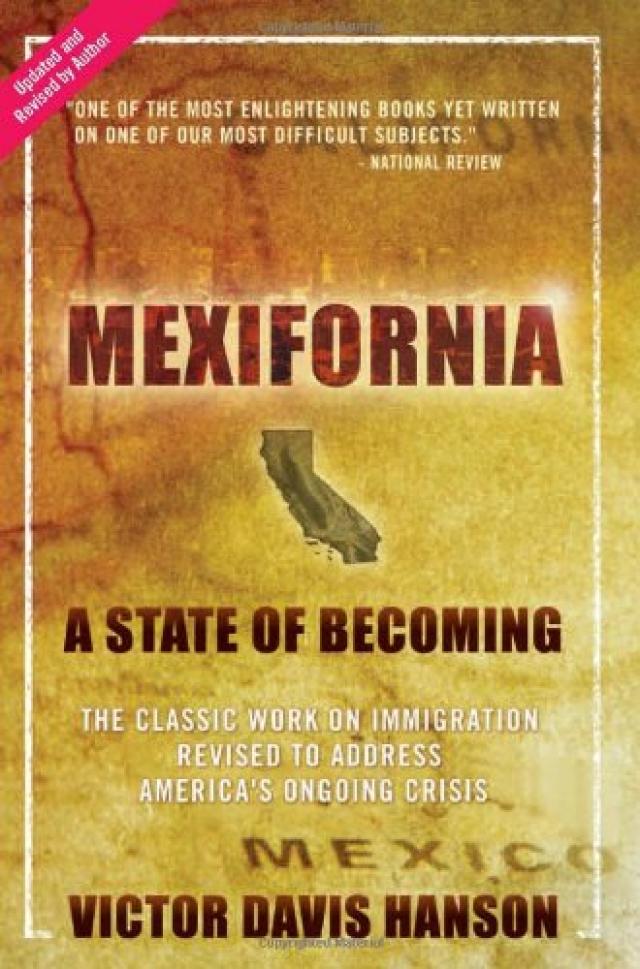
Mexifornia: A State of Becoming

Mexifornia: A State of Becoming

Victor Davis Hanson

Victor Davis Hanson

Product DescriptionMassive illegal immigration from Mexico into California, Victor Davis Hanson writes, "coupled with a loss of confidence in the old melting pot model of transforming newcomers into Americans, is changing the very nature of state. Yet we Californians have been inadequate in meeting this challenge, both failing to control our borders with Mexico and to integrate the new alien population into our mainstream." Part history, part political analysis, and part memoir, "Mexifornia" is an intensely personal work by one of our most important writers. Hanson is perhaps known best for his military histories and especially his social commentary about America and its response to terror after 9/11. But he is also a fifth-generation Californian who runs a family farm in the Central Valley and has written eloquent elegies for the decline of the small farm such as "Fields Without Dreams" and "The Land Was Everything." Like these books, "Mexifornia" is an intensely personal look at what has changed in California over the last quarter century. In this case, however, Hanson's focus is on how not only California, the Southwest, and indeed the entire nation has been affected by America's hemorrhaging borders and how those hurt worst are the Mexican immigrants themselves. A large part of the problem, Hanson believes, comes from the opportunistic coalition that stymies immigration reform and, even worse, stifles an honest discussion of a growing problem. Conservative corporations, contractors, and agribusiness demand cheap wage labor from Mexico, whatever the social consequences. Meanwhile, "progressive" academics, journalists, government bureaucrats, and La Raza advocates envision illegal aliens as a vast new political constituency for those committed to the notion that victimhood, not citizenship, is the key to advancement. The problems Hanson identifies may have reached critical mass in California, but they affect Americans who inhabit "Mexizona," "Mexichusetts" and other states of becoming. Hanson writes wistfully about his own growing up in the Central Valley when he was one of a handful of non-Hispanics in his elementary school and when his teachers saw it as their mission to give all students, Hispanic and "white" alike, a passport to the American Dream. He follows the fortunes of Hispanic friends he has known all his life--how they have succeeded in America and how they regard the immigration crisis. But if "Mexifornia" is emotionally generous at the strength and durability of the groups that have made California strong, it is also an indictment of the policies that got California into its present mess. But in the end, Hanson strongly believes that our traditions of assimilation, integration, and intermarriage may yet remedy a problem that the politicians and ideologues have allowed to get out of hand.
Read online
  • 637
The Father of Us All: War and History, Ancient and Modern

The Father of Us All: War and History, Ancient and Modern

Victor Davis Hanson

Victor Davis Hanson

Victor Davis Hanson has long been acclaimed as one of our leading scholars of ancient history. In recent years he has also become a trenchant voice on current affairs, bringing a historian's deep knowledge of past conflicts to bear on the crises of the present, from 9/11 to Iran. "War," he writes, "is an entirely human enterprise." Ideologies change, technologies develop, new strategies are invented-but human nature is constant across time and space. The dynamics of warfare in the present age still remain comprehensible to us through careful study of the past. Though many have called the War on Terror unprecedented, its contours would have been quite familiar to Themistocles of Athens or William Tecumseh Sherman. And as we face the menace of a bin Laden or a Kim Jong-Il, we can prepare ourselves with knowledge of how such challenges have been met before.The Father of Us All brings together much of Hanson's finest writing on war and society, both ancient and modern. The author has gathered a range of essays, and combined and revised them into a richly textured new work that explores such topics as how technology shapes warfare, what constitutes the "American way of war," and why even those who abhor war need to study military history. "War is the father and king of us all," Heraclitus wrote in ancient Greece. And as Victor Davis Hanson shows, it is no less so today.From Publishers WeeklySince 9/11, Davis, director of the Hoover Institution's group on military history and contemporary conflict, has emerged as a major commentator on war making and politics. This anthology brings together 13 of Hanson's essays and reviews, revised and re-edited. They have appeared over the past decade in periodicals from the American Spectator to the New York Times. Hanson's introductory generalization that war is a human enterprise that seems inseparable from the human condition structures such subjects as an eloquent answer to the question Why Study War? a defense of the historicity of the film 300, about the Persian Wars, in a masterpiece of envelope pushing, and a comprehensive and dazzling analysis of why America fights as she does. He explains why, though a lesser historian than Thucydides, Xenophon retains a timeless attraction and analyzes war and democracy in light of America's decreasing willingness to intervene in places like Rwanda or Darfur. The pieces are well written, sometimes elegantly so, and closely reasoned. They address familiar material from original and stimulating perspectives. Hanson's arguments may not convince everyone, but cannot be dismissed. His critics and admirers will be pleased to have these pieces available under one cover. (May) Copyright © Reed Business Information, a division of Reed Elsevier Inc. All rights reserved. From BooklistFolksinger Pete Seeger ain’t gonna study war no more, but classicist Hanson warns against skipping class in this set of essays reworked from his recent articles, book reviews, and book introductions. In Hanson’s estimation, amnesia about military history permeates America’s media, political, and intellectual leadership: out of fashion in the academy, military history was the specialty of just 1.9 percent of American history professors as of 2007. As he suggests reasons for this state of neglect, Hanson expatiates within specific essays, such as his preface to Donald Kagan’s The Peloponnesian War (2003), on the effects of historical forgetfulness. Hanson sees examples abounding in American leaders’ negative reactions to the Iraq War, responses that the author witheringly critiques for poor historical aptitude and poor understanding about the military and military operations. At bottom, Hanson argues that recoiling from learning about warfare ignores what he insists is its tragic nature: that war, inherent in human nature, can only be struggled against and not be wished away. Not a happy message to peace-studies idealists but one a balanced current-events collection should include. --Gilbert Taylor
Read online
  • 51
The End of Sparta

The End of Sparta

Victor Davis Hanson

Victor Davis Hanson

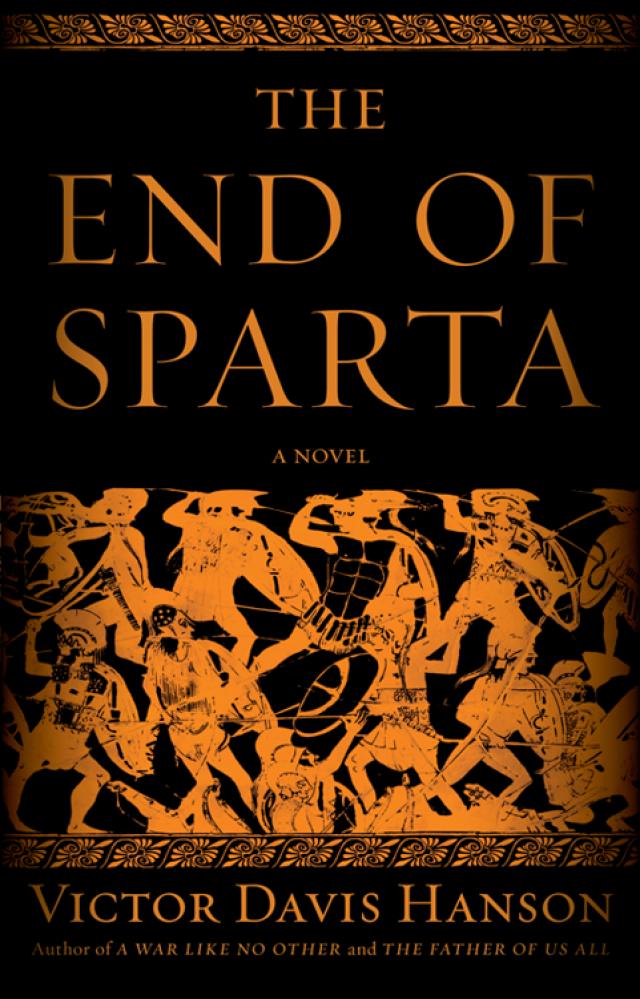
In this sweeping and deeply imagined historical novel, acclaimed classicist Victor Davis Hanson re-creates the battles of one of the greatest generals of ancient Greece, Epaminondas. At the Battle of Leuktra, his Thebans crushed the fearsome army of Sparta that had enslaved its neighbors for two centuries.We follow these epic historical events through the eyes of Mêlon, a farmer who has left his fields to serve with Epaminondas-swept up, against his better judgment, in the fever to spread democracy even as he yearns to return to his pastoral hillside.With a scholar's depth of knowledge and a novelist's vivid imagination, Hanson re-creates the ancient world down to its intimate details-from the weight of a spear in a soldier's hand to the peculiar camaraderie of a slave and master who go into battle side by side. The End of Sparta is a stirring drama and a rich, absorbing reading experience.Praise for Victor Davis Hanson:"I have never read another book...
Read online
  • 42
Hoplites: The Classical Greek Battle Experience

Hoplites: The Classical Greek Battle Experience

Victor Davis Hanson

Victor Davis Hanson

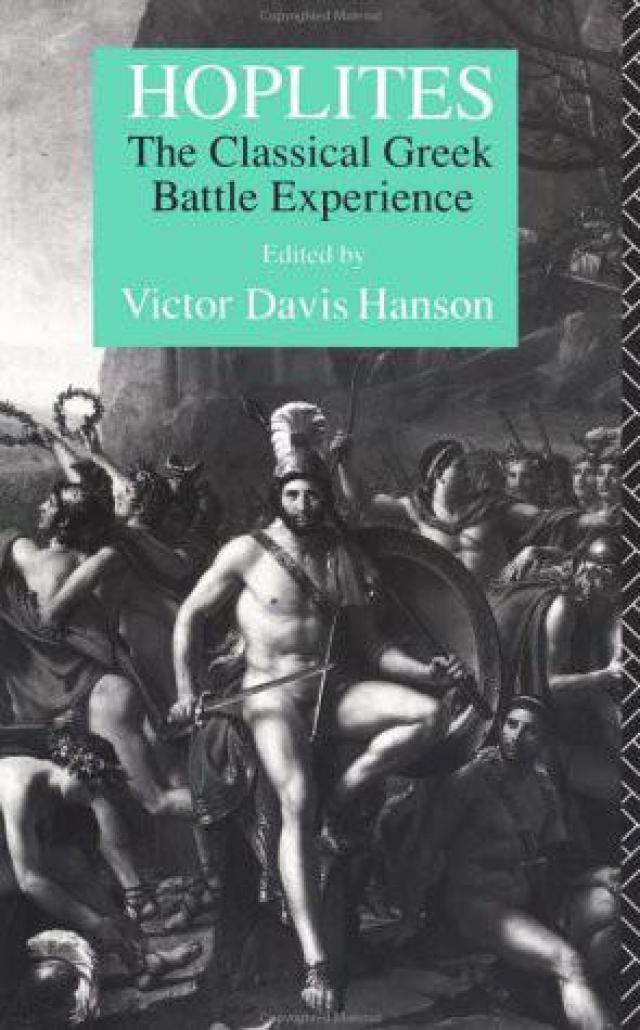
Incorporating research found in ancient literary, iconographic, epigraphic, and archaeological sources, this book explores the experiences of the soldiers who conducted battle on the small plains of ancient Greece.The volume, which draws on the accumulated expertise of nine American and British scholars, emphasizes the actual techniques of fighting and practical concerns as the use of commands, music in warfare, the use of "dog-tags", and ritual on the battlefield.ReviewThe collection of hitherto unpublished essays brought together by Victor Davis Hanson in this book may be seen as the first scholarly approach we have had to what actually happened in a major battle between Greek city-states in classical times.–*The Classical Review*. . . indispensable for any serious student of Greek warfare or Greek society. . . . readily accessible to a wide audience.–*Classical World*About the AuthorVictor Davis Hanson is Professor of Classics at California State University, Fresno.
Read online
  • 23
Carnage and Culture: Landmark Battles in the Rise of Western Power

Carnage and Culture: Landmark Battles in the Rise of Western Power

Victor Davis Hanson

Victor Davis Hanson

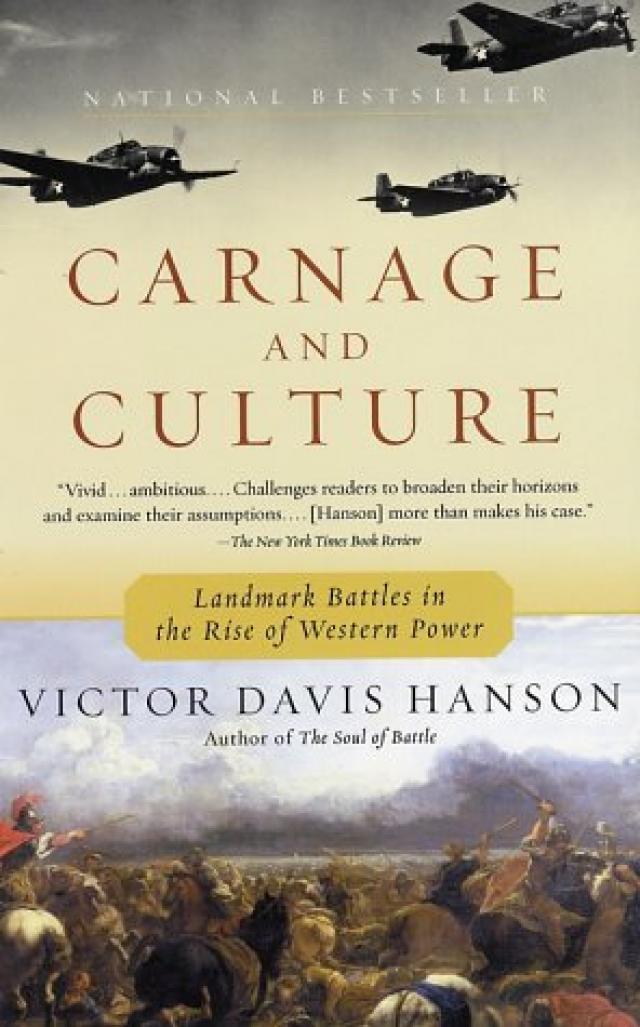
Amazon.com ReviewMany theories have been offered regarding why Western culture has spread so successfully across the world, with arguments ranging from genetics to superior technology to the creation of enlightened economic, moral, and political systems. In Carnage and Culture, military historian Victor Hanson takes all of these factors into account in making a bold, and sure to be controversial, argument: Westerners are more effective killers. Focusing specifically on military power rather than the nature of Western civilization in general, Hanson views war as the ultimate reflection of a society's character: "There is…a cultural crystallization in battle, in which the insidious and more subtle institutions that heretofore are murky and undefined became stark and unforgiving in the finality of organized killing."Though technological advances and superior weapons have certainly played a role in Western military dominance, Hanson posits that cultural distinctions are the most significant factors. By bringing personal freedom, discipline, and organization to the battlefield, powerful "marching democracies" were more apt to defeat non-Western nations hampered by unstable governments, limited funding, and intolerance of open discussion. These crucial differences often ensured victory even against long odds. Greek armies, for instance, who elected their own generals and freely debated strategy were able to win wars even when far outnumbered and deep within enemy territory. Hanson further argues that granting warriors control of their own destinies results in the kind of glorification of horrific hand-to-hand combat necessary for true domination.The nine battles Hanson examines include the Greek naval victory against the Persians at Salamis in 480 B.C., Cortes's march on Mexico City in 1521, the battle of Midway in 1942, and the 1968 Tet Offensive in Vietnam. In the book's fascinating final chapter, he then looks forward and ponders the consequences of a complete cultural victory, challenging the widespread belief that democratic nations do not wage war against one another: "We may well be all Westerners in the millennium to come, and that could be a very dangerous thing indeed," he writes. It seems the West will always seek an enemy, even if it must come from within. --Shawn CarkonenFrom Publishers Weekly"The Western way of war is so lethal precisely because it is so amoral shackled rarely by concerns of ritual, tradition, religion, or ethics, by anything other than military necessity." Ranging from Salamis in 480 B.C. to the Tet offensive in Vietnam, Hanson, a California State at Fresno classics professor, expands the scope of his The Western Way of War: Infantry Battle in Classical Greece, offering a provocative look at occidental aggression as illustrated by nine paradigmatic battles between Western and non-Western armies. Hanson sheds the overly romanticized view of battles as nationalist or ethnic honorifics and vividly portrays the deadly killing machines Western powers evolved for the destruction of non-Western opponents. Throughout, Hanson stresses the technology based lethality of Western warfare, and the role of individual initiative as opposed to the more collectivist strategies of the Persians, Carthaginians, Arabs, Turks, Aztecs, Zulus, Japanese and Vietnamese opponents who get a chapter apiece. The single Western defeat chronicled in these pages, of the Romans in Cannae in 216 B.C., shows a victorious Hannibal unable to capitalize on his win. (The idea of the citizen/soldier, the role of civic militarism and the republican ideals of Rome seem to be the reasons why not.) A number of Hanson's conclusions will engender debate, such as his claim that America won in Vietnam, but failed to recognize it, as well as the larger claim that "free markets, free elections, and free speech" have led directly to superior forces. The book's last few chapters are fairly driven by that idea, which, along with precise, forceful writing, sets it apart from the season's secondary-sourced, battle-based military histories. (Aug.)Forecast: Hanson's direct, literate style and his evenhandedness should appeal to the liberalist middle of the left and right alike. By isolating the ingredients of military success via elaborate examples, the book can potentially draw on two separate military-history readerships: those looking for theory and those for action.Copyright 2001 Cahners Business Information, Inc.
Read online
  • 17
A War Like No Other: How the Athenians and Spartans Fought the Peloponnesian War

A War Like No Other: How the Athenians and Spartans Fought the Peloponnesian War

Victor Davis Hanson

Victor Davis Hanson

From Publishers WeeklyHanson (Warfare and Agriculture in Classical Greece, etc.) presents an elegant, lucidly written analysis of the 27-year civil war, a "colossal absurdity," that ended in Athens's 5th-century B.C. loss to Sparta and the depletion of centuries of material and intellectual wealth. Hanson deftly chronicles these destructive decades, from the conflict's roots (e.g., the fundamental mutual suspicion between Athens and Sparta) to its legacy (the evolution of the nature of war to something "more deadly, amorphous, and concerned with the ends rather than the ethical means"). Hanson considers the war's economic aspects and the ruinous plague that struck Athens before delving into his discussion of warfare. He offers a tour de force analysis of hoplite (or infantry) combat, guerrilla tactics, siege operations and sea battles in the Aegean. Though landlocked Sparta ultimately brought down Athens's once-great naval fleet and replaced democracy with oligarchy by 404 B.C., Hanson complicates the received notion of a lost Hellenic Golden Age. Throughout this trenchant military and cultural history, he draws parallels between the Peloponnesian War and modern-day conflicts from WWII to the Cold War and Vietnam. Across the centuries, these are lessons worth remembering. (Oct.) Copyright © Reed Business Information, a division of Reed Elsevier Inc. All rights reserved. From BooklistBy the standards of modern mass warfare, the Peloponnesian War, which ravaged Greece for 27 years, was a small-scale affair. The military forces were relatively small, and the weapons seem primitive. But by the standards of the classical Greek world, this conflict was massive and devastating. Hanson is a classicist and military historian, and his concise and stirring account of the war lacks the comprehensive scope of Donald Kagan's definitive work, * The Peloponnesian War (2003). However, as a strictly military account, Hanson has written a first-rate chronicle, capturing the intensity and savagery of ancient warfare and conveying how ordinary warriors must have experienced it. Hanson has a gift for explaining both strategic objectives and relatively complicated tactical maneuvers in terms easily understandable by laymen. In his portrayals of some of the key players, Hanson provides interesting insights, especially concerning some rather obscure but important figures. For general readers and history buffs who hope to gain a solid understanding of this seminal and tragic conflict, this is an ideal. Jay FreemanCopyright © American Library Association. All rights reserved*
Read online
  • 5
183