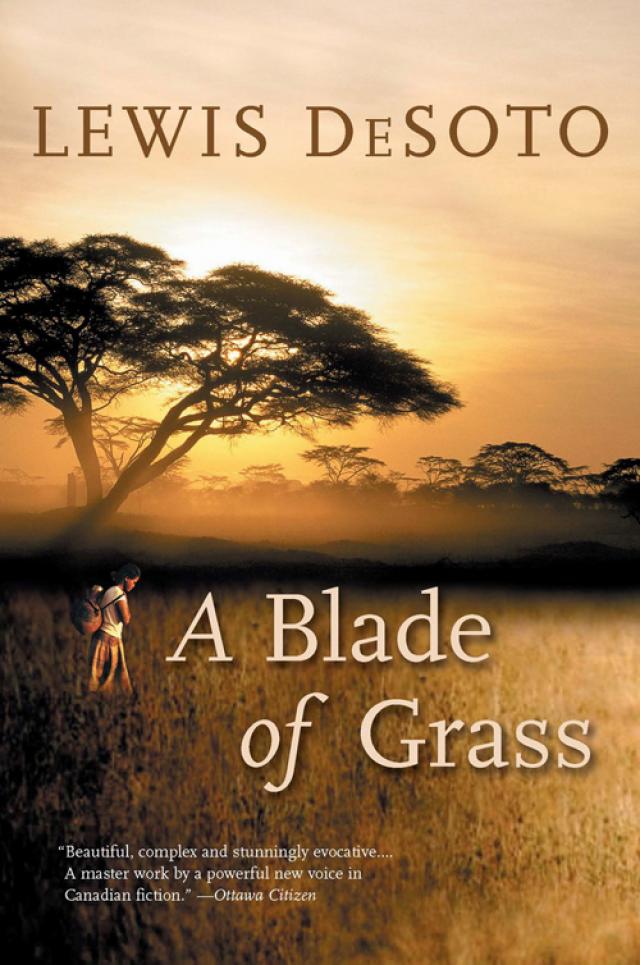
Märit Laurens is a young woman of British descent who comes to live with her husband, Ben, on their newly purchased farm along the border of South Africa. Shortly after her arrival, violence strikes at the heart of Märit's world. Devastated and confused but determined to run the farm on her own, Märit finds herself in a simmering tug of war between the local Afrikaner community and the black workers who live on the farm, both vying for control over the land in the wake of tragedy. Märit's only supporter is her black housekeeper, Tembi, who, like Märit, is alone in the world. Together, the women struggle to hold on to the farm, but the quietly encroaching civil war brings out conflicting loyalties that turn the fight for the farm into a fight for their lives.Thrilling to read, A Blade of Grass is a wrenching story of friendship and betrayal and of the trauma of the land that has shaped post-colonial Africa.Amazon.com ReviewLewis De Soto's debut novel, A Blade of Grass, tells the story of Marit Laurens, a young woman of British descent, recently orphaned, who has moved with her new husband Ben to a remote farm on the contested borderland between South Africa and an unnamed country. When Ben is killed by a bomb in an act of guerilla warfare, she decides to stay on and run the farm. Alone in the world, she befriends Tembi, the daughter of her black housemaid, who has also been killed, in an accident. Struggling to transform herself as the surrounding countryside descends into bloody conflict, Marit finds herself caught between the fear and prejudices of the local Afrikaner community and the shifting loyalties and growing feeling of entitlement of the indigenous black workers. When first the Afrikaners and then the blacks flee the area, and the outside world starts to encroach menacingly on the isolated farm, Marit is stripped of everything that gave her a sense of self and a sense of belonging to this place.A Blade of Grass is a delicate, if at times naively sentimental, exploration of the arc of a courageous relationship between two women from different societies, each an outcast from her own, during the death throes of apartheid: from the rigid structure of master and servant, through the tenderness of the shared experience of aloneness and defiance in the face of societal pressures, to betrayal. De Soto has transformed the quiet immensity of the South African veldt into spare, luminous prose. He contains everything--repression and ownership, belonging and loss, humiliation and hope--in the small gesture, the seed, the blade of grass. The story's brutality is barely graphic in its depiction, but the terror is present nonetheless, lurking insistently beneath the surface, waiting at the edge of the farm. --Diana Kuprel, Amazon.caFrom BooklistPart historical fiction, part war-survivor story, this beautiful first novel is above all an intimate drama of two young South African women who cross apartheid barriers in their search for home. The time is the 1970s somewhere near the border. When the civil war comes close and a farmer is killed, his widow refuses to leave with the other whites. Her housekeeper, Tembi, is the only black person to stay on when the government soldiers drive away her people. The story is told from the women's alternating viewpoints as they break down the mistress-servant relationship, care for each other, and work the land, even when they lose electricity, running water, crops, cattle, and all outside contact. Tembi's voice is sometimes too distant, but her personal story brings close the apartheid atrocity of family breakup. With lyrical simplicity, DeSoto evokes the elemental landscape of the veldt that survives even the screaming military jets. In the tradition of Olive Schreiner's classic Story of an African Farm (1883), the focus is on women, their loneliness and strength. Hazel RochmanCopyright © American Library Association. All rights reserved
Read online