

Look down in mercy, p.1
Look Down in Mercy, page 1
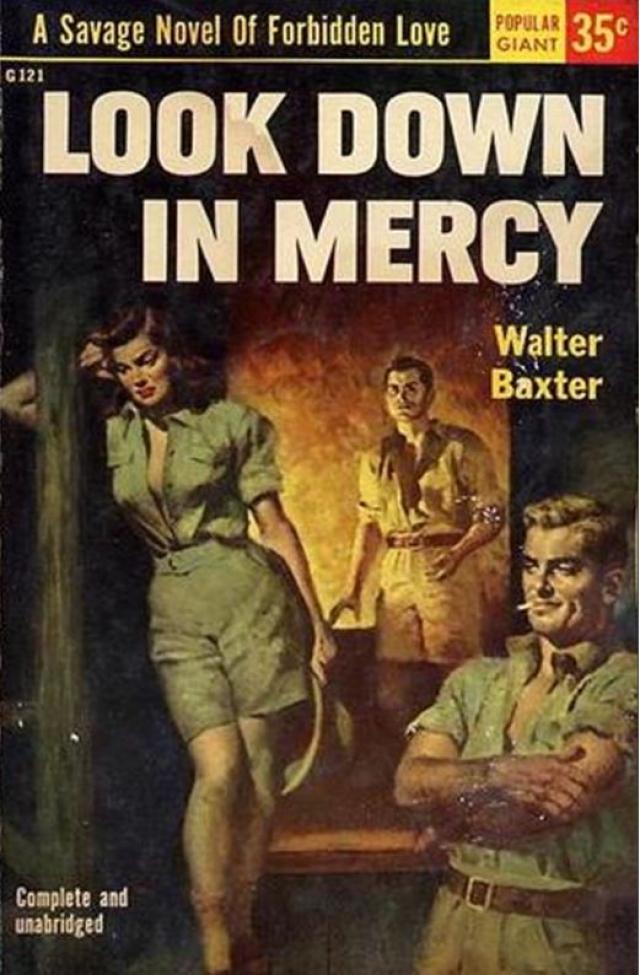


Look Down in Mercy
“Oh God, our refuge, and our strength,
look down in mercy on Thy people
who cry to Thee…….”
Prayers after Low Mass
COPYRIGHT, 1951, 1952, BY WALTER BAXTER
All rights reserved. This book, or parts thereof, must
not be reproduced in any form without permission.
Library of Congress Catalog Card Number: 52-5265
Manufactured in the United States of America
Van Rees Press • New York
* * *
This TNT Edition
is the 1952 American edition
which contains an alternate ending (part 3, chapter 19).
The original UK edition (1951) does not contain this last chapter, but has a different, less optomistic ending. It has been included in this edition,
together with
an Introduction by Gregory Woods to the 2014 Valancourt edition.
2025
To Eve Disher
All names, characters, and events in this book are
fictional, and any resemblance to real persons
which may seem to exist is purely coincidental.
( Look Down in Mercy )
Introduction
by
Gregory Woods
For a first novel, Look Down in Mercy is an extraordinary achievement. Like many fictional accounts of the Second World War, it is based on first-hand experience. Walter Baxter had taken part in the 1942 campaign against the Japanese in Burma, and had joined the subsequent retreat into India. The novel’s version of these events is rendered psychologically plausible with a wealth of detail about physical and mental endurance, in a hostile climate, on the face of an unforgiving landscape, and at the mercy of an efficient and ruthless enemy. As a hardcore novel of warfare, it is persuasive and compelling.
But there is more to it than that. This is more than a pulp-fiction account of heroism and derring-do. Despite its depressing moments of racism about both the Japanese enemy and the Indian allies—moments which, like the book’s similar evidence of routine sexism, are quite unremarkable for their era—the novel is no mere celebration of British strategic or moral superiority. Yes, it includes accounts of Japanese war crimes; but its British central character, Tony Kent, is all the more interesting for the fact that, in his personal relationships no less than his professional behaviour as a soldier, he is morally compromised throughout.
A further degree of complexity is added to an already sophisticated book by what we might call its ‘gay theme’, the intimate relationship that develops between Kent and his batman, Anson. So anguished is this relationship, on Kent’s part at least (for Anson seems to accept it in good heart, with a docile equanimity that is often very moving), that it is perfectly in keeping with the context of the war. Like the retreat into India, on foot and in the extremes of illness and thirst, the love affair is no sentimental romance, but an epic of resistance and endurance. Even if the protagonists survive, it is hard to see how their love will.
Kent’s attitudes to homosexuality are unquestioningly negative. Most of his moments of intimacy with Anson are compromised by guilt feelings and followed by attacks of self-loathing or, at best, of regret. Even at the decisive moment of their first embrace, while the narrative suggests the abandonment of scruples (‘without considering the consequences’), nevertheless we are told that Kent puts his arms around Anson ‘believing that what he was about to do was utterly disgraceful and criminal’. (Not until 1957 would the Wolfenden Report recommend the partial decriminalisation of male homosexual acts, and not until 1967 would those recommendations be enacted, if only in England and Wales; but this liberalisation would not apply to the armed services.) So deeply ingrained is Kent’s disapproval that, even when disregarding the specific consequences of this particular embrace, at this exact moment, at this precise map reference, he cannot help being flooded with an awareness of the possibility of social scandal: informally, in any social milieu he knows, this sexual act must be judged ‘disgraceful’; and formally, should it ever reach the courts, martial or otherwise, it must inevitably be judged ‘criminal’. So much for the pleasure of the two men’s first embrace.
In the morning, Kent feels ‘misery and regret’ over what they have done, even if ‘he could almost feel love’ for the man he is lying next to. In the hours that follow, he deliberately takes on a risky leadership role that he might normally have delegated to one of his non-commissioned officers, in part because ‘he wanted to prove something to himself and to Anson, but what it was he did not know’. To have become the lover of another man—if only perhaps once, only perhaps in a moment of weakness, only perhaps for lack of the presence of women—is to run the risk of obliterating one’s masculine identity, albeit while still wearing the uniform and insignia of membership of the armed services. To have spent a night in another man’s arms is to call into doubt one’s manly capabilities. Hence the test and the proof. In the hot light of day, ‘something’ needs proving, to the satisfaction of both parties. At this stage, it seems, Kent wants to prove that last night was an aberration and that he is still a real man. Kent has read the British newspapers and he has seen, or heard of, the visible presence of homosexual men in Britain. In no respect does he identify with them, either as individuals or as a cause:
As for being a pervert (the word conjured up, for him, repelling images of furtive old men peering over the tops of public urinals, clergymen volunteering to undergo ‘treatment’ for six months to avoid prison, and effeminate shop-assistants talking like a music-hall comedian), last night was the first time that anything of that nature had happened to him.
He persuades himself that nothing of the sort would have happened if he had not been ‘away from Celia for so long’ (she being his wife); and that no such thing will happen again because he intends to track down ‘that nice nurse’ Helen Dean, with whom he spent a drunken night on the ship that was taking them to Rangoon. In other words, regardless of his fondness for Anson, he knows he does not belong to any of the limited range of homosexual types he is aware of—never having actively sought sexual contact with another man, never having been deemed a suitable case for either treatment or punishment, and not being effeminate (even if this needs proving to himself and Anson)—and he knows that, as soon as suitable circumstances can be arranged, his heterosexuality will prevail.
That is one step towards reassurance on the morning after. More difficult to achieve, because demanding a lack of witnesses, Anson’s discretion, and continued vigilance, is that nobody else should ever become aware of the two men’s relationship. After they first spend a night together in the security and comfort of a private bedroom and bed, Kent is again both ashamed and calculating: ‘He had committed the unforgivable sin, and now there was nothing to be done except not to be found out’.
As we have seen, on the morning after their first encounter, Kent reassures himself that ‘last night was the first time that anything of that nature had happened to him’. But, as it turns out, he has either forgotten his own schooldays or discounted them. There is a conversation between him and Anson, much later in the book, in which Kent explicitly claims never to have done ‘anything like this’ in his life. Anson, who presumably has, suggests that he must at least have ‘known something about it … when you were a kid at school’. Kent replies:
Yes, but that was different, utterly different. You must know what little beasts boys are. It was just dirty-mindedness, it didn’t mean anything. Once, maybe twice, fooling around in the lavatories.
He adds, ‘It wasn’t anything like this.’ This lack of meaning, as attributed to sexual encounters between schoolboys, clearly refers to the ‘passing phase’ theory of adolescent homosexuality, so useful to excuse the past indiscretions of men who had been through the English public (i.e. private) school system. Youthful experimentation, lack of female company, the hothouse atmosphere of a closed institution—these allowed for both romantic attachments and (as long as no one caught the miscreants) frictional release. But his and Anson’s relationship is, as Kent says, ‘utterly different’. It is, of course, more dangerous—running the risk of court martial and imprisonment or ‘treatment’—and, as he has finally begun to realise, more meaningful. What he does with Anson is no mere ‘dirty-mindedness’
When the odious Goodwin arrives, ‘venomous and sneering’, to attempt to blackmail Kent, all of the latter’s fears about the consequences of his ‘criminal carelessness’ prove justified. (The novel’s opening chapter, in which Anson and Goodwin take a shower next to each other, proves to have been a mischievous diversionary tactic on the part of the author.) Imprisonment apart, blackmail was the main risk homosexual men faced during the era of criminality. It could be the outcome of any homosexual encounter with a stranger; and it could result from the negligence allowing a third party to witness a compromising encounter. Fear of blackmail kept many men celibate.
Walter Baxter exploits such fears for most of the novel, using Goodwin to embody the threat. The fact that we know he is a murderer eliminates any moral ambiguity about his repulsive personality. It is always going to be hard even for the homophobic reader to sympathise with him when he calls Kent ‘nothing but a bloody nancy boy’ and a ‘gutless nancy’, since he is such a manifestly nasty piece of work. Indeed, even the homosexual reader might understand how Kent, when faced with Goodwin’s threats and insults, reflects that ‘he would rather be suspected of murder than homosexuality’ and p
Goodwin is all bad, Anson all good. Both are rather two dimensional characters. But, as I have already suggested, the real power of this novel comes from Baxter’s willingness to develop a central character who is morally ambiguous even to the extent of being thoroughly compromised. Kent is both a hero and a coward, a saver of lives and a killer, a homophobe and the lover of a man. He treats Anson as if he were disposable—and we can be sure that he would sacrifice Anson if his own safety were at stake. Anson knows this. And yet, in spite of all the negative aspects of his personality, Baxter still manages to use Kent as a positive representative of homosexuality: masculine, patriotic, mature and capable (in all these respects matching the less visible but steadier Anson).
Similarly ambivalent are both of the book’s two endings, that of 1951 for the British market, and that of 1952 for the American (printed here as an appendix). One is unhappy and the other happy, but neither is definitive. I shall not go into detail about this, but Baxter clearly wanted to leave open the possibilities in each, not least in their moral implications. Compared with the heavy-handed alternative endings of Gore Vidal’s The City and the Pillar (1948 and 1965), one involving murder and the other rape, these are—even if dramatic—subtle and suggestive in ways that, in both cases, appropriately round off a novel that consistently avoids resorting to the obvious.
Walter Baxter’s second novel, The Image and the Search (1953), about a widow who takes several lovers in a quest to replace the image of her late husband, turned out to be far more controversial than Look Down in Mercy. In March 1954, Lord Beaverbrook used the pages of the Daily Express to put pressure on the publishers, Heinemann, to withdraw it. They did so, and also withheld it from Putnam’s in the USA. In October of that year, publisher and author were charged under the Obscene Publications Act. They had to endure two trials before finally being acquitted. Anticipating by some sixteen years the absurdities of the trial of Lady Chatterley, one of the prosecutors asked, ‘Would anyone give this book as a present to his daughter or his typist?’
Like E.M. Forster before him, Baxter found the pressure not to write about the topics that interested him too much to bear, and he gave up writing. Instead, he eventually became a successful restaurateur. His greatest success was in running, jointly with his lover Fergus Provan, the Chanterelle in South Kensington. If at some point he makes an appearance in Christopher Isherwood’s diaries as a self-pitying drunk, we can offer him the courtesy of our indulgence. After all, this was a man who had written two daring and accomplished novels, both of which raised the topic of homosexuality at a time when for a homosexual novelist to do so took some nerve. And, having been daring, he had been ordered not to dare.
Gregory Woods
27 May 2014
[This essay was first published as the introduction to Walter Baxter, Look Down in Mercy (Richmond, Virginia: Valancourt Books, 2014), pp.v-x).]
Part One
( I )
A nson stood under the shower with his head thrown back and let the cool water splash on his hot face.
Goodwin was standing under the next shower, soaping his body with one hand and rinsing it off with the other. Both of them carried the marks of several years’ service in India, brown forearms and knees and the tan of their faces extending to an ill-defined V on the chest; the rest, the exhausted dead white of constant sweating.
But there the resemblance between them ceased. At twenty-two Anson was a few years younger than Goodwin and his hair was curly, light brown, and his skin was fresh. He had high cheekbones and an almost straight nose; his mouth was generous. His features were not outstanding, but the expression of his eyes and his youthfulness gave him charm and an impression of sincerity that was completely lacking in Goodwin, whose hair was dark and straight, and who seemed to have lost all the attributes of youth. His skin was coarse and the lines across his forehead and from the nose to the corner of his expressionless mouth were already ineradicable. He lathered his hands and turned to Anson.
“Catch.” With his eyes half shut he lobbed the soap in the direction of the next shower; it fell on the concrete floor and slid into the guttering. Anson picked it out, taking no notice of the gray ropy slime that grew like a waterweed from the concrete. Goodwin finished washing his face and neck, blew his nose into his fingers, and rinsed his hands under the shower. He dried himself on a scruffy towel and started for the door.
Anson leisurely turned off his own shower and then Goodwin’s. The taps were stiff with age and verdigris, and their constant drip had pitted the concrete. The sound of the barracks came slowly after the noise of the water, a waltz sung with conventional pathos, mingled with the tinkle of the dripping showers and the clash of pails from the cookhouse as breakfast was dished up; from above a kite hawk whistled musically as it circled the barrack area.
He left the showers without bothering to dry himself. It was only seven o’clock, but the freshness of the morning had long disappeared in the sweat and boredom of half-an-hour’s P.T. There would be a little time of cool grace while his body dried, and then the sweat and heat would return with his clothes.
He reached the lofty wooden barrack room and crossed the veranda. It was a strange room, cleaned and tidied every day by thirty men, inspected every morning by four people all of whom tried to find fault, and yet there was an impalpable atmosphere of chaos and a very palpable one of sour sweat and urine. Above his head the punkahs swished their weighted fringes, pushing the limp air this way and that, their gentle squeaking and creaking filling the room with a hypnotic background that was always ready to step forward and dominate. But no amount of airing or hot dry winds blowing steadily all day through the open doors and windows could dissipate the strangely animal smell.
Anson stood in the gap between his own bed and Goodwin’s and looked vacantly at his clothes.
“Come on, kid, for Christ’s sake hurry up.” Goodwin spoke without anger, almost without thinking. It was always “for Christ’s sake hurry up, get a move on, stop mooning about.” It was often unnecessary, but it helped fill a corner of the void caused by the barren years of being a private soldier, of having no home, no work, no responsibility, and hating the strange lands and incomprehensible people. By a gradual and unsuspected process Anson’s vagueness had become a mutual comfort. He started to dress quickly, suddenly realizing that he was hungry, and they walked in silence to the dining hall.
The sun was high enough to strike in broad swaths through the tangle of low buildings and tamarind trees. It was already hot and the wind was beginning to build itself up in warm little eddies. A pariah dog scuttled behind the cookhouse, emaciated in spite of the prodigality of waste left by the men, functionless except as a scavenger and sustainer of its parasites. “What are we on this morning?” Anson asked.
“Dunno. Didn’t look at the detail. Some balls, I suppose.” They joined the last of the line being ladled out pints of tea. Anson nearly asked the man in front of him the same question and then stopped. Whatever they were due to do would be as familiar to him as the monotonous plains around Sialpur and the pale-blue foothills of the Himalayas in the distance.
( 2 )
By ten o’clock in the morning the garrison hospital was in a state of siege against the sun, its windows and doors shaded and shuttered, its walls and verandas throwing back a white blaze of heat. Coming in from the glare of the sun it certainly felt a few degrees cooler, but it was still far too hot to be comfortable and by the middle of the afternoon the sun’s assault would have subdued everything. The quiet talk and the tintinnabulation of medicine bottles would have ceased and their place taken by the sound of the wind in the palms and trees of the hospital compound, and the thin noises of the patients as they dozed uneasily on their hard damp pillows.






