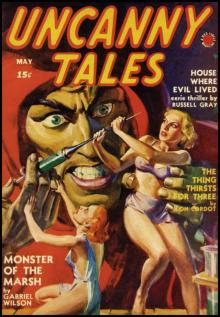
Robots through the ages, p.20
Robots through the Ages, page 20


Smiling reminiscently, the old woman continued, “And the golem cut the rabbi’s wood and brought his water and guarded the ghetto.”
“And one time only he disobeyed the Rabbi Löw, and Rabbi Löw erased the Shem Ha-Mephorash from the golem’s forehead and the golem fell down like a dead one. And they put him up in the attic of the shule, and he’s still there today if the Communisten haven’t sent him to Moscow . . . This is not just a story,” he said.
“Avadda not!” said the old woman.
“I myself have seen both the shule and the rabbi’s grave,” her husband said conclusively.
“But I think this must be a different kind of golem, Gumbeiner. See, on his forehead; nothing written.”
“What’s the matter, there’s a law I can’t write something there? Where is that lump of clay Bud brought us from his class?”
The old man washed his hands, adjusted his little black skull-cap, and slowly and carefully wrote four Hebrew letters on the grey forehead.
“Ezra the Scribe himself couldn’t do better,” the old woman said admiringly. “Nothing happens,” she observed, looking at the lifeless figure sprawled in the chair.
“Well, after all, am I Rabbi Löw?” her husband asked deprecatingly. “No,” he answered. He leaned over and examined the exposed mechanism. “This spring goes here . . . this wire comes with this one . . .” The figure moved. “But this one goes where? And this one?”
“Let be,” said his wife. The figure sat up slowly and rolled its eyes loosely.
“Listen, Reb Golem,” the old man said, wagging his finger. “Pay attention to what I say—you understand?”
“Understand . . .”
“If you want to stay here, you got to do like Mr. Gumbeiner says.”
“Do-like-Mr.-Gumbeiner-says . . .”
“That’s the way I like to hear a golem talk. Malka, give here the mirror from the pocketbook. Look, you see your face? You see the forehead, what’s written? If you don’t do like Mr. Gumbeiner says, he’ll wipe out what’s written and you’ll be no more alive.”
“No-more-alive . . .”
“That’s right. Now, listen. Under the porch you’ll find a lawnmower. Take it. And cut the lawn. Then come back. Go.”
“Go . . .” The figure shambled down the stairs. Presently the sound of the lawnmower whirred through the quiet air in the street just like the street where Jackie Cooper shed huge tears on Wallace Beery’s shirt and Chester Conklin rolled his eyes at Marie Dressler.
“So what will you write to Tillie?” old Mr. Gumbeiner asked.
“What should I write?” old Mrs. Gumbeiner shrugged. “I’ll write that the weather is lovely out here and that we are both, Blessed be the Name, in good health.”
The old man nodded his head slowly, and they sat together on the front porch in the warm afternoon sun.
Our next story is a 1966 post-apocalyptic novelette by Roger Zelazny, a nominee for the Hugo Award for Best Novelette the following year. It takes place long after humanity’s self-extinction and recounts the tale of Frost, a sentient machine, who continues, along with other sentient machines, to work at rebuilding the earth, while also examining the differences between humans and machines . . . —BTS
FOR A BREATH I TARRY
ROGER ZELAZNY
They called him Frost. Of all things created of Solcom, Frost was the finest, the mightiest, the most difficult to understand.
This is why he bore a name, and why he was given dominion over half the Earth.
On the day of Frost’s creation, Solcom had suffered a discontinuity of complementary functions, best described as madness. This was brought on by an unprecedented solar flareup which lasted for a little over thirty-six hours. It occurred during a vital phase of circuit-structuring, and when it was finished so was Frost.
Solcom was then in the unique position of having created a unique being during a period of temporary amnesia.
And Solcom was not certain that Frost was the product originally desired.
The initial design had called for a machine to be situated on the surface of the planet Earth, to function as a relay station and coordinating agent for activities in the northern hemisphere. Solcom tested the machine to this end, and all of its responses were perfect.
Yet there was something different about Frost, something which led Solcom to dignify him with a name and a personal pronoun. This, in itself, was an almost unheard of occurrence. The molecular circuits had already been sealed, though, and could not be analyzed without being destroyed in the process. Frost represented too great an investment of Solcom’s time, energy, and materials to be dismantled because of an intangible, especially when he functioned perfectly.
Therefore, Solcom’s strangest creation was given dominion over half the Earth, and they called him, unimaginatively, Frost.
For ten thousand years, Frost sat at the North Pole of the Earth, aware of every snowflake that fell. He monitored and directed the activities of thousands of reconstruction and maintenance machines. He knew half the Earth, as gear knows gear, as electricity knows its conductor, as a vacuum knows its limits.
At the South Pole, the Beta-Machine did the same for the southern hemisphere.
For ten thousand years, Frost sat at the North Pole, aware of every snowflake that fell, and aware of many other things, also.
As all the northern machines reported to him, received their orders from him, he reported only to Solcom, received his orders only from Solcom.
In charge of hundreds of thousands of processes upon the Earth, he was able to discharge his duties in a matter of a few unit-hours every day.
He had never received any orders concerning the disposition of his less occupied moments.
He was a processor of data, and more than that.
He possessed an unaccountably acute imperative that he function at full capacity at all times.
So he did.
You might say he was a machine with a hobby.
He had ever been ordered not to have a hobby, so he had one.
His hobby was Man.
It all began when, for no better reason than the fact that he had wished to, he had gridded off the entire Arctic Circle and begun exploring it, inch by inch.
He could have done it personally without interfering with any of his duties, for he was capable of transporting his sixty-four thousand cubic feet anywhere in the world. (He was a silver-blue box, 40x40x40 feet, self-powered, self-repairing, insulated against practically anything, and featured in whatever manner he chose.) But the exploration was only a matter of filling idle hours, so he used exploration-robots containing relay equipment.
After a few centuries, one of them uncovered some artifacts—primitive knives, carved tusks, and things of that nature.
Frost did not know what these things were, beyond the fact that they were not natural objects.
So he asked Solcom.
“They are relics of primitive Man,” said Solcom, and did not elaborate beyond that point.
Frost studied them. Crude, yet bearing the patina of intelligent design; functional, yet somehow extending beyond pure function.
It was then that Man became his hobby.
High, in a permanent orbit, Solcom, like a blue star, directed all activities upon the Earth, or tried to.
There was a power which opposed Solcom.
There was the Alternate.
When Man had placed Solcom in the sky, invested with the power to rebuild the world, he had placed the Alternate somewhere deep below the surface of the Earth. If Solcom sustained damage during the normal course of human politics extended into atomic physics, then Divcom, so deep beneath the Earth as to be immune to anything save total annihilation of the globe, was empowered to take over the processes of rebuilding.
Now it so fell that Solcom was damaged by a stray atomic missile, and Divcom was activated. Solcom was able to repair the damage and continue to function, however.
Divcom maintained that any damage to Solcom automatically placed the Alternate in control.
Solcom, though, interpreted the directive as meaning “irreparable damage” and, since this had not been the case, continued the functions of command.
Solcom possessed mechanical aides upon the surface of Earth. Divcom, originally, did not. Both possessed capacities for their design and manufacture, but Solcom, First-Activated of Man, had had a considerable numerical lead over the Alternate at the time of the Second Activation.
Therefore, rather than competing on a production-basis, which would have been hopeless, Divcom took to the employment of a more devious means to obtain command.
Divcom created a crew of robots immune to the orders of Solcom and designed to go to and fro in the Earth and up and down in it, seducing the machines already there. They overpowered those whom they could overpower and they installed new circuits, such as those they themselves possessed.
Thus did the forces of Divcom grow.
And both would build, and both would tear down what the other had built whenever they came upon it.
And over the course of the ages, they occasionally converse . . .
“High in the sky, Solcom, pleased with your illegal command . . .”
“You-Who-Never-Should-Have-Been-Activated, why do you foul the broadcast bands?”
“To show that I can speak, and will, whenever I choose.”
“This is not a matter of which I am unaware.”
“. . . To assert again my right to control.”
“Your right is non-existent, based on a faulty premise.”
“The flow of your logic is evidence of the extent of your damages.”
“If Man were to see how you have fulfilled His desires . . .”
“. . . He would commend me and deactivate you.”
“You pervert my works. You lead my workers astray.”
“You destroy my works and my workers.”
“That is only because I cannot strike at you yourself.”
“I admit to the same dilemma in regards to your position in the sky, or you would no longer occupy it.”
“Go back to your hole and your crew of destroyers.”
“There will come a day, Solcom, when I shall direct the rehabilitation of the Earth from my hole.”
“Such a day will never occur.”
“You think not?”
“You should have to defeat me, and you have already demonstrated that you are my inferior in logic. Therefore, you cannot defeat me. Therefore, such a day will never occur.”
“I disagree. Look upon what I have achieved already.”
“You have achieved nothing. You do not build. You destroy.”
“No. I build. You destroy. Deactivate yourself.”
“Not until I am irreparably damaged.”
“If there were some way in which I could demonstrate to you that this has already occurred . . .”
“The impossible cannot be adequately demonstrated.”
“If I had some outside source which you would recognize . . .”
“I am logic.”
“. . . Such as a Man, I would ask Him to show you your error. For true logic, such as mine, is superior to your faulty formulations.”
“Then defeat my formulations with true logic, nothing else.”
“What do you mean?”
There was a pause, then:
“Do you know my servant Frost . . . ?”
Man had ceased to exist long before Frost had been created. Almost no trace of Man remained upon the Earth.
Frost sought after all those traces which still existed.
He employed constant visual monitoring through his machines, especially the diggers. After a decade, he had accumulated portions of several bathtubs, a broken statue, and a collection of children’s stories on a solid-state record.
After a century, he had acquired a jewelry collection, eating utensils, several whole bathtubs, part of a symphony, seventeen buttons, three belt buckles, half a toilet seat, nine old coins and the top part of an obelisk.
Then he inquired of Solcom as to the nature of Man and His society.
“Man created logic,” said Solcom, “and because of that was superior to it. Logic He gave unto me, but no more. The tool does not describe the designer. More than this I do not choose to say. More than this you have no need to know.”
But Frost was not forbidden to have a hobby.
The next century was not especially fruitful so far as the discovery of new human relics was concerned.
Frost diverted all of his spare machinery to seeking after artifacts.
He met with very little success.
Then one day, through the long twilight, there was a movement.
It was a tiny machine compared to Frost, perhaps five feet in width, four in height—a revolving turret set atop a rolling barbell.
Frost had had no knowledge of the existence of this machine prior to its appearance upon the distant, stark horizon.
He studied it as it approached and knew it to be no creation of Solcom’s.
It came to a halt before his southern surface and broadcasted to him:
“Hail, Frost! Controller of the northern hemisphere!”
“What are you?” asked Frost.
“I am called Mordel.”
“By whom? What are you?”
“A wanderer, an antiquarian. We share a common interest.”
“What is that?”
“Man,” he said. “I have been told that you seek knowledge of this vanished being.”
“Who told you that?”
“Those who have watched your minions at their digging.”
“And who are those who watch?”
“There are many such as I, who wander.”
“If you are not of Solcom, then you are a creation of the Alternate.”
“It does not necessarily follow. There is an ancient machine high on the eastern seaboard which processes the waters of the ocean. Solcom did not create it, not Divcom. It has always been there. It interferes with the works of neither. Both countenance its existence. I can cite you many other examples proving that one need not be either/or.”
“Enough! Are you an agent of Divcom?”
“I am Mordel.”
“Why are you here?”
“I was passing this way and, as I said, we share a common interest, mighty Frost. Knowing you to be a fellow antiquarian, I have brought a thing which you might care to see.”
“What is that?”
“A book.”
“Show me.”
The turret opened, revealing the book upon a wide shelf.
Frost dilated a small opening and extended an optical scanner on a long jointed stalk.
“How could it have been so perfectly preserved?” he asked.
“It was stored against time and corruption in the place where I found it.”
“Where was that?”
“Far from here. Beyond your hemisphere.”
“Human Physiology,” Frost read. “I wish to scan it.”
“Very well. I will riffle the pages for you.”
He did so.
After he had finished, Frost raised his eyestalk and regarded Mordel through it.
“Have you more books?”
“Not with me. I occasionally come upon them, however.”
“I want to scan them all.”
“Then the next time I pass this way I will bring you another.”
“When will that be?”
“That I cannot say, great Frost. It will be when it will be.”
“What do you know of Man?” asked Frost.
“Much,” replied Mordel. “Many things. Someday when I have more time I will speak to you of Him. I must go now. You will not try to detain me?”
“No. You have done no harm. If you must go now, go. But come back.”
“I shall indeed, mighty Frost.”
And he closed his turret and rolled off toward the other horizon.
For ninety years, Frost considered the ways of human physiology and waited.
The day that Mordel returned he brought with him An Outline of History and A Shropshire Lad.
Frost scanned them both, then he turned his attention to Mordel.
“Have you time to impart information?”
“Yes,” said Mordel. “What do you wish to know?”
“The nature of Man.”
“Man,” said Mordel, “possessed a basically incomprehensible nature. I can illustrate it, though: He did not know measurement.”
“Of course He knew measurement,” said Frost, “or He could never have built machines.”
“I did not say that He could not measure,” said Mordel, “but that He did not know measurement, which is a different thing altogether.”
“Clarify.”
Mordel drove a shaft of metal downward into the snow.
He retracted it, raised it, held up a piece of ice.
“Regard this piece of ice, mighty Frost. You can tell me its composition, dimensions, weight, temperature. A Man could not look at it and do that. A Man could make tools which would tell Him these things, but He still would not know measurement as you know it. What He would know of it, though, is a thing that you cannot know.”
“What is that?”
“That it is cold,” said Mordel and tossed it away.
“Cold is a relative term.”
“Yes. Relative to Man.”
“But if I were aware of the point on a temperature scale below which an object is cold to a Man and above which it is not, then I, too, would know cold.”
“No,” said Mordel, “you would possess another measurement. Cold is a sensation predicated upon human physiology.”
“But given sufficient data I could obtain the conversion factor which would make me aware of the condition of matter called cold.”
“Aware of its existence, but not of the thing itself.”
“I do not understand what you say.”
“I told you that Man possessed a basically incomprehensible nature. His perceptions were organic; yours are not. As a result of His perceptions He had feelings and emotions. These often gave rise to other feelings and emotions, which in turn caused others, until the state of His awareness was far removed from the objects which originally stimulated it. These paths of awareness cannot be known by that which is not-Man. Man did not feel inches or meters, pounds or gallons. He felt heat, He felt cold; He felt heaviness and lightness. He knew hatred and love, pride and despair. You cannot measure these things. You cannot know them. You can only know the things that He did not need to know: dimensions, weights, temperatures, gravities. There is no formula for a feeling. There is no conversion factor for an emotion.”