A dutiful daughter, p.1
A Dutiful Daughter, page 1


THOMAS KENEALLY was born in 1935 in country New South Wales to Irish Catholic parents. As a child he dreamed of becoming a famous sportsman. In 1958 he entered the seminary but left in 1960 before being ordained. He had a number of different jobs and became for a time a schoolteacher.
Keneally published his first book The Place at Whitton in 1964. He won the Miles Franklin Award in consecutive years for his novels Bring Larks and Heroes (1967) and Three Cheers for the Paraclete (1968). He was shortlisted for the Booker Prize three times before being the first Australian ever to win it, in 1982, for Schindler’s Ark. This book formed the basis of Steven Spielberg’s Oscar-winning film Schindler’s List. His novel The Chant of Jimmie Blacksmith was made into a film by Fred Schepisi. The author played a cameo role.
Thomas Keneally has written over thirty books, both fiction and non-fiction, as well as plays and essays. He is an ardent Republican and was the founding chairman of the Australian Republican Movement. In 1983, Keneally became a Member of the Order of Australia and in 1997 was named as an Australian Living Treasure.
GEORDIE WILLIAMSON is the author of The Burning Library and a former publisher at Picador Australia. He is the Australian’s chief literary critic, and in 2011 he won the Pascall Prize for criticism. Geordie lives with his family in southern Tasmania.
ALSO BY THOMAS KENEALLY
Fiction
The Place at Whitton
Bring Larks and Heroes
Three Cheers for the Paraclete
The Survivor
The Chant of Jimmie Blacksmith
Schindler’s Ark
An Angel in Australia
Gossip from the Forest
Confederates
The Widow and Her Hero
The People’s Train
The Daughters of Mars
Napoleon’s Last Island
Crimes of the Father
Two Old Men Dying
Non-fiction
Our Republic
Homebush Boy: A Memoir
Searching for Schindler: A Memoir
Australians: Origins to Eureka
Australians: Eureka to the Diggers
Australians: Flappers to Vietnam
CONTENTS
INTRODUCTION
What a Life She Could Have Had
by Geordie Williamson
A Dutiful Daughter
What a Life
She Could Have Had
by Geordie Williamson
‘THE style of a narrative is a kind of dialect’, observed the American writer and painter Guy Davenport in a 1976 essay: ‘The laws it obeys are of its own nature.’ These words appeared five years after publication of the novel that occupies the extreme orbit of Thomas Keneally’s imaginative universe. A Dutiful Daughter is at once the most introvert and urgently expressive of his works: a northern-hemisphere allegory set on a swamp-ridden dairy farm somewhere on the coastal fringe of the ‘least significant of continents’, a tale of incest and bestial transformation which plays out somewhere between kitchen-sink realism and philosophical novel.
If A Dutiful Daughter lacks the savagery that marks 1972’s The Chant of Jimmie Blacksmith, it nonetheless has a core every bit as shadowy and aggrieved. And where that later and more famous fiction could clearly be situated within its larger political and social context, Keneally’s own favourite among his works uses fabulist elements to deflect more obvious links between word and world.
The novel transmits a message—one embedded in some of the most visceral, anguished and elegant prose Keneally has produced—that is not easily discerned. Davenport’s observation can be taken further in A Dutiful Daughter’s case. This is a narrative with its own idiolect, a private language of sign or symbol that at first seems to refer exclusively to itself. Only gradually does it release hints of broader meaning, and these are all the more disturbing and momentous for being treated so.
Take the novel’s scant opening chapter, barely two full pages, which begins:
It had been a thunderous spring. On Saturday, thunder again rolled over the Glover farm. Perhaps, even with four hundred of its acres swamped, it was not yet convinced of the powers of water. At the peak of her thirty best and merely sodden acres, Barbara Glover, in her kitchen, was taken by a sudden fury at the crisp network voice that said ‘further thundery showers’. She dropped the half-drawn syringe of antibiotic and ground the radio knob to off, as if the broadcaster were vulnerable at her hands.
So much is said here; so much of importance is communicated through language as semantically concrete as it is referentially vague—from the literal fact of the meteorological phenomenon that threatens to shut the isolated, inundated farm off from the world, to the symbolic severance by Barbara of the frail media thread which attaches her to distant modernity, to the studied stylistic repetition of ‘thunder’ and its variants which seems to echo the auditory action of a gathering storm. The total effect is of a snowdome lid descending over the scene, sealing it off completely. It could also be registered as biblical, such a deluge. This is not a novel where God is present, however, except by human registration of her absence.
But why the doubled insistence on Barbara Glover’s ownership of both land and hearth? And what about that syringe, dropped like Chekhov’s revolver? The second half of this passage doesn’t provide much respite from the general mystification:
Rain, she could see, was falling on the rim of the mountains down which her brother was coming home. Or was supposed to come home—yesterday. Barbara breathed and drew herself up to quash her sick anger at his culpable non-arrival, the sick longing for his coming.
We infer that Barbara Glover has a primary, unmediated understanding of her world and its workings, one that requires no official bolstering. We also gather that her brother inspires an ambivalence so strong that it manifests as nausea.
Damian (a name derived from the Greek word domazo, meaning to conquer or tame) is getting a lift over the sodden hill as his sister drops the syringe. He is the younger sibling, soft and pliant in contrast to Barbara’s steely vehemence. Escaped to the regional centre and university, he has spent the night in the nearest town with Helen, a fellow student and his lover, rather than coming straight home. He is torn, we learn, emotionally and intellectually, between the blandishments of the outside world and the closed familial circuit of the farm: between the ordinary prospects of intimacy and marriage and normalcy implicit in Helen’s affection, and those deeper currents that link him to Barbara.
The novel belongs to Damian in one sense, since it is told through him using the rarely employed second-person perspective. The continuous use of ‘You’ in reference to Damian’s interior struggles is oddly fascinating: it creates a mirror effect. It’s as if the author is admonishing himself via his creation. Either that, or Keneally is drawing readers into an uncomfortable proximity with Damian’s guilt and confusion.
But the narrative as a whole bends in tribute towards the beautiful sister left behind in her rural fastness. She is the dominant agent here, and nowhere more so than in relation to Barbara and Damian’s parents: a couple we are first introduced to as invalids requiring constant care and attention, but soon come to know as something far stranger.
Keneally’s novel begins in a way that suggests the objective eye of the author trained on a reliable, prosaic reality. The sense of moment is keenly painted. It is the late ’60s; a decade of ferment and upheaval elsewhere in the world is dawning now, even on what is probably the mid-North Coast of New South Wales. It is hard not to read the assertiveness of female voice in this novel, its concentration on the uneasy co-existence of old patriarchal certitudes alongside new liberatory thought, without thinking of Germaine Greer’s The Female Eunuch, published the year before A Dutiful Daughter, with its wild rhetoric and defiantly pornographic vocabulary.
The author is similarly alert to the nature of people and place. The hardscrabble rural life, the insularity of families clinging to the lower rungs of a fraying economic order: these are familiar to anyone who grew up in country Australia in those years. And yet the language with which Keneally describes this world remains luminous and exact. Even dull poverty shines under his ministrations.
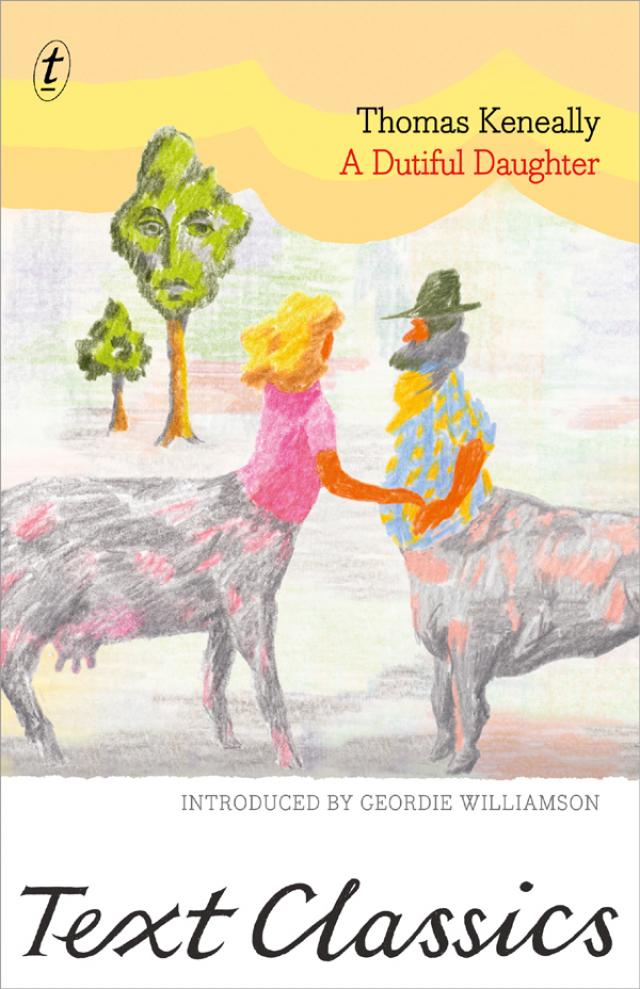
All this accumulated world data, this lustrous attentiveness, comes up hard against the sheer irreality of the truth. The Glover parents aren’t invalids; they are bovine centaurs: half human, half cattle. This transformation occurred years before, when Barbara first menstruated, a time to which the narrative circles back to describe.
The twelve-year-old Barbara has no sense of the reason for her bleeding. She believes that she is dying and spends a night in mortal fear. Only in the morning, when she commands her little brother to burn her soiled nightgown and Damian is caught in the act by their parents, is the ordinariness of her situation admitted to. Barbara has become a woman without her mother and father ever appraising her of the conditions of entry to that state. This new knowledge— of both biology and parental betrayal—is empowering in a terrible way. Having run away with her parents in pursuit, she returns to the farm and an astonished Damian hours later, leading her newly altered folks like chastened livestock behind her.
At which point, every reader of this remarkable book will ask: what does it all mean? In John Updike’s The Centaur, a partly autobiographical novel from 1963, the narrator’s father is viewed on occasion as a centaur (indeed, he is Chiron, first and best of his kind) as a way of describing the disjunction between the modest life of a Pennsylvania high-school teacher and that indivi dual’s grander aspirations, his elevated soul-station. Updike uses mythic shifts to ennoble an ordinary man.
This is not Keneally’s approach. Rather, he releases some animalistic impulse latent in the old farming couple: one a returned wartime corporal, the other a strict Catholic termagant. Are they representative of an ossified demographic, destined to be swept aside by the young? Or are they vessels of Christian suffering, admonished by the very Earth they presumed to flourish upon? In any event, the cruelties they undergo and inflict are shocking, candid, and not to be erased from the mind’s eye.
Granted full charge of the household from that early age, Barbara keeps up a wall of bureaucratic pretence that her parents are still whole and extant. She rules them, but she is trapped by them; she seals herself up in virginity and becomes obsessed by a manuscript of a mediaeval trial that has come into her possession, one that may well be a lost transcript of the legal examination of Joan of Arc. If this sounds like curious reading material for a half-educated country girl, recall the peasant ground from which the legendary French warrior-mystic emerged.
Damian’s freedom, then, is premised on his sister’s seclusion, her imprisonment. It is a heavy price, and one he loves her for paying: so much so that the pair, at one dangerous, vivid point, become lovers. Damian’s latest return to the farm throws into stark relief the choices facing them both. When Helen turns up there to claim her boyfriend, while another suitor finally breaks through Barbara’s imperious self-containment, the stage is set for a backblocks cataclysm.
Such is the weirdness of this material, it would have fallen to pieces in a lesser author’s hands. Keneally, writing at the white heat of his early and more enamelled style, resolves the issue by framing it all in terse, tidy, concise language, often uncommonly beautiful, that seems to say: believe me or not—I don’t care. The indifference, allied to the intensity of expression his creations parade, works through the logic of paradox.
As a former seminarian, Keneally had plenty of Christian theology at his fingertips during the novel’s creation. He understood the enduring power of paradox in the Christian tradition: the Trinity, the Incarnation, Christ’s hypostatic union of earthly boundedness and godlike infallibility. These are puzzles, like the disagreements between the four Gospels, that we are still, millennia later, venturing to resolve.
A Dutiful Daughter might be described as a novel built from secular paradoxes. It proceeds as social realism yet is shaped by the utmost fabulism; it raids a Western European myth kitty but its setting is antipodean. The novel swaddles its vision of ugliness, despair, wounded sexuality, filicide, madness and disease in burnished prose— it proceeds, with careful objectivity, to describe a situation of psychological extremity.
Finally, A Dutiful Daughter gestures furiously towards the world as it is—the radical politics, the emerging neoliberal moment, the decline and fall of a certain kind of Australian existence, the blowing-up of the last balustraded remnants of sexual Victorianism—while refusing to allow its perfect narrative sphere to be violated by that world’s dull contingencies.
‘Narrative voice,’ writes Davenport in the same essay— by which he means that mysterious amalgam of ‘tone, attitude, confidence’ by which a work of literature lives and breathes—‘is as characteristic of its epoch as any other style.’ In refusing to submit A Dutiful Daughter fully to time and place, Keneally kept his narrative mysterious, inviolable. This is no period piece; it is a small, strange, darkling classic, composed for the private eternity of a proper artist.
A Dutiful Daughter
For John Abernethy
It had been a thunderous spring. On Saturday, thunder again rolled over the Glover farm. Perhaps, even with four hundred of its acres swamped, it was not yet convinced of the powers of water. At the peak of her thirty best and merely sodden acres, Barbara Glover, in her kitchen, was taken by a sudden fury at the crisp network voice that said ‘further thundery showers’. She dropped the half-drawn syringe of antibiotic and ground the radio knob to off, as if the broadcaster were vulnerable at her hands. Rain, she could see, was falling on the rim of mountains down which her brother was coming home. Or was supposed to have come home—yesterday. Barbara breathed and drew herself up to quash her sick anger at his culpable non-arrival, the sick longing for his coming.
Then the syringe again.
To her right, the bottom of the half-door was closed, and the top leaf ajar. She heard from beyond the door the fractious shufflings of her father, her mother’s frequent groans. The groans were a matter of course; though not to disturb her, Barbara. It was the father who became readily anxious.
‘Barbara!’ the father roared. He sounded firm, and might as well have. There were areas in which Barbara’s dominance was absolute, and made a roar as irrelevant as a whine.
The girl sighed and laid the syringe on the draining-board again. Looking west once more through the kitchen window, she could have been thought to be love-sick.
‘Oh please,’ the mother said distantly.
Barbara lifted the syringe. In the strangely luminous gloom of the kitchen, she thumbed the plunger and saw a spurt of molten fluid rise from the needle. But even though moving towards the half-door, she seemed very indefinite about the syringe—its purpose, her intentions. It could have been a loaded brush in the hand of a painter lacking a theme.
When her hand was already on the half-door bolt, she caught a sound, the shrill of a truck in low gear. So too would her parents have heard and be hearing, their perceptions and the truck-whine growing dryly in the hollow pre-storm air. The mother groaned with the foretaste of it; her son’s holidaying eyes and ears coming within range of her symptoms, her distended glands and viscous discharges.
No one in the house moved.
There came the eking noise of brakes, and a slammed door, and the rattle of their gate being visited.
Barbara Glover’s mouth moved with a certain avidity. She looked exceptional in that any shape her slow sweet lips made was both hesitant and imperial. Her beauty, like the beat of the visiting motor, ached in the air.
She tiptoed back to the splash-board and put down, yet again, the syringe. She formed a soft word.
‘Damian,’ she said.
You are Barbara’s brother Damian sweating by the gate, waiting while a girl called Helen turns her father’s truck on the tiny road. You watch the mauve slime hiss beneath the tyres while she must reverse and turn, reverse and turn, reverse and turn again before she is pointed town-wards. You would like to distract the house’s eye from her by straightaway opening the gate and jogging up to the door. But having spent the night with Helen and suspecting yourself of loving her—or better still suspecting yourself of being unwise not to love and marry her—you feel you owe her a wave-off.
She is a gay bustling girl, the sort of trim and unamazed girl you would expect to find as features editor of the campus paper, or politicking around the students’ council, or (in despair of administrators) painting ‘Grey-Arsed Old Men Know Nothing of Revolt’ outside the staff club. She has descended from activism to take interest in you, Damian, and to cherish you for the safer part of the night in the guest-room of her parents’ house in town.
On account of the lateness of your homecoming, you feel apprehension like a rash at the back of your neck. You wonder too, watching her joyous manhandling of the truck, whether you want to be committed to this sweet little activist. You try to envisage a context in which she and Barbara could fruitfully relate. But the project defeats you.
As she leans close and tensed over the truck’s steering, her bent smile forces one from you. She leaves you with an affectionate clenched fist.
She could have a sports car, like the soft rich girls of the campus. Instead, yesterday, the two of you begged rides all the way down from your tableland university. She gave a special sauce to your homecoming, but then you had reached the town and your delight died. Fifteen miles east, on a road behind the beaches, was your own home, a journey you would have to make alone. Nor was there anywhere to kiss the girl good-bye on the wide-open streets of that hateful town; where courthouse, Methodist Church, Masonic Temple, and Caledonian Hotel all aimed their blunt faces against ripeness and the ache of the young.