

First term at fernside, p.1
First Term at Fernside, page 1


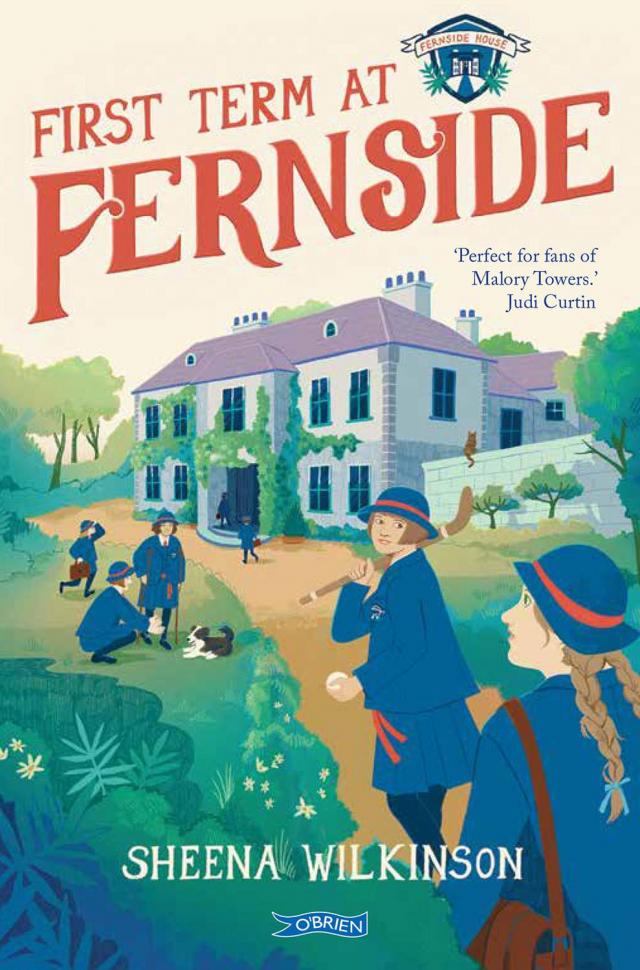
‘I loved the Malory Towers books when I was a child, and was excited to read First Term at Fernside. It’s like reading Enid Blyton – except with more warmth and kindness.’
Judi Curtin, author of the Lily and Alice novel series
‘With everything from buttery toast, cute pets and team sports, to daring escapades, forging friendships and boarding-school rules that are made to be broken. Top marks for a terrific boarding-school adventure about friendship, empathy and bravery.’
Eve McDonnell, author of Elsetime and The Chestnut Roaster
‘A joy, with all the best-loved features of Blyton’s school stories – dorm japes and fearsome matrons – but a refreshingly modern sensibility and diverse cast. An instant classic.’
Joanna Nadin, author of A Calamity of Mannerings
‘Full of quirky, fun characters struggling with everything from fitting in and making the school netball team to a mysterious animal-napper. Perfect for fans of Murder Most Unladylike.’
Alison Weatherby, author of The Secrets Act
‘The loneliness as well as the fun of being at boarding school is so realistic, and the way the girls pull together is heart-warming.’
Leila Rasheed, author of At Somerton: Secrets and Sapphires
‘A homage to the classic school story, full of debates about freedom and opening up to the wider world.’
Pádraic Whyte, Associate Professor in Children’s Literature, Trinity College Dublin
Dedication
For Elaine Fenton, with much love and thanks for many years of friendship.
From Kingscote to Fernside, and everything in between.
Contents
Title Page
Dedication
1 Back to School
2 You Can’t Cry
3 Strictly Out of Bounds
4 The First Night
5 This Little World
6 In Miss West’s Form
7 A Disastrous Breaktime
8 The Form Election
9 The Disappearing Cat
10 The Last New Girl
11 On the Riverbank
12 The Forbidden Garden
13 Waiting for the Sword to Fall
14 The New Teacher
15 An Invitation
16 Rudy
17 On the Way Home
18 Linnet’s Secret
19 Caught!
20 Where’s Mim?
21 Sadie’s Story
22 From the Attic Window
23 The Rescue
24 Madame Françoise
25 The Netball Team
26 What Linnet Saw
27 A Cry in the Morning
28 Lost Dog
29 Vanished into Thin Air
30 Under the Hedge
31 A Cry in the Night
32 We Don’t Need You
33 Plans
34 I Can’t Go
35 Rowanbank in the Morning
36 Trespassers
37 Doctor Flynn
38 Explanations
39 Second Chance
40 Team Player
41 Happy Half Term!
Acknowledgements
Other Books
About the Author
Copyright
Chapter 1
Back to School
At least Linnet would not be on the train to embarrass Robin in front of her friends. Uncle Linus was driving her all the way to Belfast in his motor car. His precious Linnet couldn’t take the train! He had offered to take Robin too, and for a grim moment Robin thought Mother would insist on her travelling with her cousin, but luckily she understood.
‘The train’s more fun,’ Robin told her. ‘We meet at the station and then an omnibus takes us all the way through Belfast to Fernside House. You should hear the noise when we all see each other again!’
‘I can imagine.’ Mother shuddered. ‘Your poor teachers.’ And then, as though there could be no doubt about it, ‘I’m sure you and Linnet will be the best of friends before the term’s out. And of course she’ll be coming here for half term.’
‘Not best friends.’ Even if Linnet hadn’t been – well, weird, Robin already had Babs as her best friend. Besides, Linnet was only twelve, and had never been to school. Robin had been thirteen for ages; they wouldn’t be in the same form.
Hopefully.
As for half term – that was two months away. No point in worrying about it yet.
‘Maybe you should know …’ Mother began, and then shook her head. ‘Doesn’t matter,’ she said. ‘Go and have a lovely term.’
Now, as the train squealed into the station at Queen’s Quay, Robin pulled her case and her precious hockey stick down from the luggage rack and grinned at Babs and the others in her carriage.
A new girl, who’d spent the whole journey staring out the window, back very straight, face very still, gathered her things with a listless air.
‘Bags the front seat in the omnibus,’ Babs said.
Third formers can’t bags,’ said Nell McGreavy, the prefect in charge. ‘Only upper fifth and above.’
‘We’re lower fourth now, actually,’ stated Babs. ‘Anyway, I always sit in the front. Last year I told the Teapot I’d be sick if I didn’t.’
‘You shouldn’t call her the Teapot,’ said Evangeline McBride. Her father was a minister so she was always searching for the good in people. ‘It’s unkind.’
‘Well, she shouldn’t go round looking exactly like a teapot, then, should she?’ Babs shook her short fair hair. ‘I’m only being – that thing Miss Rea’s always saying. Observant.’ She pushed her spectacles up her nose.
The new girl sighed.
The train came to a screeching stop and Robin flung open the door and blinked out into the steam and smoke, which cleared to reveal Miss Taylor, round and beady-eyed, waiting on the platform with a list and a frown.
‘You’re late,’ she said, as though Robin personally had been driving the train. ‘The Bangor train’s been in for ages.’
Nell stepped forward with a detailed account of a delay at Ballygowan owing to some sheep straying onto the line.
‘That will do, Nell,’ Miss Taylor said. ‘Take the girls outside – two by two please and quietly! The omnibus is waiting. Now, who’s this?’ She turned to the new girl and glanced down her list. ‘Frances Elliott?’
‘Fran.’
‘Chum with Evangeline.’
Evangeline gave Fran a broad welcoming smile, and they all trooped through the station and on to the waiting omnibus which had a cardboard sign in the front window: Fernside House.
They climbed in to a welcoming roar which subsided as Miss Taylor hauled herself aboard. ‘Settle down,’ she said. ‘You know Fernside House girls are supposed to be young ladies. Barbara Wylie – sit down at once!’
Babs looked at the two upper fifths in possession of the front seat, glanced at Miss Taylor to gauge if it was worth arguing, but Nell McGreavy gave her a not-too-gentle shove and said, ‘For goodness sake, sit. You lower fourths get worse every term,’ and Babs and Robin slid into the nearest free seat.
Since Miss Taylor was one of the strictest mistresses, the roar diminished to quiet chatter as the bus rattled along. This was Robin’s second year, and as she looked out at the narrow streets, full of carts and people rushing about – women in shawls chatting in doorways, girls swinging round lamp posts, boys trundling soapbox gliders – she thought how different this Belfast was from the area round Fernside House. Here was noise and crowds and redbricked terraced houses, and grubby corner shops, and newspaper boys leaning against walls shouting, ‘Tele!’, their big sacks of the Belfast Telegraph slung over their shoulders.
But soon the omnibus ran along by the river, past grand houses in leafy grounds, some even with their own gate lodges. Out and out they went, to the southern edge of the city, where, especially at night after the trams stopped running, you felt you were in the countryside.
Robin gave a contented wriggle at the prospect of a brand new school year.
‘Hockey this term,’ she said to Babs, who was frowning at the backs of the girls in front, talking in their earnest upper-fifth way about the new science laboratory which had been put up in the holidays. Imagine talking about lessons when you didn’t have to! ‘We must beat Ellis House!’
‘Hmm.’ Babs didn’t even pretend to like games. But Robin was almost sure to be in the junior eleven this year: lower fourths were often included, and she was one of the best players. Lucy, the games captain, had told her so last year, a moment Robin revisited again and again when she needed to cheer herself up.
Miss Taylor read out the dorm lists – Robin was in Lilac, with Babs, Fran and Evangeline, as well as another new girl and – as she had feared – Linnet.
‘What’s your cousin like?’ Babs asked. Robin was about to say ghastly, the most awful cry-baby and terribly weird, but stopped herself. It was unfair when Linnet wasn’t here to defend herself. Anyway, they would all find out soon enough, and maybe Linnet would become friends with Evangeline. Or Fran. And the more she chummed with them, the less likely she was to blight Robin’s life. So it wasn’t only kindness that made her say, ‘I don’t know her very well.’
And now the journey was nearly over! The omnibus was turning off the main road into Fernside Road, past the short terrace of whitewashed cottages, past Miss Larkin’s shop which was out of bounds except for prefects, past the three brand-new villas opposite. Soon they would pass the house which used to be a farm and still had re d gates, and then the three or four big houses similar to Fernside House.
Suddenly Fran leapt up with a yell. ‘Stop the bus!’ She started to squeeze out past a very confused Evangeline.
‘Frances Elliott!’ Miss Taylor sounded furious. ‘Are you ill?’
‘No!’ Fran pointed out the window, where a scruffy grey horse in the shafts of a cart laden with boxes and sacks was standing outside Larkin’s shop, head down, resting a hoof. ‘That poor horse! We must do something!’
The bus slowed, but Miss Taylor cried out, ‘Drive on please!’
‘No!’ Fran sounded fierce. ‘That horse needs help. We can’t just drive by.’
Robin knew what she meant: the horse certainly looked pathetic, thin and scabby, but no more so than lots of the horses you saw in the city. ‘It’s Mr Herron’s horse,’ she explained. ‘He delivers fruit and vegetables from his market garden.’
‘It’s not fit to pull that big cart!’ Fran was white with indignation, freckles standing out on her cheeks. Her blue school hat had flown off when she had jumped up, showing red hair, freshly bobbed for school like Robin’s own. ‘Look at the whip marks on its poor sides!’
Robin picked up the hat and handed it to her. ‘It’s very sad,’ she said, ‘but there’s nothing we can do.’
‘I give half of my pocket money to Our Dumb Friends’ League,’ said Evangeline. ‘You could do that if you want to help animals.’
‘That’s a good idea.’ For once Robin felt grateful for Evangeline. ‘Honestly, Fran, you can’t leap about and shout in school – you’ll get into trouble. And look – here we are!’
The bus was slowing.
Fernside House was the second-last house on the road. The very last one was Rowanbank, and as the road led only to some fields and then the river, and Rowanbank had been empty for years, the school was very secluded. Miss Rea was always telling parents how healthy and wholesome it was, and yet how close to the cultural advantages of the city. Which meant that sometimes you were taken by tram to the Municipal Museum, which was never quite as interesting as Miss Rea believed. More importantly, Robin thought, there were other girls’ schools nearby to play hockey matches against. And you had green space around too; the garden of course, and the hockey pitch and the tennis courts and – not strictly allowed, but not expressly forbidden – the neglected, glorious wilderness of Rowanbank next door.
As he approached the gateway, the driver said, ‘This here gateway’s too narrow for my bus.’
‘Never mind, we’ll walk,’ Miss Taylor said. ‘All the better to view the improvements. The exercise will do everyone good.’ She patted her own stout sides. Babs raised her eyebrows and Robin tried not to giggle.
In fact, Miss Taylor set a brisk pace, striding down the shrub-lined driveway as if marching into battle.
‘Why’s the driveway so long?’ Babs complained. ‘It’s all right for the Teapot; she hasn’t got a suitcase and a silly old hockey stick.’
‘Look, girls,’ Miss Taylor gestured ahead. ‘Our new science lab!’
And there, at right angles to the old, ivy-clad Fernside House, stood a brand-new building. Robin hadn’t thought much about the science laboratory; if she had imagined anything it was a small hut, but this was a long, red-brick building with a row of six windows and freshly painted double doors. The date 1925 was carved neatly on a stone over the doorway. Mim, the school cat, a tortoiseshell of huge proportions and disdainful expression, was licking her paws in a patch of sunlight on its doorstep and did not look up. It would take more than the arrival of an omnibus’s worth of girls to distract Mim.
The upper fifths oohed and aahed. Babs said, ‘Well, it’s nice to have something shiny and modern around this old dump.’ Only Robin seemed to see that the building took up half the hockey pitch, and the half that had not been built over was all rubbly and rough, cordoned off with a rope and warning, with a big red-painted sign: Out of Bounds.
The hockey pitch, her very favourite bit of Fernside House, had disappeared.
Chapter 2
You Can’t Cry
Linnet had expected school to be scary. But not this scary.
From the moment Daddy said goodbye at the steps of the forbidding grey, ivy-covered house that she was somehow expected to live in with dozens of other girls, it was nothing but bustle and noise and orders, and scampering, scampering, scampering to keep up – and all the time a painful refrain throbbed in her heart.
You can’t cry. You can’t cry. You can’t cry, it beat out as she scurried to unpack her things into the top two drawers of the scuffed chest beside her bed – her cousin Robin was to have the neighbouring bed and the bottom two drawers.
You can’t cry, it warned when Matron, all starch and disapproval, said that she had never met a girl so clumsy and to pick up her underclothes from the floor this instant.
You can’t cry, it reminded her when an older girl called Lucy helped her to carry her trunk out to the door of the dormitory to be picked up and taken to the trunk room. Lucy was obviously being kind when she said how exciting for Linnet’s parents to be going abroad; she couldn’t have known how the words would stab and gouge. Only a year, Daddy said. Not long, Mummy had added.
A year was forever. She had been at Fernside House for – she checked her new wristwatch – forty-seven minutes, and already she longed to leave with an ache so fierce that she couldn’t even think the word home without tears pushing at the backs of her eyes.
Home! The quiet house with everything familiar and cosy, where she knew how to be without even thinking. Lessons with kind Miss Devlin, and her own books and best of all, her garden. She couldn’t bear to think of what would happen to it without her – her roses unloved, her strawberries uneaten – well, the birds would enjoy them, that wasn’t so bad. You can’t cry. You can’t cry. She looked round the bedroom – dormitory, she must remember to say – and wondered if it would feel friendlier or scarier when full of girls. She counted the beds: six. How could she sleep with five other girls? The only one she knew was Robin, but she hadn’t seen her for ages.
‘What on earth are you doing still in the dormitory?’ Matron filled the doorway, arms full of towels, apron crackling. ‘Did I or did I not tell you to go to the junior common room to wait for the train girls?’
‘You did, but I couldn’t remember …’
‘Bottom of the stairs, third door on the left. Opposite the portrait of Miss Burn. You can’t possibly miss it.’
Linnet wasn’t so sure, but she trailed out of the room and tried to remember how to get to the stairs. She frowned. Right, she thought, past some doors, and then …
‘Back stairs!’ called Matron, as if she had eyes in the back of her head, and Linnet turned and scuttled on – anywhere, just to escape. Maybe there would be a bathroom she could hide in until she calmed down. Oh, all these doors! They all looked the same! She flung one open at random, but it was only another dormitory, empty and silent, lace curtains fluttering in the open window. Little whines were starting at the back of her throat; she despised herself, but she was powerless against them, and her cheeks were already damp. Another second and she’d be properly sobbing, and in what Mummy called one of Linnet’s states.
A commotion somewhere below. A stern shout: ‘Girls! I know you’re excited to be back, but there’s no need to sound like harridans. Up to the dorms straight away. You all know where to go. Evangeline, look after Fran.’
‘Of course, Miss Taylor.’
‘Back stairs, Barbara Wylie.’
All the names! All the noise! And now a ferocious clatter of shoes and giggles and the corridor gushed with girls – not the trickle who, like her, had arrived in ones and twos by car, but dozens, more girls than she had seen in her whole life, all chattering at the tops of their voices.
‘Bags the bed by the window!’
‘We’re in Rose again! Bags not the bed with the saggy mattress.’
Linnet pressed herself against the wall and let them stream past. Most of them glanced at her, some smiled, but all were too excited to stop for a tear-stained new girl. And then, into the sea of bright unknown faces, the brown and red and fair bobbed heads, swam a face she knew, a face surrounded by the same straight mousey hair as her own, and with the same green-flecked eyes.






