

The barbarian swordsmen, p.1
The Barbarian Swordsmen, page 1
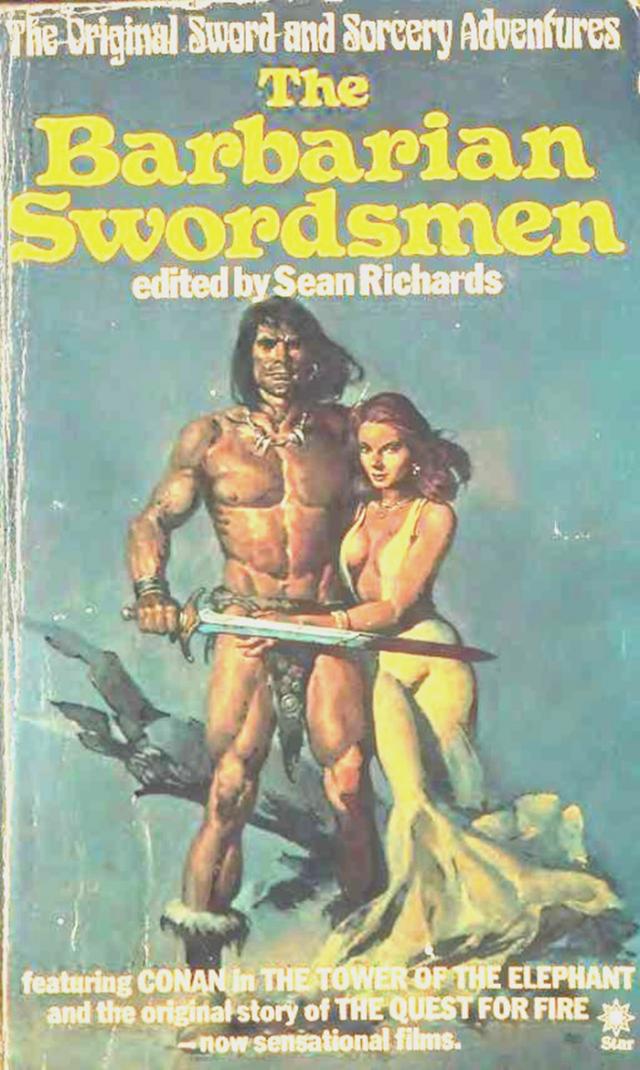


11-12-2024
Converted from a new scan of the :
Star Edition from 1981
THE BARBARIAN SWORDSMEN
It was Conan’s savage instinct which made him wheel suddenly; for the death that was upon them made no sound. A fleeting glance showed the Cimmerian the giant tawny shape, rearing upright against the stars, towering over him for the death stroke. No civilised man could have moved half so quickly as the barbarian moved. His sword flashed frostily in the starlight with every ounce of desperate nerve and thew behind it, and man and beast went down together.
Cursing incoherently beneath his breath, Taurus bent above the mass and saw his companion’s limbs move as he strove to drag himself from under the great weight that lay limply upon him. A glance showed the startled Nemedian that the lion was dead, its slanting skull split in half.
THE BARBARIAN
SWORDSMEN
Great Stories of Heroic Fantasy
Edited by Scan Richards
Star
A STAR BOOK published by the Paperback Division of
W. H. ALLEN & CO. LTD
A Star Book
Published in 1981 by the Paperback Division of
W. H. Allen & Co. Lid
A Howard and Wyndham Company
44 Hill Street, London W1X 8LB
This selection and introduction
Copyright © Sean Richards, 1981
Typeset by Computacomp (UK) Ltd, Fort William, Scotland
Printed in Great Britain by
Hunt Barnard Printing Ltd., Aylesbury, Bucks.
ISBN 0 352 30831 1
This book is sold subject to the condition that it shall not, by way of trade or otherwise, be lent, re-sold, hired out or otherwise circulated without the publisher’s prior consent in any form of binding or cover other than that in which it is published and without a similar condition including this condition being imposed on the subsequent purchaser.
ACKNOWLEDGEMENTS
The editor is grateful to the following authors, agents and publishers for allowing copyright stories to appear in this collection: Bibliotheque Charpentier, Paris for the extract from La Guerre du Feu by J. H. Rosny, translated by Pamela Chamberlaine; A. P. Wan Ltd for The Sword of Welleran by Lord Dunsany; Glenn Lord, Conan Properties Inc and Neville Spearman Ltd for The Tower of the Elephant by Robert E. Howard; Glenn Lord, Executor of the Howard Estate for Brachan the Kelt by Robert E. Howard; The Author for Jirel Meets Magic by C. L. Moore; A. D. Peters Ltd for Spawn of Dagon by Henry Kuttner; The Author’s Estate for The Thief of Forthe by Clifford Ball; The E. J. Carnel Literary Agency for The Two Best Thieves in Lankhmar by Fritz Leiber.
For
FRANK PARNELL
—who has shared many a story and sunk many a pint with me.
Contents
Introduction
The War of Fire
The Sword of Welleran
The Tower of the Elephant
Brachan The Kelt
Jirel Meets Magic
Spawn of Dagon
The Thief of Forthe
The Two Best Thieves in Lankhmar
The Man Who Infuenced Robert E, Howard
Introduction
The myths and legends of prehistoric man that have been passed down to us over the centuries hint at nations and peoples that have risen, seen great glories and triumphs, and then vanished into the mists of time as if they had never existed
—lost for ever except in the fragments of those old traditions. Because our power of speech and our ability to record history is of only a comparatively recent date, we know precious little of those early civilisations, and even what the folk tales tell us is often dismissed by scholars as being little more than oral traditions already embroidered with fantasy long before they were first committed to record.
Such arguments are, doubtless, well founded, but the human mind still contains so many uncharted areas that who is to say that there is no truth at all in the old stories of men of great courage who went out to face the dangers of the world about them—a world bounded far more closely by the darkness and unknown perils than our modem world—and thereby inspired great legends? Not I for one—nor the authors in this book who have utilised just such ancient traditions to create a literary genre known generally as Heroic Fantasy or more specifically as Sword and Sorcery Fiction.
To define these stories precisely is not an easy matter, but perhaps the best definition of them was given by that doyen of American fantasy editors, Hans Stefan Santesson (1914-19753 in an essay he published about Sword and Sorcery Fiction in 1975. ‘Sword and Sorcery stories/ he wrote, ‘are extrapolations from the known and the half- known* recreations of long-forgotten worlds which we have reason to believe existed in the long distant past, but of which nothing remains, nothing tangible, nothing which can be touched or felt or weighed in the hand. Nothing but that intangible something within the memory of the race which it is easy enough to dismiss as a folk myth if, in common with most people, you know nothing of history—yours and that of those who came before you.’
In this same essay, Mr Santesson also shows us that it is not hard to find the roots of our own modern Heroic Fantasy if we look carefully enough at these beginnings of race memory: ‘Over the centuries—over the millenia—the adventures of known and remembered men became the hero-sagas, sung or recited over leaping fires, exhortations to the young to in some measure equal the achievements of these heroes, warning to the common enemy that the traditions of the singers were the traditions of men of giant stature and of incredible valour.’ And those words fairly summarise the concept of all the adventures you will find in this book, I believe.
By their definition of Sword and Sorcery stories, there is another important element to them beyond the hero’s ability to wield his sword or weapons to great effect—that is the practising of magic powers that work. I stress the word ‘work’ for in very many instances the hero must achieve his ultimate victory by overcoming the supernatural capabilities that magicians and wizards are believed to possess. These powers are not just hinted at as in most other types of fantasy stories, but invariably shown in terrible and often deadly operation. And bearing this in mind, we can see that the reader of Sword and Sorcery is not only transported to lands he may scarcely credit exist, but must also suspend any disbelief he might have about the power of necromancy and the other dark arts of the occult. If he can, then this genre is as mightily rewarding and exciting as its heroes.
I cannot, of course, pretend that this is the first collection of Heroic Fantasy or Sword and Sorcery. The very fact that tales of this kind have been appearing for getting on towards a century now, makes any such suggestion a nonsense. But apart from containing what I believe to be some of the very best stories of their kind which are also not readily available elsewhere, this book does have three special features which make its appearance at this moment in time most appropriate.
Firstly, after all these years of existence, the cinema is at last bringing Heroic Fantasy and Sword and Sorcery to the screen —and not one story, but two, both of which are represented here: ]. H. Rosny’s classic work ‘The War of Fire5, and Robert E. Howard’s great Co nan adventure, ‘The Tower of the Elephant’. I shall be discussing these stones and the films in which they are featured in a moment.
Secondly, although most experts on Heroic Fantasy consider that the founding father of the modern genre was the distinguished Irish author, Lord Dunsany (who is, of course, reprinted herein), I personally believe this honour belongs to the earlier and sadly neglected French writer, ]. H. Rosny, one of whose stories—as I just mentioned—has been filmed. Forty years after his death I think it is time to put the record straight.
And, thirdly, the book prints for the very first timer a Sword and Sorcery story ‘Brachan the Kelt> by Robert E. Howard which has lain in manuscript form since his death—as well as revealing in Howard’s own words that one of the strongest influences on his work was the British essayist and poet, Alfred Noyes, the centenary of whose birth has just been celebrated.
These three special features, then, plus the range of the stories from Rosny’s pioneer tale to a contribution by the man who is perhaps the genre’s greatest current practitioner, Fritz Leiber, does, I believe, make this volume rather different to its predecessors. I hope you will agree.
Before beginning the stories, there are a few remarks about them and their authors which I think are of some importance, and which can more conveniently be discussed here than immediately in front of each item.
The anthology begins with a story by the Frenchman known as J. H. Rosny aine (the elder) who, around the turn of this century, wrote a series of five novels set in prehistoric times which I believe effectively founded the genre of Heroic Fantasy. The name J. H. Rosny was actually the pseudonym of a man named Joseph Henri Boex (1856-1940), who it though he lived much of his life in France was actually bom in Belgium. An imaginative and prolific writer, he was in many respects the equal of Jules Verne, writing tales of fantasy, lost worlds, prehistory and even early Science Fiction, yet he enjoyed only a fraction of his fellow countryman’s success and none of his lasting fame. For a time he collaborated with his younger brother, Justin, both of them sharing the J. H. Rosny pen-name, which was why the elder brother adopted the suffix to distinguish his work. The five ‘prehistoric romances* (as he called them) which Rosny wrote were entitled Vamtreh (1892), Eyrimah (1893), ^ Guerre du Feu (1909), Le Felin Geant (1918) and Helgvor du Fleuve Bleu (1930
La Guerre du Feu, or ‘The War of the Fire’, is a splendidly authentic recreation of life some 80,000 years ago, and features a mighty hero named Naoh of the Oulhamr tribe. His quest to find the Fire which his tribe needs for light, heat, cooking, and protection against enemies and wild animals, as well as the power to enable them to forge their weapons, is graphically told, even if the style is a little stilted by today’s standards. Rosny was deeply interested in anthropology, zoology, and sociology, and he combined careful research into primitive limes along with a vivid imagination in the creation of this story and the others which feature the mighty Naoh. His warrior is the architypical Barbarian hero, heavy-featured but handsome, with a strong jaw, bulging muscles, powerful legs, and he is a skilled fighter endowed with ample courage and daring. Indeed, he has all the features so beloved of later writers in the Sword and Sorcery genre. In the extract from ‘The War of Fire* which opens the collection, Naoh, accompanied by two other young warriors, is tracking down a fearsome tribe of cannibals who are believed to be in possession of some of the precious Fire. His plan is to take some of the brands of flame from them for his tribe at whatever cost…
As I said earlier, this story has just been filmed as ‘Quest for Fire’, and the picture is remarkable in that it recreates the prehistoric period not only through clever make-up of the actors, but also by their using a special primitive language which has been developed by the novelist Anthony Burgess.
Rosny’s story is followed by ‘The Sword of Welleran’ (written in 1908), a superb tale of Heroic Fantasy by the man often credited with founding the genre, Edward John Moreton Drax Plunkett, 18th Baron Dunsany, better known as Lord Dunsany Cl 878-1957). Dunsany, like Rosny, was a master of language which he used adventurously and colourfully to recount exciting exploits in strange places, and like the Frenchman had to wait years before his talent was recognised. Unlike Rosny, though, he is today world-famous and many of his books are in print. As a person, Dunsany was something of a man of action, being a noted sportsman, outstanding wildlife hunter and adventurous traveller, and his love of exotic locations and weird legends is reflected in many of his sixty-odd books. It is perhaps not surprising that Lord Dunsany, who was over six foot tall and renowned for his fiery temper, should have been inspired to tell stories of mighty swordsmen, for one of his ancestors had been a robber baron in Drogheda, and he actually lived in a Twelfth Century Castle in County Meath. My favourite of all his stories of Heroic Fantasy is the tale of the mighty Welleran of Merimna and hence it is included here.
Lord Dunsany was not surprisingly an influence on the most famous writer of Sword and Sorcery, the ill-fated American, Robert E. Howard (1906-1936). Howard lived a short but prolific life in the small Texas backwater town of Cross Plains, pounding out highly imaginative stories on a variety of subjects for the ‘pulp’ magazines of the twenties and thirties until, in a moment of depression after learning of the imminent death of his mother, he committed suicide by shooting himself. Although he was popular with his readers, Howard was hardly financially successful—though since his death he has become a cult figure on a par with H. P. Lovecraft (with whom he corresponded) and acknowledged as one of the most important contributors to the legendary horror magazine, Weird Tales. It was in the pages of that magazine that he introduced Conan, a Barbarian warrior from Cimmera, the like of whom had not been seen before and whose adventures are now regarded as the cornerstone of the Sword and Sorcery genre. Speaking of his creation later, Howard said, ‘The man Conan seemed suddenly to grow up in my mind without much labour on my part, and immediately a stream of stories flowed off my pen almost without effort.’ In all, Howard wrote 17 stories of the mighty warrior which appeared in Weird Tales between 1932 and his death (four more were published posthumously), but since then he has become the centre of an industry, his adventures continued by other writers and artists in magazines, books, comics and, most recently, in a film, ‘Conan the Barbarian’. This multi-million dollar epic starring the former ‘Mr Universe’ title-holder, Arnold Schwarzennegger, utilises two of Howard’s stories in the script by John Milius, ‘The Tower of the Elephant’ and ‘The Thing in the Crypt’. The first of these, which appeared in Weird Tales in March 1933, is included in this collection.
Robert Howard also created a number of other Sword and Sorcery characters whose adventures have also subsequently become very popular including King Kull, Bran Mak Morn and Solomon Kane. What is not generally known is that he had plans for yet another Heroic Fantasy figure in the shape of a brave and adventurous warrior called Brachan the Kelt. Howard was, of course, fascinated by the ancient Celts, and during his short life made a close study of Celtic history, anthropology, archaeology and mythology, which is vividly reflected in his work. (For example, although Conan was not a Celt, his people, the Cimmerians, are said in the stones to be the remote progenitors of the Celts.) Shortly before his death, he began work on a story about Brachan, who, the evidence suggests, might well have become a rival of Conan if Howard had lived longer and developed him further. It is all conjecture, needless to say, but by courtesy of Glenn Lord,
Howard’s literary executor, I am able in these pages to give first publication in book form anywhere to ‘Brachan the Kelt’ e—a story which I find all the more fascinating because it is told in the first person by a modem man remembering a previous existence as a Barbarian. Could it represent a secret conviction or wish of Howard himself, I wonder? In any event, it is an item I am sure no Howard collector will want to be without. And I also believe everyone will be fascinated by the letter from Robert E. Howard to H. P. Lovecraft which appears as an Appendix to this book and in which he discloses that an important influence on him was Alfred Noyes, the British essayist, poet, and short story writer.
The first author to follow in the footsteps of Howard’s Conan was, perhaps surprisingly, a woman who created a remarkable female rival for the Cimmeran. She was Catherine Moore (1911- ) who signed herself enigmatically as C. L. Moore, and gave to Sword and Sorcery the beautiful Jirel of Joiry who first appeared in the pages of Weird Tales in 1934. Miss Moore had actually already made her mark with readers the previous year with a story based on the legend of Medusa called ‘Shambleau’ which introduced a star-rover called Northwest Smith—but it was the series of tales about the Barbarian swordswoman Jirel which secured her fame. Although Jirel was pictured in Weird Tales wearing the obligatory copper brassiere and negligee-type garments, she was actually a brave and resourceful warrior who commanded the strongest fortress in the kingdom of Joiry. With her clever mind, quicksilver sword arm and distracting beauty, she proved herself more than a match for any adversary—warrior or magician—in the half dozen stories which C. L. Moore subsequently wrote between 1934 and 1939. The best of these is, I think, ‘Jirel Meets Magic’ (1935), which provides something of a change of pace from the stories which precede it in this collection, in that it features in particular the kind of sorcery that gives Sword and Sorcery the other half of its definition.
Another important contributor to the early development of the genre was Henry Kuttner (1914-1958), who was becoming regarded as one of the very best fantasy writers at the time of his sudden death from a heart attack. In 1940 he had married our previous contributor, Catherine Moore, and together they produced a number of stories of fantasy and Science Fiction which remain unsurpassed today. Like his wife, Henry Kuttner began his writing career in the pages of Weird Tales and scored a notable success with his very first contribution, the grisly tale of ‘The Graveyard Rats* (1936). It was in 1938 that he decided to try his hand at creating a hero in the Conan mould, and came up with Elak, a dashing, brawling adventurer from Cyrena, the northernmost kingdom of the lost continent of Atlantis. Elak, along with his drunken and generally useless companion, Lycon, first appeared in a two-part serial, ‘Thunder in the Dawn* in May and June 1938, and then in three further adventures, of which I have picked the second, ‘Spawn of Dagon* (1938). It gives a vivid picture of Atlantis as visualised by Kuttner and a dramatic confrontation between Elak, an evil wizard called Zend and a gruesome battalion of fish-men.






