

La petite mort, p.1
La Petite Mort, page 1
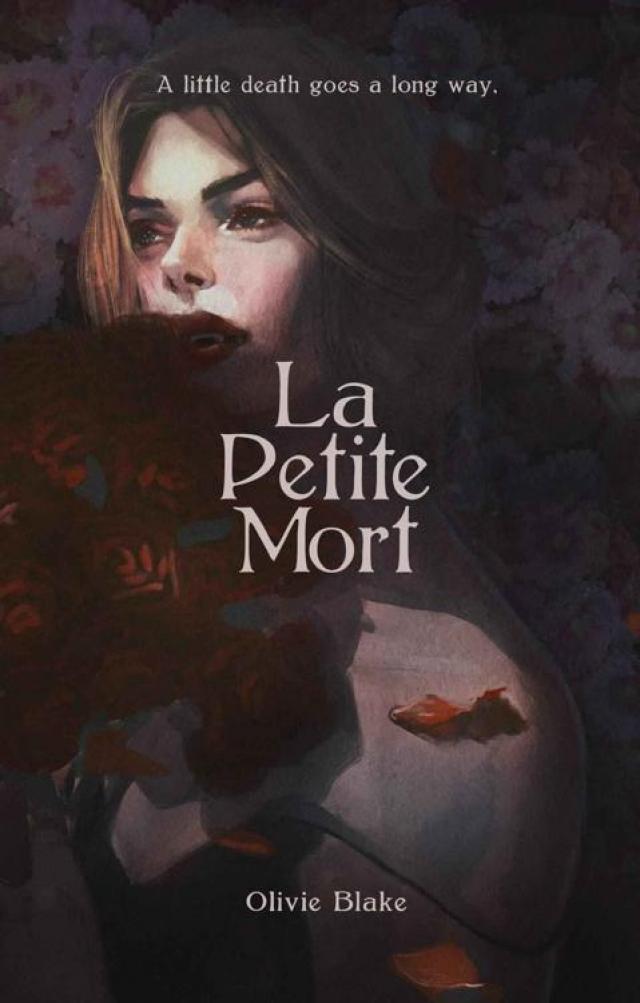


LA PETITE MORT
Olivie Blake
ALSO by
OLIVIE BLAKE:
Masters of Death
Lovely Tangled Vices
One For My Enemy
Fairytales of the Macabre
(Fairytale Collections, Vol. I)
Midsummer Night Dreams
(Fairytale Collections, Vol. II)
The Lovers Grim
(Fairytale Collections, Vol. III)
By OLIVIE BLAKE and
LITTLE CHMURA:
Alpha
Alpha, Vol. II: Rising
First Printing, 2019
Witch Way Publishing
9090 Skillman St, #182-A/203
Dallas, TX 75243
www.witchwaypublishing.com
Copyright © 2019 by Olivie Blake
Image Copyright © 2019 by Little Chmura
Editor: Tonya Brown
Cover Illustrator: Little Chmura
Cover Designer: Olivie Blake
All rights reserved. This book or any portion thereof may not be reproduced or used in any manner whatsoever without the express written permission of the publisher except for the use of brief quotations in a book review.
Printed in the United States of America
ISBN 978-0-578-5552-01
For Tonya and Aurora, my tireless editors,
and for every girl who only smiles to show her teeth.
TABLE of CONTENTS
PART I: The Caretaker
PART II: The Alchemist
PART III: The Casket Girl
PART IV: The Entrepreneur
PART V: The Ghost
PART I: The Caretaker
“Is this goodbye?” whispered Elisabeth, clinging to the meager fabric of Jacques’ shirt. Like the two of them, the garment was torn and dirtied, left to ruin with no promise of mending. “I don’t know that I can bear it.”
“Goodbye? Never. I’ll find you,” promised Jacques, gallant in his impossibilities; ever brave, ever clever, ever handsome. They had always known they could never be together—he the penniless rogue, she the forsaken orphan—but in the moment, she longed to believe a different truth. “Whatever it takes, I will make my way to you in the New World, Elisabeth. And if I die trying,” he swore, gathering her in his arms, “then I will have spent my last breath declaring my love for you.”
Already, Jacques’ quick hands were coveting her bodice; soon, her desire would overtake her will to refuse. “But where will you go? How will you find me?”
“Wherever I have to go. However I have to do it.” His certainty stole her breath. “I’ll go as far as my feet can take me, Elisabeth; out of Paris, out of France, and into your arms.”
His lips, heated with devotion, met hers with the force of a gasp, tangling their bated breaths. This would be goodbye, perhaps forever. She would sail for America tomorrow, leaving her world behind, and as proof of her love, there would be only this: a single, fragile moment of pleasure to last a lifetime.
Desperately, Elisabeth took hold of Jacques’
“Marisa!”
Marisa looked up, startled, as her sister Alicia’s elbow landed squarely in her ribs.
“Give me that,” Alicia hissed, swatting the book from her hands. “You’re going to miss everything—”
“Leese, no,” Marisa groaned quietly, struggling to mark her page as Alicia tugged it from her fingers. “Come on, I’m nearly finished, I just want to know how it ends—”
“How else? Marriage, babies, happily ever after,” Alicia said with a roll of her eyes. “It’s a romance book, it’s all the same every time!”
“Okay, first of all—”
“—now, all of this is quite silly, of course,” their guide was saying loudly, “as in truth, the moniker ‘casket girls’ is little more than a mistranslation of ‘fille à la cassette,’ or ‘casquette.’ The girls were brought over from France by decree of King Louis XIV in an effort to populate the territory of Louisiana during the early eighteenth century. However, much like the game of telephone, the word ‘casquette’ soon mutated into the idea that these women were carrying caskets—as in, yes, cases for corpses—which was quite sensational to the colonists who lived there. In reality, the casket girls were young women sent to the Ursuline Convent to await a proper husband, but rumor soon spread that the girls had been infected by a particular kind of creature. A vampire,” the guide finished, leaving space for a dramatic pause, “causing them to crave human blood. Now, as many of you already know, New Orleans is positively steeped in supernatural lore—”
“See? Listen,” Alicia said in hushed admonishment, giving Marisa another shove. “It’s history, it’s interesting, pay attention. You might need to know this someday.”
“What on earth would I need to know this for?” Marisa whispered. “They don’t make you take a history test to live in New Orleans, Leese, and besides, those girls weren’t vampires. The blood thing would have come from tuberculosis—not to mention,” she scoffed, “a bunch of young women with no parents, sent to a new country without anyone’s protection? They were probably forced into prostitution.” She snatched the book back from her sister, concluding, “I’d rather spend my Saturday with Elisabeth and Jacques, thanks.”
“Life with a liberal arts major, honestly,” Alicia sighed to herself, relinquishing the book with a roll her eyes. “Shouldn’t you be fundamentally opposed to romance novels, anyway? Aren’t they anti-feminist or something?”
“Don’t be ridiculous. The heroines in these books have agency, and—”
“Ladies,” the tour guide prompted, waiting expectantly for them to look up. “Am I boring you?”
“Sorry, um… Genevieve,” Alicia said, squinting down at the gleaming letters of the guide’s name badge. “We were just discussing how fascinating this all is. We’re Creole,” she added, gesturing to herself and Marisa. “Or, you know. Kind of. Our dad is. We were raised in Boston,” she clarified, obviously unable to stop herself once she’d started, “but we have family from NOLA. In the French Quarter, actually.”
“Interesting,” Genevieve said, though she looked fairly unimpressed. “Are you familiar with the French Quarter, then?”
“Oh, no, not at all,” Alicia said warmly, always quick to engage with strangers. Probably why she was a lawyer, Marisa thought with an internal grumble, while Marisa was mostly adrift. “But my sister just inherited a house there, so, you know. Trying to learn everything we can before she becomes a resident and all that—”
“Well, then I suggest you listen,” Genevieve remarked with a mostly-false smile, and Alicia’s mouth, which had paused mid-sentence, quietly snapped shut, becoming the stubbornly-set jaw Marisa knew to be far more representative of her combative older sister. “Anyway, as I was saying. The third floor of the convent is where there were supposedly creatures, which many have come to believe were vampires—”
“That was totally uncalled for,” Alicia muttered to Marisa, irritated now. “You should probably go back to your book while I meditate on not getting into a fight with the snippy tour guide.”
“Do you think she’s French?” Marisa asked, eyeing Genevieve’s features, which now leaned more snobbish than lovely after her retort to Alicia. “I wonder if they pick girls who look French on purpose, just to add to the aesthetic.”
“—third floor has windows that were said to be nailed shut,” Genevieve went on, her voice slightly raised with each word, “with each nail blessed by the Pope himself—”
“You’re right, this is stupid,” Alicia grumbled to Marisa, glancing around and fidgeting. “Want to get coffee after this? I saw a cute little cafe when we walked over. Something croissant-adjacent, I think.”
“Sure,” said Marisa, opening her book and resuming her intensive study of what, exactly, Elisabeth was about to desperately do to Jacques.
“Are you sure you can’t stay longer?” Marisa lamented, lounging in their hotel room that afternoon after a somewhat exhausting trip down Bourbon Street. “According to Yelp there’s some kind of vampire speakeasy somewhere. Since you’re so into vampires,” she added, rolling over to make a face at Alicia, who sighed.
“I’m not into vampires, I just thought, you know, when in NOLA—” She trailed off, frowning at her suitcase. “Did you borrow my bralette?”
“No,” Marisa lied, “and are you listening? I don’t want you to go. Frankly, I’m a little concerned about what’s going to be inside Grandma’s house,” she said with a shudder. “Dad always said it was cluttered and weird.”
“Dad only lived there until he was three,” Alicia reminded her, still searching fruitlessly for her clothes. “I think most of what he remembers seeing was in his imagination.”
Their father, Luc, had little to say about his New Orleans origins, actually, having lived in Boston nearly all his life. Their grandfather, Lucian, had never spoken on the subject, or about his life in New Orleans at all, until the day he died. All that existed for evidence of the family’s Southern past was Marisa’s Creole complexion, and a single photograph from their father’s birth: baby Luc wrapped up in Oscalia Marrero’s arms.
Privately, Marisa had always thought the grandmother she’d never met had a strange look on her face in the picture. Her smile was guarded; almost as if she had seen a ghost somewhere on the other side of the camera lens.
“Still,” Marisa sighed, flopping onto her back again. “Weird she would leave it to us, isn’t it? Considering Dad never even heard from her after Grandpa died.”
“Well, she never left her house,” Alicia said, adding thoughtfully, “I think she was one of those agoraphobes.”
“Ugh. Which means her house is going to be cluttered.”
“Your house, you mean.”
“Ours!”
“Yours,” Alicia corrected. “She left it to one of the Marrero sisters, not both. It’s pretty valuable real estate,” she reminded Marisa, still trying to make the best of things. “I looked it up on Zillow and it’s worth millions, probably. Or would be, if it had ever been sold—and which I’m selflessly giving up,” she teased, knowing full well she had a perfectly sufficient house in Boston and a law career that paid far more than she needed, “so you’ll have to stop complaining.”
“But—” Marisa sighed. “Can’t you at least come with me before tomorrow? I’m going to need help, probably. Boxes and things.”
“I wish I could, but unfortunately the partners were pretty clear,” Alicia said. “I have to be on a flight tonight.”
“Yeah, but—”
“And besides, the will’s stipulations are unavoidable.” Alicia rose to her feet, falling beside Marisa on the bed. “Weird as it is, you can’t enter the premises until the eve of a new moon. So, tomorrow is the earliest.” She reached over, tapping Marisa’s knuckles fondly. “But I’ll be back as soon as I can, promise. And it’s not as if you haven’t lived alone before, right? Just get a good alarm system and, I don’t know. A dog or something.”
“Yeah, yeah,” Marisa mumbled, feeling immensely childish.
She had lived alone, until Paul. And that had been seventeen months of a pretty good thing that abruptly ended along with his MFA program, when he’d packed up for a writing residency somewhere in the woods of the Dakotas. Marisa, who’d never quit the waitressing job she’d taken to pay for her tuition, had found herself out of an apartment and a plan until the day the lawyers informed her family that Oscalia Marrero, the estranged mother of Alicia and Marisa’s father Luc, had passed away. Oscalia had left all her belongings, including the house on Royal, not to her son, but to whichever of her two granddaughters was willing to follow her instructions to the letter. Alicia—who was married, taking prenatal vitamins, and on track for a promotion within her firm—wasn’t particularly enticed by the prospect of moving to a totally new city where she knew absolutely no one. Marisa, on the other hand, considered it her personal Eat, Pray, Love.
Now that she was actually here, though, she wasn’t so sure. She and Alicia had stopped by the previous day to look at the outside of the house, only to find it was so narrow and inauspicious they passed it three consecutive times. Not that Marisa had been expecting to receive one of the beautiful buildings with the trellises and the brick and the charming planters, but the teeny-tiny Creole cottage with its dingy blue shutters and peeling white paint wasn’t exactly what she’d hoped to find.
Alicia sighed, rolling over to face Marisa. They were close, despite their five-year age difference, and in spite of the fact that they hardly looked like sisters. Alicia was tiny and petite, with skin that looked permanently tan and hair that, as a child, had been perfect silken ringlets. Marisa, by contrast, was a too-tall, too-thin, hipless and breastless Amazonian with wild, natural hair and a set of hazel eyes that made the question “What are you?” the bane of her existence.
“You’re going to be fine,” Alicia said, patting the top of Marisa’s head. “This is your chance to start over, start fresh. Who knows? Maybe you’ll actually have an adventure instead of just reading about them,” she advised, gesturing to the book Marisa had left on the nightstand. “And hey, maybe you’ll meet someone.”
Despite being a romantic at heart, Marisa wasn’t particularly keen to admit it. “Who says I want to meet anyone?”
Alicia gave her a doubtful look.
“I’m working on me,” Marisa said defensively. Which she was.
Mostly.
“Fine,” Alicia permitted, doing Marisa the favor of not voicing her skepticism aloud. “Then at the very least you won’t have to pay rent for a year. After that, if you don’t like it here, you can always sell the house. We’ll figure it out. But in the meantime,” she sighed, glancing reluctantly at her watch, “I do have to head to the airport, so—”
“You go ahead,” Marisa said, not particularly wanting her sister to worry about her. She was, after all, an alleged adult. “I’ll just… wander a bit. And I’ll FaceTime you tomorrow, after I’ve gone into the house.”
“Perfect.” Alicia leaned forward, tapping Marisa’s nose. “I’ve got a really good feeling, you know. I think this is going to be a fun year for you. Besides,” she added brightly, “maybe you’ll meet a vampire.”
“Doubtful,” Marisa said. “I’m pretty sure the only bloodsuckers in the Deep South are the mosquitos.”
“Well,” Alicia replied, “I suppose you’ll just have to find out.”
Marisa wasn’t particularly in the mood for hanging out in an empty hotel room on a Saturday night, so she decided to make her way down Bourbon Street, checking out what would soon be her new home. It was populated mostly by tourists, which was unsurprising, but the whole street had an invigorated feel to it; alive, despite the touted presence of the lingering undead. A trip to Boutique du Vampyre offered up a book about the history of vampires in New Orleans and an invitation to the supposed vampire speakeasy, all which seemed to be part of a kitschy tourist experience Marisa didn’t particularly have the energy to fight. In the end, she took the password and the book and wandered over to the bar for a nightcap, still considering it better than being at the hotel alone.
The bar’s aesthetic was commendable; the stained glass, the ‘break in case of emergency’ stake, the attention to detail, the moderately shifty patronage amid people squealing over love potions… it was all very well done, if a bit overwrought. Marisa settled herself in a corner near the balcony, sipping her absinthe cocktail (one would be enough; she could tell as much after a single swallow) and glancing over the book she’d purchased, accidentally knocking shoulders with someone who was passing by.
“Sorry,” she said, distractedly shifting for more space.
“Should keep a closer eye on your surroundings,” replied a silken female voice, prompting Marisa to look up from the page she’d been reading about a rather monstrous woman named Madame Blanque. “You’ll want to be careful around here.”
A young woman, hair pulled up in a high ponytail and wearing a pair of skinny black jeans with a velvet tuxedo blazer, was giving Marisa a slow, steady once-over. She wasn’t particularly near Marisa’s height, bordering on diminutive; with the way her chin was lifted, though, she managed to dominate the space between them, probably owing to the superiority of her clothes. And her shoes. And her face.
The girl’s lips slid into a careful, meticulously crafted smile as Marisa blinked, a little taken aback at the attention.
“Why,” Marisa asked, and then, in an attempt to joke, “Because of the vampires?”
The girl’s hair was an ashy brown-black, her brow a similar darkness, pulled back to reveal a crisply unfurrowed forehead and nose that sloped up from a high bridge. She wore little makeup save for the precise line of her jet black cat-eye and a red lip that was, as Alicia would have probably sniffed, too dark for her ivory complexion. If it weren’t for the shape of the girl’s mouth (or for that odd smile), she would have looked quite severe. Instead, the upturn of her too-red lips was girlish, a little beauty mark above her mouth lending a sense of innocence to her otherwise unsettling air.
“No,” said the girl. “Because men are trash, and at least three of them have been staring at you since you walked in.” She angled Marisa slightly to the left, gesturing over her own shoulder. “There’s Ed Hardy over there,” she said, referencing a man in a deep V-neck who was covered with tattoos, “and Slimeball McGee at six o’clock. Last but not least, there’s pale, sweaty white guy,” she said, tipping her head to the right, “who looks like the kind of dude to make you think twice about leaving your drink unattended.”






