

Freedom songs, p.1
Freedom Songs, page 1
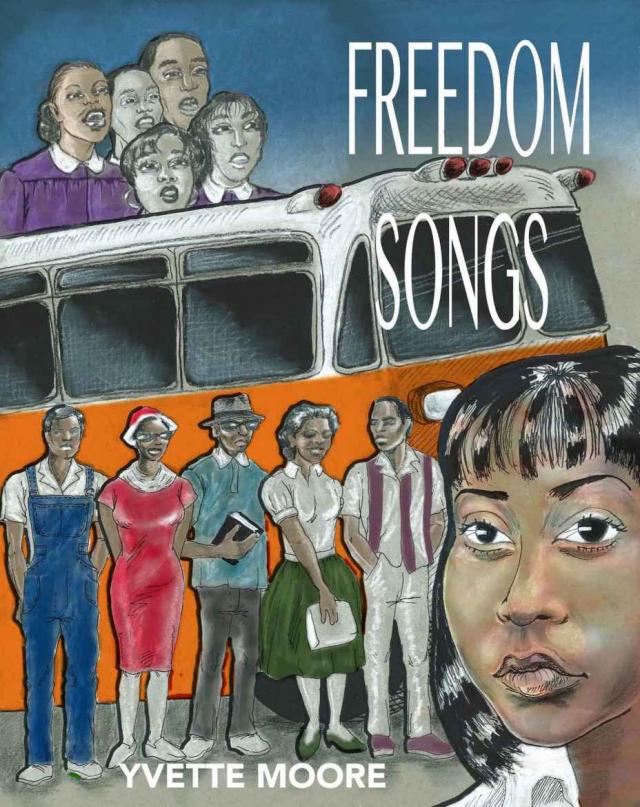


FREEDOM SONGS
Yvette Moore
Jubilee Year Communications
First published in the United States by Orchard Books, a division of Franklin Watts, Inc., New York, 1991. Reprinted by Puffin Books, the Penguin Group, 1992.
Republished in print and e-book by Jubilee Year Communications, 2017, PO Box 4094, Atlanta, GA 30302, 1jubileeyear@gmail.com.
Copyright © 1991 Yvette Moore
All rights reserved. No portion of this book may be reproduced or transmitted in any form or by any means, electronic or mechanical, including photocopying recording or by any information storage or retrieval systems, without permission in writing from the Publisher: Yvette Moore, Jubilee Year Communications LLC. Cover art by Richard Smith. Graphics by Kirk Q. Brown Design.
ISBN-10: 1543093132
ISBN-13: 978-1543093131
DEDICATION
In loving memory of the ones who have passed on, who sacrificed so much to give us a better life, whose daily prayers, toil and dreams were for us, their children and their children’s children … Thank you.
God bless you forever.
ACKNOWLEDGMENTS
I’m grateful to colleagues, friends and family who graciously shared with me their personal stories from Freedom Summer and the Civil Rights Movement as I wrote this book for its original publishing. I’m especially grateful to Judy Richardson of the Student Nonviolent Coordinating Committee (SNCC) Legacy Project; Lon and Hermina Moore of the Martin County, North Carolina, NAACP; and the late Dr. Anne “Bit” Bowen Rubin of Camden, New Jersey, Public Schools.
Special thanks to my sister, Attorney Camellia A. Moore for your legal help and support; to Iris Lindsey for sharing your knowledge; and to Valerie Jenkins for your encouragement.
NOTE
In this book, the term Negro is used instead of black or African American. In the 1960s, the time in which the story takes place, Negro was the term used for, and by, Americans of African descent. The term is used here for historical accuracy.
Chapter One
Southern folk are mystical. Sirens and sounds from mufflerless cars light up warm nights in Brooklyn where I live. But in my mother’s North Carolina, prophesies drift on soft spring breezes alongside the scent of pine and honeysuckle, leaving little room for coincidence. Omen-filled dreams chart people’s lives. They touch the intangible. Even when they leave the land, signs still follow.
For weeks in Mommy’s dreams was her mother, smiling, walking, and surveying new surroundings. A brilliant sun beamed, but Ma Pudnum’s face outshone it. For weeks Mommy told Daddy she had to go home to see her mother.
“It’s just a dream, Ruby—don’t worry,” Daddy kept saying.
"I’m not worried—just want to see her,” Mommy kept answering.
And so, in the wee hours of Good Friday morning 1963, we packed sandwiches and suitcases into our brown Bonneville and headed south, leaving in the middle of the night like fugitives making a clandestine return, to avoid traffic. My baby brother, Ronnie, was most excited about the trip, it being his first time down and all. My older brother, Craig, said next time we should try to get Mommy to dream about Hawaii. Daddy swallowed the trip like a measure of castor oil—an occasional nasty necessity. For him southern air was saturated with bad memories of a sharecropper’s son. Both his parents were dead when he left Alabama for the Army, and he never looked back. Missed school days and getting left back because he had to work some white man’s farm, colored his South ugly.
For me North Carolina was cousins and fun, rainbow skies to sketch after sudden spring showers, and thick woods to explore on endless summer days. I loved being down there.
Daddy always looked at me and shook his head when I said I loved it Down South. He’d “had enough of crackers to last a lifetime.” “Crackers” is what he calls white folk Down South. “Them” is what he calls white folk in New York. But that was Daddy’s thing, and I didn’t have time for it. And even if I did, I didn’t know enough white people well enough to be calling them anything, really. The teachers at school were white, but they were teachers. And some of the shopkeepers around were white, but they were shopkeepers. There used to be some white kids on our block, but they moved away before I could even cross the street by myself.
Whatever Daddy said, I loved Down South. For one thing, people said my name right: Sheryl Williams. That’s Sheryl, one syllable, like Shirley minus the ey part. Ever since kindergarten, teachers have been messing up my name. She-ryl, they’d always say. At first, I corrected them, but they’d just look at me, smile crazy-like, then say it wrong again. She-ryl’s not a bad name. It’s just not my name. My name is Sheryl.
For another thing, Down South could help me do the one thing I wanted to do by September when I started high school: be a fly girl, a fly girl with lots of clothes and even more boyfriends. In every spare moment, and some not so spare ones, I imagine me in Wingate High School colors, red and white, pom-poms flying, cheering on the basketball team in the playoffs. Three seconds on the clock, they don’t think they can pull it off. Then I start a cheer. The ball goes in, buzzer goes off, and they win by a point. Team lifts captain on their shoulders, but he’s looking, looking, searching the crowd for something . . . somebody. . . . Me, because I’d be a fly girl by then.
Becoming one was going to be a full-time job in the four months I had left, as paltry as my wardrobe was and as strict as Mommy can be. But Down South, I could at least practice. Who down there would know I wasn’t a fly girl already? I had clothes enough to be fly for four days anyway. If I said something smart to a boy down there, who of my friends would be standing there to look at me like I’d sprung a leak through the top of my head? My cousins didn’t know that in school I only daydreamed and went to art club. Even if they did, they wouldn’t hold me to it. They’d let me try stuff—and on this trip, I would.
Craig, Ronnie, and I sat in the back of the car; Ronnie on my lap, looking out the window and asking if we were “Down South yet” every five minutes; Craig stretching his long legs across the width of the car and over my ankles; I pressing my face against a backseat window, my drawing pad and pencil bag between my ankles. We sang with the radio, ate fried chicken, and played “my car” until we woke to the warmth of a rising cherry-orange sun that I vowed to paint. Ronnie, after slobbering on my arm all night, was amazed to see grazing cows.
Yes, we were “Down South yet,” Mommy, now in the driver’s seat, told Ronnie in baby talk.
“The mommy and daddy cows have to eat a good breakfast before they go to work, right?’’ said Ronnie, as serious as cancer. I tickled his ear with my nose.
"That is their job,” Mommy said, “eating and being healthy enough to make good milk and more cows!”
Daddy, still trying to sleep, put his hand over Mommy’s mouth. She laughed and bit him. Mommy had shunned sleep all night, and now a numinous southern morning energized her.
Twenty minutes from Ma Pudnum’s, Craig finally woke up and yawned.
“Ugh, boy, cover your mouth! Your breath smell like something dead’s caught up in you!’’
I pulled my sweater over my nose and quickly rolled down the window on my side. Craig laughed and stretched, then leaned over and blew his awful morning breath right into my face. I tried to push him back on his side. He tried to pull my sweater away from my face with one hand and roll the window back up with the other, all the time laughing and letting out more of that rot breath while Ronnie yelled about “horsies.”
“Hey, knock it off back there! This ain’t no playground.” Daddy, abandoning the idea of sleep, sat up. He turned the radio back on, but only sad nasal voices backed by country steel guitars filled the airwaves. We tried to make up sadder songs, but that was impossible.
And when the smell of burning wood filled the car, we knew the creek was near. Mommy screamed and opened the window to greet her mangy old friend. Local garbage was burned there, but for some reason the creek never smelled of burned rubble, just smoldering wood. Leaves had long since been seared off the dead and dying pines that stood scattered in bark-high creek water. We crossed the small bridge that overlooked the dank swamp, and its wobbly, weatherworn planks trembled under the weight of our car. I prayed it would stand, but Mommy didn’t even slow down. When we screamed, she said, “Oh, hush, this bridge has been shaking ever since I can remember.’’
Well, that calmed our fears, Mommy.
Once over, we turned up the first dirt road, leaving a trail of dust behind us. She went even faster after we crossed the railroad tracks. Daybreak, and folk were already in their gardens, plowing their fields, or hanging out wet clothes. One by one, like molasses-covered dominoes, they’d stop to wave and try to figure who-all was in that honking car. Speeding, Mommy oohed and aahed, then named them with each honk: Miss Luella, Uncle Willie, Uncle Enoch, Cousin This, Deacon That.
Buds weren’t even on Brooklyn trees yet, but spring flowers bloomed in Ma Pudnum’s yard. Mommy tooted the horn and jumped out of the car into the arms of the smiling Dream Lady.
Ma Pudnum’s nose had been itching—all week. Down South, everything meant something, and an itchy nose meant some unexpected body was on the way, but Ma Pudnum never figured it’d be her Ruby and us-all.
“Well, look-a-here,” Ma Pudnum said, taking off her garden gloves. She pulled Daddy and Craig into her soft cheeks by the back of their necks.
“We Down South!”
Y’all sure are!” She picked Ronnie up and kissed him. “Do you know who I am, precious?”
&nb sp; "You my Puddin’ Grandma!” Everybody cracked up at that.
Right about then, Ma Pudnum peered down into the car. “Where’s Sheryl?”
I was in the rearview mirror, retwisting my ponytail as fast as I could.“Good gracious,” Mommy said, “is that girl still primping?’’
Oh, Lord.
Child, ain’t nobody out here but us and the trees!” Ma Pudnum called. I took the curler out of my bang and got out of the car, smiling stupid and patting down my bang.
“Hi, Ma Pudnum!”
Ma Pudnum’s eyes sparkled when she folded me into arms warm and smelling of sweet bread. The last time I hugged her, my head had rested right in the hollow between her round stomach and breasts. Now, my eyelashes brushed her cheeks.
“Look at you!” Ma Pudnum said, stepping back to get a full look and to shine. “You done got all grown on me! How old are you now? Fifteen, sixteen?”
Fifteen, sixteen, ooh!
"Fifteen, sixteen? Lord, give me strength,” Mommy said.
"No, I’m fourteen.”
“And looking just like Ruby when she was your age.”
***
Being Down South was nice, not only because folk say your name right, but because you see yourself at every turn. In New York, people say— although I don’t see it—that Mommy, Daddy, and Craig, Ronnie, and I look alike. But to my eyes—and to Craig’s too—there were missing links. Craig has the same eyes as Mommy, but where’d those big lips come from? Ronnie is the same Brazil-nut color as Daddy, but where’d he find those cheeks? Down South answered some of those mysteries. Take Craig’s lips. We found them right in Ma Pudnum’s room, hanging over her bed in an oil painting of Granddaddy tinted in subdued browns. Aside from the half-finished cigar gripped in the left corner of Granddaddy’s mouth, those lips were Craig’s.
(We also found the small, black potbellied stove, sitting on four legs next to Ma Pudnum’s bed, that was responsible for the burn scar on Mommy’s right cheek. Somehow when Mommy was about Ronnie’s age, she fell onto one of the two small saucer-size circles directly on top of the stove, knocking into its long, large, ribbed, S-shaped pipe that ushered smoke up the chimney.)
Ronnie’s cheeks and my nose we found in the middle of Ma Pudnum’s face.
Ma Pudnum looks like an African-Indian. Surrounding her dark, supple, leather-baked face are two coarse gray braids pulled over the top of her head in opposite directions, pinned at the nape of her neck. Narrow Asian-like eyelids shelter dark round pupils that peer out over high cheekbones. Her large forehead, slanted like the side of a hill, was the same as Ronnie’s. Small lips covered large China-white teeth and firm jaws. In the middle of all that was my nose. And that made me happy as getting a gift when it wasn’t even Christmas. It made me think about all the other noses and lips and foreheads and cheeks and eyes and ears—especially the ones that couldn’t be ignored—that I’d seen, in school, on the train. And I wondered who’d given those folks those features. And I wondered if they knew the family treasure laid open in the middle of their faces.
Sometime during all the hugging and inspecting, a tall, thin, young man in too-small overalls came out of the work shed. Mommy yelled, something about a college man in high waters, and ran for her baby, and only, brother, Peter. “Lord, have mercy,” Mommy said. He was getting more handsome by the minute. They hugged and swayed.
When they stopped, she looked up at him. “Do the girls ever let you study?"
"They let me get straight As.” He smiled. But there was something in his eyes.
Mommy’s brother was nineteen and tall as Daddy, about six feet even, though much thinner, with skin smooth and dark as bittersweet chocolate. As for his face, I could see Mommy all in it—he was handsome. But his eyes were different. They were brown and almond shaped and covered with a thick canopy of black brows swerving this way, then that, like Mommy’s—but something else was there. Mommy’s eyes always danced on the edge of a smile, but his eyes were on the edge of . . . I don’t know, something. Once when I was little, and we came down here, I thought it was meanness, and I decided to stay out of his way. But later that same stay, he came looking for me, offering a ride on the mule. I didn’t even ask him, or Mommy, or Ma Pudnum, or anybody. I guess I must have looked like I wanted a mule ride. Anyway, his eyes weren’t at meanness. They were . . . somewhere else. Even in laughter, they seemed focused light-years away. I wish I knew where.
Mommy’s brother was a mystery to me. Not an evil, scary kind, but a mystery just the same. I just couldn’t figure him out.
I didn’t even know what I was supposed to call him. Seemed like he was just too young to call uncle, even though he was. Craig called him Pete, but Craig’s two years older than me and there are only three years’ difference in their ages. Usually, I didn’t call him anything—just kind of threw my voice in his direction when I was talking to him. We didn’t talk much anyway, so this more than sufficed. All he did was read and work; at least that’s all I’d ever seen him doing. While they talked, I stared at him, even though I was trying not to, and wondered about his eyes.
“You still play football?” Craig asked.
“Yeah. We’re training right now for next season.”
School was out for Easter break, and Pete planned on setting out tobacco plants before the Good Friday sun rose high.
“I could help you with planting today.” “Sure. Thanks.”
Craig had volunteered for work. Lord, have mercy. We went inside to the other good thing about Down South—Ma Pudnum’s house.
From the outside, it seemed small and simple, but inside a labyrinth of doors and rooms and closets where Craig and I used to play hide-and- seek told a story: This room was added when Mommy was born; that one when the baby got smallpox—it was turned into a sun porch when she died.
The large kitchen was one of the original rooms in the maze of seven in a house that had grown along with Ma Pudnum’s family.
By the time we’d brought the luggage into the house and washed, breakfast was steaming on the table in the roomy kitchen—hominy grits and fried herring, buttermilk biscuits and homemade fig preserves, smoked ham and eggs made to order. I had mine scrambled hard. Daddy had his sunny-side up and oozing warm orange yoke all over the place. I put the milk jug between our plates.
Ma Pudnum always cooked for a legion, and that was a good thing too, because after she said grace and thanked God for the wonderful Easter surprise (that was us), neighbors and family began stopping by. They’d knock loudly on the front doorpost one or two times, then before Ma Pudnum could ever answer, the metal screen door would slowly screech open, then bam-slam shut just before the mosquitoes got in. The room broke into a million conversations, and the door kept screeching. Every time it did, I’d look up expecting to see Mommy’s sister, Minnie Ruth, and her four daughters, but it never was.
After a while, Ma Pudnum’s friend Miss Luella rose to take care of the million and two dishes piling in the sink. I offered to help, but she shooed me away like a fly. I didn’t argue.
With all the clamoring in that kitchen, you could hardly hear Miss Luella clanking away with the dishes, let alone the person next to you. So how did everyone know to get quiet when Daddy, Craig, and Mommy’s brother started talking about his school?






