

You will know the truth, p.1
You Will Know the Truth, page 1


Advanced Praise for
You Will Know the Truth
by Leslie T. Thornton
“What a terrific, galloping read. The women characters are badass, the details precise—from the courtroom to the Situation Room. Can’t wait to see the movie!”
George Stephanopoulos, Former White House
Communications Director and network television anchor
“This thriller moves with wonderful pace and surprise but not without plenty of thought-provoking and entertaining moments. A host of compelling characters come together in this story in unpredictable yet believable ways. Leslie Thornton has an ear for dialogue and she taps her unique life experiences to weave a gripping tale of intrigue that immerses the reader into some of the diciest spots in Washington, D.C.—from dark alleys to courthouses and the halls of The White House.”
Thurgood Marshall Jr., Former Assistant to the President and White House Cabinet Secretary to President Clinton, Former Director of Legislative Affairs, and Former Deputy Counsel to Vice President Gore
“Leslie T. Thornton has cracked the code of the D.C. thriller—in a world where we live with constant distractions, she has a created a novel so rich and engaging with plots twists you will never see coming, that I could not put it down. I squealed when twists were revealed. I could not get to the next page fast enough. It is the perfect read.”
Alyssa Mastromonaco, New York Times Best Selling author
and co-host of Crooked Media’s Hysteria podcast
“Leslie T. Thornton’s gripping legal thriller takes you from the gritty criminal trial courts of Washington to the awe-inspiring Oval Office—with stops in between—and she does this as only a real Washingtonian could. With every turn of the page, the plot twists to reveal the crazy intersections between Washington’s villains and its heroes. Washington has sometimes been called ‘a small town’, but, whatever you call it, Thornton owns it!”
Jamie S. Gorelick, Former Deputy Attorney General
of the United States, and Former General Counsel
of the U.S. Department of Defense
“From ‘Who done it?’ to ‘Who did it!’…You Will Know the Truth has more twists than a bag of licorice. In a shocking finale, your emotions will be overwhelmed as you weigh the ethical dilemma faced by our chosen leaders. What would you be willing to do . . . for the greater good?”
Harry Rhoads, Jr., Co-founder, Washington Speakers Bureau
“The next great crime-thriller author has arrived! Leslie T. Thornton has crafted a gripping tale that will keep you spellbound reading her page-turning novel until you get to the climactic finish. You Will Know the Truth has a riveting plot with authentic Washington, D.C. references and captivating, distinctive characters. She is a true Washington insider, with a comprehensive knowledge of how the city operates—from its gritty streets, to its fabled courtrooms to the hallowed halls of the White House.”
Ronald C. Machen Jr., Former United States Attorney
for the District of Columbia
“You Will Know the Truth is a clever, non-stop thriller that takes political intrigue to the next level. Leslie T. Thornton’s artfully written debut novel delivers riveting plot twists as seen through the eyes of richly developed characters perilously navigating Washington’s closely guarded secrets. What makes Thornton’s work so compelling is that her saga is peppered with vivid, stunningly accurate ‘inside baseball’ accounts that show she really knows her stuff. Don’t miss it.”
Larry Cockell, Former Deputy Director
of the United States Secret Service
“A nonstop thriller that takes you from the grittiness of a criminal courtroom to the political intrigue at the centers of power at the White House. Thornton uses her insights as a criminal defense lawyer and D.C. insider to craft a story of murder, secrets and lies that leave you guessing until the last page.”
Kim Taylor-Thompson, former Director of the Public Defender
Service for the District of Columbia,
and Professor of Clinical Law Emerita, NYU School of Law
“Those who know Washington will recognize the places and wonder why they haven’t met these people. Those who don’t should be prepared to become involved in a world where you never know what’s going to happen next and can’t wait to find out. Everyone will believe the story is one of Washington’s deep secrets revealed by an insider breaking the code of silence…and who knows? If you like crime and politics, read Leslie T. Thornton’s first book. You won’t forget it and you’ll be ready for her next offering.”
Alan Wheat, Former Congressman
“Leslie T. Thornton has written an exciting, gripping and insightful page-turner that grabs the reader’s heart and gut. This writer knows Washington, D.C. After spending much of her career living and working in this power-centered city, she learned a lot. She writes for the lifelong Washingtonian and for the rest of the world who live outside the Potomac. Whether you’ve spent much time in the city or not, Thornton’s book teaches you all you need to know about the back-stabbing politics, the policies made for the few, and the everyday wheeling and dealing that so quickly becomes part of formerly normal men and women’s culture. Thornton writes of a city that is for the powerful and not for the faint of heart. Not only is her book an emotional roller coaster, it is one you will want to share with others. Great writing. Great storytelling, from page one to the very end.”
Bob J. Nash, Former Assistant
to the President & Director of Presidential Personnel
Table of Contents
CHAPTER ONE
CHAPTER TWO
CHAPTER THREE
CHAPTER FOUR
CHAPTER FIVE
CHAPTER SIX
CHAPTER SEVEN
CHAPTER EIGHT
CHAPTER NINE
CHAPTER TEN
CHAPTER ELEVEN
CHAPTER TWELVE
CHAPTER THIRTEEN
CHAPTER FOURTEEN
CHAPTER FIFTEEN
CHAPTER SIXTEEN
CHAPTER SEVENTEEN
CHAPTER EIGHTEEN
CHAPTER NINETEEN
CHAPTER TWENTY
CHAPTER TWENTY-ONE
CHAPTER TWENTY-TWO
CHAPTER TWENTY-THREE
CHAPTER TWENTY-FOUR
CHAPTER TWENTY-FIVE
CHAPTER TWENTY-SIX
CHAPTER TWENTY-SEVEN
CHAPTER TWENTY-EIGHT
CHAPTER TWENTY-NINE
CHAPTER THIRTY
CHAPTER THIRTY-ONE
CHAPTER THIRTY-TWO
CHAPTER THIRTY-THREE
CHAPTER THIRTY-FOUR
CHAPTER THIRTY-FIVE
CHAPTER THIRTY-SIX
CHAPTER THIRTY-SEVEN
CHAPTER THIRTY-EIGHT
CHAPTER THIRTY-NINE
CHAPTER FORTY
CHAPTER FORTY-ONE
CHAPTER FORTY-TWO
CHAPTER FORTY-THREE
CHAPTER FORTY-FOUR
CHAPTER FORTY-FIVE
CHAPTER FORTY-SIX
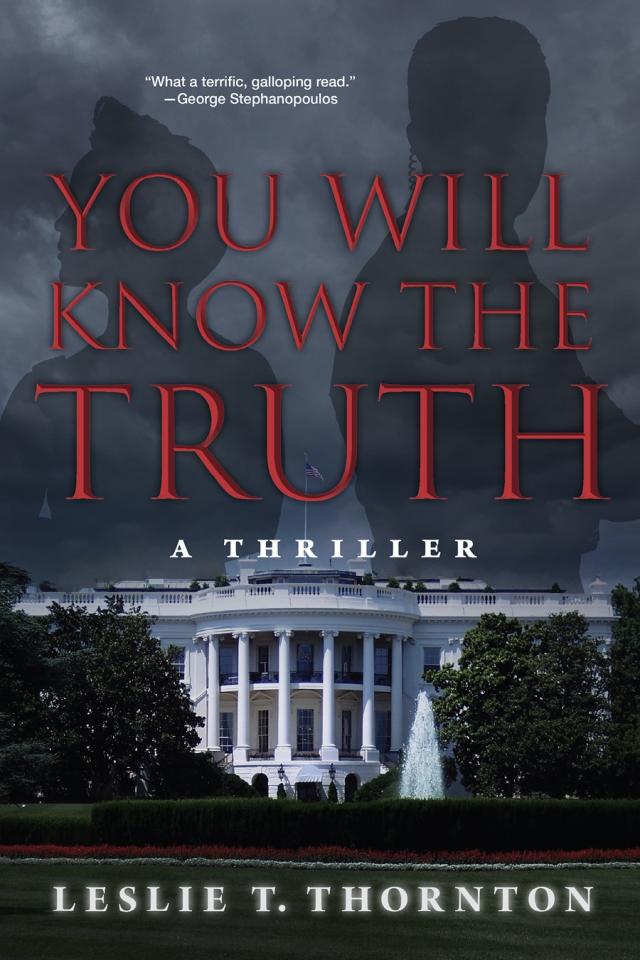
YOU WILL KNOW THE TRUTH
YOU WILL KNOW THE TRUTH
A Thriller
Leslie T. Thornton
Published in the United States by Sweet Read Publishing.
You Will Know the Truth. Text copyright © 2021 by Leslie T. Thornton. All rights reserved. No part of this book may be used or reproduced in any manner whatsoever without written permission except in the case of brief quotations embodied in critical articles and reviews. Printed in the United States of America. For information, contact Theodore and Ann Burgh at Sweet Read Publishing for more information, sweetreadpublishing@gmail.com, 910-409-1076, 4617 Pineview Drive, Wilmington, NC 28413.
www.sweetreadpublishing.com
The Library of Congress Cataloging-in-Publication data is available upon request.
ISBN 978-0-986-09415-6 (hardcover)
ISBN 978-0-986-09416-3 (ebook)
First Sweet Read Publishing Edition: 2021.
Subjects: FIC031030—FICTION / Thrillers / Legal, FIC031060—FICTION / Thrillers / Political, FIC050000—FICTION / Crime.
Cover concept by Samantha Carlin
Cover design by adam b. bohannon and Leyla Erkan.
Interior design by adam b. bohannon.
Bible verses included are from the New International Version.
In limited part, inspired by real events.
.
For my remarkable family
Daddy—you called me and Libby your “pride and joy.” We were only 20 when God took you away, so I have missed you for a lifetime. But I truly believe that some of the best parts of me were the best parts of you.
Mom—you were stunning, smart, a total badass—ask anyone—you would have stood in front of a train for your family, and often did. You always told me and Lib that we could be anything, do anything, long before it was the popular thing for mothers to instill in their daughters. Thank you for raising the girl that became this woman. For all the times you stood in front of a train for us. For reading the earliest draft of my novel and, unknowingly, leaving me with the most exquisite memories of your loving, embarrassed, scared, and funny expressions.
Libby—my twin sister, my other half, my giggle-buddy, my other heart.
Weaver and Hugh—my older brothers and giant supporters. Hugh, you wondered if we needed a family intervention after reading a particularly gritty pa rt, and Weave, you wanted to play ‘Rolex’ in the movie, LOL.
YOU WILL KNOW THE TRUTH
CHAPTER ONE
It started off typically enough, at least for a case carrying the weight of overwhelming horror and abject savagery. Prosecutors skillfully outlined the sacrifices poor Mrs. Campbell had made trying to give her kids a better life than she had lived. They talked about how treasured she was in the community, the online fundraiser that was launched when her husband died, about why she was reluctant to accept the money. Prosecutors explained why she wanted to stay in a neighborhood even as it changed, became less safe, and took her husband.
It was hard to argue with. There would be no cross-examining the witnesses to Mrs. Campbell’s goodness and grace. You sully the sinner, Nicki knew. You don’t drag the sufferer. Especially not this one.
The prosecution had witness after witness lay out the painful story. The good and decent Mrs. Campbell, in her haste to get home from her second job in time to say goodnight to anyone who might be still up, cut through the back alley adjacent to her home on F Street, S.E. It was longer than she preferred—that alley—and darker. But she had taken that short cut a thousand nights before, and sometimes she’d made it home in time to kiss her grandson goodnight and say their prayers—a special delight because this grandson bore her husband’s name.
That night, Mrs. Campbell heard footsteps behind her. They would not have frightened her though—lots of people in the neighborhood used that short-cut, almost all of whom she knew personally. Teenage boys mostly, racing home to make curfew. Among other innocents. “Don’t tell Mom!” they would call to her as they tore by.
That night though, the voices Mrs. Campbell heard—the last ones she would ever hear—were not from people in the neighborhood. They were not teenage boys racing home. They were not innocent. They were lawless, felonious men who took her life with appalling disregard. What was the point?
CHAPTER TWO
“The law is a horrible business.”
—Clarence Seward Darrow
Mrs. Campbell’s murder left an appalling crime scene, even for one committed in a back alley already covered in the filth and stain of a ruinous neighborhood. A first responder threw up, the rumor went, and Nicki Jo Lewis, no surprise, pulled one of the case’s four defendants. It was a terrible case at the center, it seemed, of ruthless and unrelenting gang activity producing some of the worst criminal conduct the city had ever seen.
It helped that Nicki’s client was only incidentally connected to Mrs. Campbell’s killing. Mrs. Campbell’s wedding ring was “found in her possession.” That’s what the radio run said, but it was just police speak. Nicki’s client was wearing it, showing it off—that’s how police investigators found out about her.
She could have found that ring anywhere, Nicki would probably argue at trial—on the street, in that alley. Anything was possible in that part of town. Still it was a bloody mess; arguably the most monstrous crime to happen in Washington, D.C. since 1950 when some New York City gangsters got chased south and ended up with their tongues pulled out through slits in their throats. On Pennsylvania Avenue. Right in front of the White House.
“Officer, would you please describe what you saw when you arrived at the scene that night?” the prosecutor had asked a few weeks after Mrs. Campbell’s murder at the preliminary hearing.
“The decedent, Mrs. Campbell, 55, was lying in the alley, on her side. Her dress was up around her waist and, and . . .”
“Please continue, officer.”
Though a seasoned investigator, the officer had barely slept since he’d begun working the case. He could not get the images, the memory of poor Mrs. Campbell, out of his head. A widow, Mrs. Campbell had worked two jobs—both menial, so that she could help send her children and grandchildren to decent schools. People knew her in the neighborhood as someone who always smiled, no matter her own troubles, and always offered to help someone else, no matter her own needs. When her own husband was killed by a stray bullet just two years before, the neighborhood crowdfunded thousands of dollars so she could move herself—their children and grandchildren—to a safer neighborhood. But she refused to go.
“This is my home,” she’d said. “It’s the kids’ home, with the only memories they’ll have of their father.” It was hard to argue against her reasoning.
“There was a lot of blood. A lot. A pipe was . . . protruding from her, from her . . . ”
“From her what, officer?”
“From her, her . . . anus.”
After two men raped Mrs. Campbell, a third shoved a steel pole so far up her rectum that it punctured her lower and upper intestines, her liver, and her pancreas, and scraped the bottom of her right lung. It was gratuitous. She bled out, but not before the contents of her intestines had poured into her stomach cavity and begun to poison her.
News reports had spared some, but not enough, of the particulars. Reporters had dramatically described Mrs. Campbell as a grandmother of thirteen (though that was hardly news in that part of town) who died a slow, agonizing death at the hands of street thugs. Thugs who hadn’t just killed her, but who taunted and humiliated her before God took her home.
The medical examiner said Mrs. Campbell probably was alive through much of it. Widely reputed for his exacting work by the time he ‘met’ Mrs. Campbell, the ME said he had never seen so much internal organ damage in a human being who had not been crushed by heavy machinery. At the hearing, the ME tried to keep the description as clinical as possible, but the crime was so violent that even complicated medical terms couldn’t temper its blow, and when he finished his testimony, people all over the courtroom were crying. One of the judge’s law clerks got sick.
It was not great for the defense.
The ignoble misery, and Stephen King-like gruesomeness of Mrs. Campbell’s murder, bothered Nicki. It was objectively shocking. But Nicki was one of the best trial lawyers at the agency—full stop—and the agency, by law, did not turn down a case for its complexity, or even general ickiness.
Tall and slender, Nicki wore her hair close-cropped, almost clean-shaven—sort of an anti-afro—long before the style was popular. It suited her. It was no fuss, much like her personality, except for the cluster of silver bangles she donned on both wrists that clanged when she walked and sang when she talked with her hands. Some days, the days when she was not in court, they went halfway up her arms. She wore jeans to work, but like all the other public defenders, Nicki kept a suit in the office for court.
Still, Nicki wore her jeans with a plain white t-shirt and a short, black leather jacket, winter or summer. She was opinionated and strong—gave you the impression there was nothing she couldn’t do—and that was probably right. Nicki had high cheek bones, a warm smile which matched the charm that could take people by surprise, and good legs. Really good legs. She was whip smart, comfortable in her own dark brown skin, and she cursed. A lot. All the defenders cursed. It was part of being in the club, and a by-product of the ugly, violent world in which they operated. Nicki said “fuck,” a lot, in everyday language and as expression, and she was the one they'd made a wager about it at the office.
Nicki’s colleagues bet she would accidentally say “fuck” in court one day, be held in contempt, and ordered to pay a fine, and one day she almost did.
“Ladies and Gentlemen of the jury,” Nicki had begun in her closing argument that day. “The government’s only eyewitness told you a pretty tall tale today. Here is why you shouldn’t believe it. Here is why you can’t believe it. The government’s only witness, the one witness the government has that puts my client anywhere near the scene, well, he was fu . . . I mean he was fouled up on drugs.”
The judge had lowered her head—she was smiling—but some of the jurors laughed out loud. It was pretty funny, everybody said, and though she hadn’t actually said the word, Nicki’s colleagues made her pay up anyway.
Here, in this case, Nicki figured if all the government had on her client was the ring, her client would not be lumped in with all the other defendants whose fingerprints and DNA were on the pipe. Still—Nicki knew—you never really know, especially in street crime cases. Defendants tend to leave things out when they are telling their lawyers what happened.






