The ghoul, p.1
The Ghoul, page 1


Jerry eBooks
No copyright 2015 by Jerry eBooks
No rights reserved. All parts of this book may be reproduced in any form and by any means for any purpose without any prior written consent of anyone.
UNKNOWN
Vol. 1, No. 6
August, 1939
STREET & SMITH PUBLICATIONS
79 7th AVE., NEW YORK
Custom eBook created by
Jerry eBooks
January, 2015
I.
IRISH worked at the Burton Hotel in N’Yawk, though it wasn’t quite as bad as that. Irish was strictly a N’Yawker, having established his right to that title very early in life by being born in Ireland—for it must be remarked that N’Yawkers are never born in N’Yawk.
Up to the time when he walks into our lives, his history had been very average, though very varied. As an orphan he had been given into the care of some Poles in the Bronx; after that he ran errands for a Hebrew gentleman who enjoyed a profit from clothings and small vestings. From errands he had graduated into the more localized and more distinguished position of hopping bells, at which trade he had first been apprenticed in a very shabby dive on Ninth Avenue. From Ninth he had graduated to Eighth. Then the Seventh and, just now, he was halfway between Seventh and Broadway just after those two avenues cease their quarrel and part to meet no more.
The Burton Hotel was a glittery place, having to do with people as polished and hard as chromium. It caught the better actors, the better yokels and the better travelers from far lands, and the only thing Irish had against the place was that it sported a few too many McGees. Now, know that a McGee is a person who seldom tips and that there are first-water McGees—who never, never tip, even after telling you that MGM has just signed them—and second-water McGees—who, with great condescension, sometimes tip a nickel—and third-water McGees—who kick through at long intervals with a dime.
But, if the pay was indifferent, there was still much to commend the Burton, for known names often stopped there—and sometimes went away leaving their baggage—and the place was in the heart of things where a man could hear the El clatter and the subway roar and all the taxi drivers blasting their horns and madly bashing up their fenders. And, in particular, the Burton offered illimitable chances for getting in trouble.
Just how Irish managed it he could not tell. Often he had been asked—sometimes, even, with the hope of an answer—just how he managed it. That he did was known very well, especially to the bell captain—who had a trick of snapping his fingers and looking down his nose and collecting five bucks at very regular intervals. The bell captain always gave Irish the people with the sourest faces and the most bags, because, after all, if Irish got into anything there was but little mutual revenue to be lost. Occasionally the assistant manager became intrigued with the problem, for it seemed almost impossible for one man to get into so many scrapes in such short intervals.
Irish, his hair standing straight up and his blue eyes very woeful, always tried to answer truthfully, such as: “Well, sir, it wasn’t that I tried to do it, but, gee, how was I to know she was goin’ to come boilin’ out of that corridor with a open bottle o’ ink in ’er hand?”
Naturally, it would be impossible for a man to know such a thing and it was actually the fault of the guest for carrying open bottles of ink and the worry of the underwriters to pay for her hundred-dollar gown. But out of twelve bellboys, why was it always Irish?
IT had been Irish who had told the G-men about the fellow in 1623 counterfeiting money all night and every night. Now, any of the twelve gentlemen on the bench might have noticed that and reported it. But they hadn’t. And it was Irish who brought down six G-men on a timid little clerk who had so much to do at the office he had to bring his mimeographing home. And even after the fellow had moved away, Irish still couldn’t tell just why it had to be he who had discovered it.
In short, if any error of any sort was to be made at the Burton, Irish would be the one to make it, and after he had been there a few months, it became quite fashionable, each time the rye was taken to the temperance lady in 1834, to howl for Irish. And there seemed to be no limit to the number of possibilities he could get from a comparatively few basics.
There was the improvision he accomplished via the wastebasket of an old sea captain who had just moved away—at least, everybody, thought he was an old sea captain. It had to be Irish who found the crackly old map. Obviously it was a treasure map, even down to the “Captain Kidd” on it.
This, of course, was the cue to Irish to make his fortune, and so he had recruited partners among his fellow workers. And when the “old sea captain” returned two. weeks later, having found another part with another show company, and when he remarked that this time he wouldn’t have to wave treasure maps around the stage, what was the Irish & Co. treasure hunters to do with the deep-sea diving outfit they had bought?
Yes, it was always Irish. There was a rumor about that it was his big feet. They were very big, of course, even for an Irishman; but it is very unlikely that they had much to do with his troubles. Rather it was another portion of his anatomy. He had a nose. It was an Irish nose, turned up slightly at the end and very small and freckled and wrinkled when he laughed. Yes, it was his nose, for he thrust it into everything which came his way. And the lady in 1834 got rye because Irish wondered what she would do under the circumstances. And the episode of the corridor and ink came shortly after a door had slammed and high voices had. been raised between two people lately married—it wouldn’t have done to walk right down in front of their door, you see. And if Irish went out to walk a Pekingese and came back with a St. Bernard, it was often in the interests of Cupid, whom the Irish dearly love to serve.
On the face of it, he was clumsy. But what man who was clumsy could have danced the bell captain’s truest love straight into his heart? And Becky—who ran the newsstand in the lobby—was certainly a judge of dancers. The immediate result, of course, was the presentation to Irish of all the McGees in the house.
On the day when we begin to examine his strange subsequent history, Irish had been discussing the ponies with Becky. Becky was from “dyown Souf” and she knew her ponies. In fact, when she had come to town to go on the stage and had drawn only thirty a week for the line and specialty plus a pair of aching gams, she had found that it interfered with her wire-office contact and so had elected to peddle papers and smokes. It was rumored that she had a system and, indeed, there were those who claimed that it consisted wholly of a wondrous pair of blue eyes. This was libel of the worst sort, for though she did flatter everyone, what girl doesn’t?
THE bell captain got a gleam in his eyes to match his hair and saw two things at once: Irish by the newsstand, and a trunk of a size which would have made a Filipino an excellent home,
“Front!” cried the captain, at the same time holding little Georgie Baines upon the bench. Irish didn’t turn, so the captain played the anvil chorus upon the bell. But Becky was showing Irish on the forms that it was Light Lily and not Smoky Lad who would win the third at Preakness, and the captain was finally forced to abandon his signal bridge and march straight upon his prey.
“Irish!”
Irish turned and gazed at the captain and was innocent of any wrong, though he immediately began to utter an apology. The captain. Fred Torrence, inspired that sort of thing, and Irish had the tender feelings which went with a tender, Irish heart,
“If you could spare a moment, Irish,” said the captain, suddenly gentle, “I think the guest at the desk might possibly have something for you to do.”
Irish nodded hastily, his hair standing straight up and flaming more than ever, and sprinted toward the guest in question. His flight was such that he overestimated his distance and the friction between shoes and marble floor and came up with a bang against the new guest’s right arm just as that gentleman had finished the laborious task of filling a card. The ink sprayed out of the pen as from a fire hose and the clerk got it on his immaculate white cuff.
The new guest spun about, and Irish, all contrite, was suddenly more frightened than he had ever been before in his life!
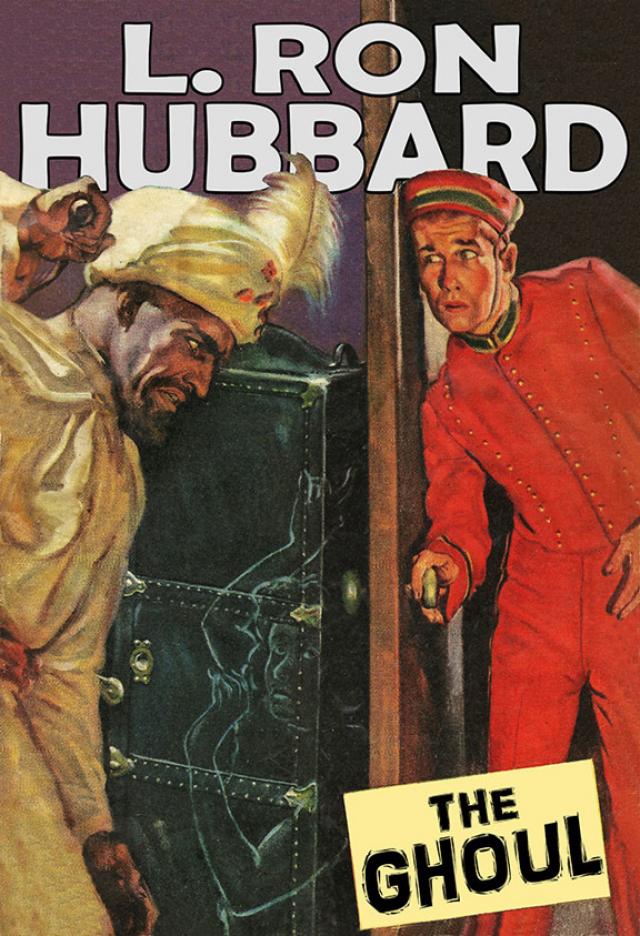
The man wore a white silk robe which readied down to the tops of his scarlet slippers. He was crowned by a turban at least a foot tall. And between turban and gown lay the most horrible eyes Irish had ever seen.
They were all yellow!
No pupil like a man’s but a vertical black slit like a cat’s!
The guest’s beard shivered with wrath, and an unholy vibration came out of him and paralyzed Irish’s wits completely. There are those who say that the men of Ireland are gifted with a second sight. Perhaps it is so. But it was certain that Irish felt fan upon his face a blast from the devil’s hottest caldron.
It took only an instant for the guest to recover himself. The clerk started to lay out the usual flaying, but the guest cut him short. “’I am sure,” he hissed, “-that it was but an accident. My baggage, it is there.”
Irish got himself alive and sped to the baggage which the taxi driver had left on the sidewalk. Much too distrait to notice petty details, he swung a strange sack under one arm and laid hold of the handle of the trunk and ran to the freight elevator. So unnerved was he that it was not until he lifted that trunk into 1313 that he found what was so odd about it.
It didn’t have any weight! Or, at least, it weighed far, far less than the usual trunk, despite its enormous size. Irish, opening the door for the new guest and then automatically checking towels and soap and lights and heat, felt the eyes goin g steadily after him. With alacrity he boosted the weightless trunk against the indicated wall, planted the sack on the bag stand and then charged out of the room, not remembering until he hit the hall that he had not waited for a tip. He turned around and there was the fellow directly behind him. Irish had moved fast and yet—He shivered and the coin which crossed his palm felt as cold as though it had been packed in dry ice.
HE avoided the eyes and dashed for the elevator, happy to be able to descend into warmer regions. Even then he did not give much thought to the weightless trunk. He needed company and needed it badly and so, as soon as the clerk, the assistant manager and, finally, the bell captain, had each given him up for about ten minutes apiece, he stumbled to the cigar counter and leaned thereon, very limp and running nervous fingers through his stiff red hair.
“Who was he?” Becky wanted to know.
“Who?”
“The gentleman in the turban. Gosh, I bet he’s a prince, or a rajah, or something, huh? Mah goodness, I’ve heard that they keep bushels of diamonds around! And rubies and things, too. What did he give you?”
Irish looked and found the coin to be a quarter. There was nothing to be read from that except “In God We Trust” and so, now that he had gotten the ringing out of his ears, he tried to solve the new guest’s identity.
“They drive in gold coaches with sixty white hosses and they’ve got a hundred and ninety wives—”
“Who?” said Irish.
“Why, rajahs, of course.”
“But maybe he wasn’t a rajah. If he was a rajah, then he’d have a secretary or something with him.”
“That’s so,” said Georgie, coming over. “Besides, the rajahs we had at the Waldorf always dressed in tail coats. They never wore gowns. At the Waldorf”—Georgie was fond of letting those about him remember that he had not always worked in a theater house—“at the Waldorf they always tipped five dollars. What’d he give you?”
“Two bits,” and Georgie displayed it.
Bert came over from the elevator. “I know what that guy is.”
“What?”
“The clerk showed me his ticket. He’s a sheik, that’s what. From Tunis.”
“A sheik!” cried Becky. “Oh!”
“Don’t worry,” Bert told her coldly. “He’s probalily got more wives than he c’n count. Maybe that’s why he came over here, huh?”
“From Tunis,” said Georgie. “They have no rajahs in Tunis. At the Waldorf—”
“Yeah,” said Bert. “At the Waldorf they all come from Forty-second Street. We know!”
“Funny thing,” said Irish. “You know that trunk he had? Well, that trunk looked like it ought to weigh about a hundred thousand pounds. But,” he said with a great air of mystery, “it don’t.”
“You couldn’t lift that much,” said Georgie, practically. “At the Waldorf—”
“You couldn’t, neither,” said Bert brutally. “What about the trunk, Irish? Did it have a gold map in it?”
IRISH waited until they quieted down. “Even that’d weigh somethin’. But it don’t.”
“What?” said Becky. “It don’t what?”
“Don’t weigh anything,” said Irish.
“If it had,” said the bell captain, joining them, “you couldn’t have pushed it around.” He cast a black look at Becky and marched in military fashion over to the desk.
“You’re kiddin’,” said Bert.
“I ain’t, neither,” said Irish. “I guess I was the one that took it up. It didn’t weigh a thing. You know, a trunk like that, empty, is hard to shove around, ain’t it?”
“Sure,” said Bert.
“Well, this didn’t even start to weigh what an empty trunk would, and I guess, by golly, it was over eight feet long.”
“Five,” said Georgie. “I saw it.”
“All right, five! And it was four feet—”
“Three,” said Georgie.
“Four feet tall!” said Irish. “Now, if it had been empty it would have weighed a little something. But it wasn’t empty, because if it had’ve been, it would have had weight.”
“What are you getting at?” said Bert. “Well,” said Irish, “it musta had somethin’ in it that weighed less than nothin’, because if it had had nothin’ in it, it would have weighed somethin’.”
“That’s impossible,” said Georgie, “Nothing weighs less than nothing.”
“You ever see a balloon go tip?” challenged Irish.
“Well—”
“There! It’s got something in it that weighs less than nothin’, I guess.”
“Well, mah goodness, Irish,” said Becky, “a man wouldn’t be carrying anything around like that! Aftah all, Irish, the man is from Tunis and I never heard of anybody in Tunis having balloons.”
“At the Waldorf—” said Georgie, promptly.
But, as promptly, Bert said: “Wait a minute, Irish. Don’t do it!”
“Do what?” said Irish with the most innocent expression in his eyes.
“Look in that trunk!”
“Why,” said Irish, offended, “I never thought of such a thing.”
“You did, too!” said Bert.
“Well, what if I did?”
“Irish!” said Becky. “Aftah all, a man’s baggage—”
“He ain’t a man,” said Irish. “He’s . . . well, he’s—”
“He was a man,” said Georgie. “At the Waldorf”—he got it off quickly before Bert could stop him—“we had a lot of sheiks and they always wore them skirts. They always do. All the men, I mean. The women wear pants. I guess I—”
“Shut up,” said Bert. “Look, Irish, what are you drivin’ at, huh?”
“Please, Irish,” said Becky. “Please don’t do anything awful! Just remember all the trouble it was when you said the woman in 1289 had shot her husband and she’d only dropped a light bulb.”
“Yeah, and remember—” But Bert got no farther.
“You think I’m going to do something,” said Irish, aggrieved. “Why, gosh, I wouldn’t think of such a thing. What’s it to me what a man carries around in a trunk, huh?” And so, whistling softly to himself, he wandered off to answer 1954, who had been ringing despairingly for the past ten minutes.
The trio at the desk looked at one another, and then sadly shook their heads.
II.
PERHAPS nothing dreadful would have come of the affair had there not lived in 1312—the room next to the unknown in the turban—a man much given to parties after midnight and bromos in quantity after midday. No. 1312 was bloated and oily, boastful and lying, besides being a first-water McGee, lived thoroughly up to his profession of theatrical agent.
Two nights followed the fateful day on which the unknown in the turban had entered the hotel and nothing untoward occurred to Irish beyond his usual run of small and trivial incidents such as enraging Mrs. Tonston by accidentally offering to take her down by the freight elevator and perhaps accidentally delivering Miss Vita Mars’ morning mail while her husband was calling. Nobody liked the way Miss Vita Mars said, “Boy!”
But on the ill-omened evening in question, 1312, as befitted a hard-working flesh broker, decided to entertain two of his newest—and loveliest—clients. Therefore, 1312’s destinated hand wrapped itself about the phone and gave the order which started everything.
“Room service? Send up a pitcher of ice water and eight bottles of seltzer. Two very important clients are here to discuss their forthcoming contracts with MGM.”
Now, it irked Fred, the bell captain, to even be addressed by a McGee, and he was especially annoyed by the obvious and uncalled-for lie. And so he instantly sent for Irish.
Irish cheerfully betook himself to the bar, not even commenting to himself that 1312 was always one to save nickels by buying his own in bottles. He collected the seltzer and ice water on the tray and shot up to the thirteenth via the servants’ elevator. Humming a clog, he galloped down the hall and rapped smartly upon 1312.
The flesh broker again imparted the information that his clients were on the verge of becoming very famous but imparted nothing else of any greater value. Irish was used to it and nodded brightly, and when the flesh broker had closed his door, Irish turned and marched up the hall.