

Maria mariposa, p.1
María Mariposa, page 1
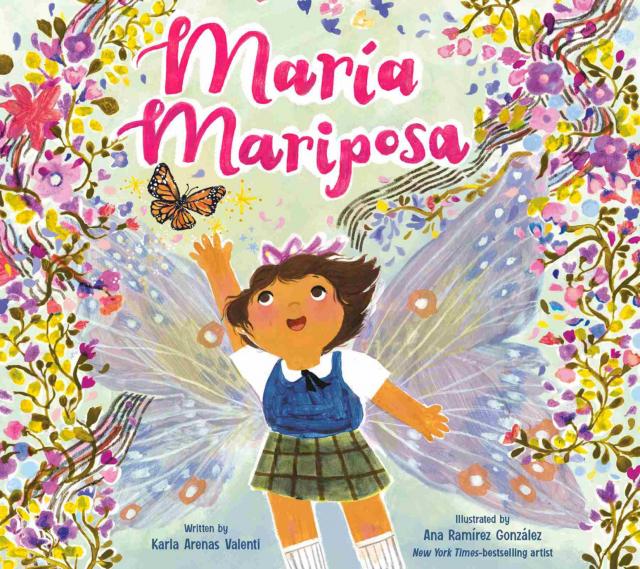


Text copyright © 2024 by Karla Valenti.
Illustrations copyright © 2024 by Ana Ramírez González.
All rights reserved. No part of this book may be reproduced in any form without written permission from the publisher.
Library of Congress Cataloging-in-Publication Data available.
ISBN 978-1-7972-0793-3 (hc), 978-1-7972-1340-8 (epub reflowable), 978-1-7972-1357-6 (epub fixed-format), 978-1-7972-1356-9 (Kindle)
Design by Jill Turney.
Typeset in Air, Shag Exotica, and Uravika Classy.
The illustrations in this book were rendered in gouache.
Chronicle books and gifts are available at special quantity discounts to corporations, professional associations, literacy programs, and other organizations. For details and discount information, please contact our premiums department at corporatesales@chroniclebooks.com or at 1-800-759-0190.
Chronicle Books LLC
680 Second Street
San Francisco, California 94107
Chronicle Books—we see things differently.
Become part of our community at www.chroniclekids.com.
I dedicate this book with love to anyone who has experienced the loneliness of being far from home. And to Daria, for giving this story its wings.
—KAV
To my dearest Levi: May your wings always carry you to places where your heart is happiest, and may you find boundless happiness in every flight of life’s journey.
—ARG
One brand-new morning, in a brand-new city, on the very first day of a brand-new school, a gift arrived from Mexico.
“¡Una mariposa!”
María said.
And she was right.
But this was no ordinary butterfly …
For on its wings, it carried the memory of home: the gold and orange of sunsets over deep blue seas, the purple of flower-heavy jacaranda trees, the polished turquoise of Abuelita’s earrings.
And as it filled María’s room, it made her feel a little less lonely and a lot more brave.
María thought she might take the butterfly to school.
But the butterfly had a better idea.
“¡Yo soy María Mariposa!”
With magic like this, María Mariposa knew she could do anything.
She made Mami her favorite hot chocolate.
She helped Papi do all the dishes.
She even made sure Tomás ate every bite of his breakfast.
And she gave Pecas a hundred kisses!
But María Mariposa wasn’t about to stop there.
She made Mr. Peterson smile with a beautiful drawing of Mrs. Peterson, whom he missed dearly.
She got Ms. Friedman’s cats to finally stop fighting.
And she made Simon feel better by telling him his favorite joke!
María Mariposa had so much Mexico magic to give that it spilled into the street and onto everyone she saw.
But when the big yellow school bus arrived, María felt a little nervous.
She fluttered her wings to make sure they were still there.
“Buenos días,” she said.
“Good morning,” the friendly driver replied.
And when the big yellow school bus dropped her off at school, María felt very nervous.
“We have a new friend in class,” María’s teacher announced. “Please tell us where you’re from.”
María stood in front of the room. She carefully picked out each of the words she wanted to say.
“Hola. I am Mexico.”
“No, you’re not” came a reply.
And the children laughed.
“Sorry,” María whispered, for she had not chosen the right words after all.
In art class, they drew self-portraits.
María was proud of her colorful wings, but a careless elbow bumped her arm.
In science, María got to feed Button (and tell him all about Mexico).
But when she forgot to close the cage, everyone was very upset.
At lunchtime, nobody shared stories or riddles or giggles with María.
She didn’t feel much like María Mariposa anymore.
And just like that, her wings were gone. Only loneliness stayed behind to keep María company.
And the loneliness was so big.
But the Mexico in María’s heart was bigger.
She didn’t need a butterfly to remind her that she was bougainvillea pink, mango yellow, and the bright green of a parrotlet.
Inside her she carried sunset golds, jacaranda purples, turquoise, and deep ocean blue.
So even in the deepest, darkest loneliness, even when María was anxious or afraid, the gift of Mexico was always with her.
And that was a very special magic.
“Hola. Yo soy María Mariposa.”
To that magic was added the jade-green ribbons of new friendships, the lilac of secret-coded messages, the silver of puddle-stomping shoes, and the making of new memories.
“¡Hasta mañana!”
“See you tomorrow.”
And as that brand-new morning turned into a brand-new evening, in a brand-new city, on the very first day of a brand-new school, one butterfly departed, leaving behind another.
Author’s Note
This story contains many elements of magical realism, a storytelling device that originated in Latin America. Magical realism has many characteristics, but the most important is that the storyteller portrays fantastical events in real-life settings. For instance, María and her new friend, Swadhi, have wings and a magical touch that transforms the real world around them. I love this storytelling technique because it reflects my own life growing up in Mexico.
Mexico is a country rich in folklore, legends, and vibrant storytelling. As in María’s story, these elements have been woven into my own life story to create a narrative that incorporates bits of myth and magic into my reality.
Once, when I was a young girl, my sister found a beautiful smooth pink stone. My father, magic maker that he is, suggested we plant it under our favorite tree in the backyard. For weeks, we went back to check on that stone, finding nothing amiss or out of place. Then, one day, my father announced it was time to dig up the stone.
Holding our breath tight, my sister, my brother, and I watched as my father ever-so-delicately scooped up piles of dirt with a spoon, careful not to disrupt the magic brewing beneath the soil. Scoop, scoop, scoop until … POP! All at once, the earth opened to yield a diamond! An impossible stone, transparent yet at the same time reflecting the sky in a million facets. A second diamond followed the first, this one splitting the spectrum of light into a brilliant rainbow. The third and final diamond caught the sun and held it tightly in its core. I reached for one of the stones and placed the sky on the palm of my hand.
How else to explain that magic except to say: I am Mexico.
My journey to the United States was different from María’s, though my feeling of being an outsider is not. I was born in Mexico and grew up in a bicultural home (my mother is from the United States, and my father is from Mexico). Straddling two cultures, I was never fully one or the other—always on the outside of both. To this day, after having lived extensively in five different countries and speaking multiple languages, I am still not fully “at home” in any of them. That loneliness can feel very big.
Thanks to the many people who have shared their magic with me over the years, I have been able to build my own wings—wings that help me stay afloat when I feel the loneliness creeping in again.
In this story, María and Swadhi are two of the millions of people who have immigrated to the United States from other countries. People immigrate for many reasons: Perhaps they want to see different parts of the world, or they are seeking better jobs; perhaps they must leave a difficult situation in their home country and find a safer place to live. Starting over is never easy, and it’s especially difficult when you’re doing it in a new country—especially a country where you don’t speak the language or have any friends. In those circumstances, it’s very easy to feel alone and scared. What would you do to help someone who is feeling lonely and afraid? How could you be a friend to someone who doesn’t have any friends?
People aren’t the only ones who migrate. Every year, between 60 million and 1 billion monarch butterflies travel more than 2,000 miles (3,200 kilometres) from the United States and Canada to Mexico, where they make their winter homes in treetops high in the mountains of a large butterfly reserve. And every year, millions of globe skimmer dragonflies are thought to journey across the sea from southern India to Africa on their own 11,000-mile (17,700-kilometre) annual migration—the longest insect migration in the world!
You can learn more about monarch butterfly migration at:
Bittel, Jason. “Monarch Butterflies Migrate 3,000 Miles—Here’s How,” National Geographic, October 16, 2017, www.nationalgeographic.com/news/2017/10/monarch-butterfly-migration.
Gobierno de México: Santuario de la Mariposa Monarca (Monarch Butterfly Sanctuary), www.gob.mx/semarnat/acciones-y-programas/santuario-de-la-mariposa-monarca.
Monarch Watch, www.monarchwatch.org.
Pennisi, Elizabeth. “Mysterious monarch migrations may be triggered by the angle of the Sun,” Science, December 18, 2019, www.sciencemag.org/news/2019/12/mysterious-monarch-migrations-may-be-triggered-angle-sun.
U.S. Forest Service: Migration and Overwintering, www.fs.usda.gov/wildflowers/pollinators/Monarch_Butterfly/migration/index.shtml.
You can learn more about dragonfly
Morell, Virginia. “Tiny dragonfly shatters insect migration record,” Science, March 2, 2016, www.science.org/content/article/tiny-dragonfly-shatters-insect-migration-record.
Walker, Matt. “Longest insect migration revealed,” BBC: Earth News, July 14, 2009, news.bbc.co.uk/earth/hi/earth_news/newsid_8149000/8149714.stm.
Karla Arenas Valenti is the author of various picture books, chapter books, and middle grade novels, including the highly acclaimed magical realist adventure Lotería. A native of Mexico City, Karla has spread her wings into many other places, living in France, Germany, Japan, and most recently the Chicagoland area, where she resides with her family, two cats, and hundreds of books. You can learn more about Karla and her books at KarlaValenti.com.
Ana Ramírez González is an artist and filmmaker at Pixar Animation Studios by day, and a New York Times–bestselling illustrator by night. Born and raised in Guanajuato, Mexico, Ana attended art school in France before studying film and animation at the California Institute of the Arts. She has illustrated picture books for Bloomsbury, Candlewick, Chronicle Books, Disney, HarperCollins, Scholastic, and Simon & Schuster. In her spare time, Ana loves to write and figure skate. She divides her time between San Francisco, Paris, and Guanajuato.
Karla Arenas Valenti, María Mariposa
Thanks for reading the books on GrayCity.Net






