Babysitter, p.1
Babysitter, page 1


BABYSITTER
Joyce Carol Oates
Copyright
4th Estate
An imprint of HarperCollinsPublishers
1 London Bridge Street
London SE1 9GF
www.4thEstate.co.uk
HarperCollinsPublishers
1st Floor, Watermarque Building, Ringsend Road
Dublin 4, Ireland
This eBook first published in Great Britain by 4th Estate in 2022
Copyright © The Ontario Review, Inc. 2022
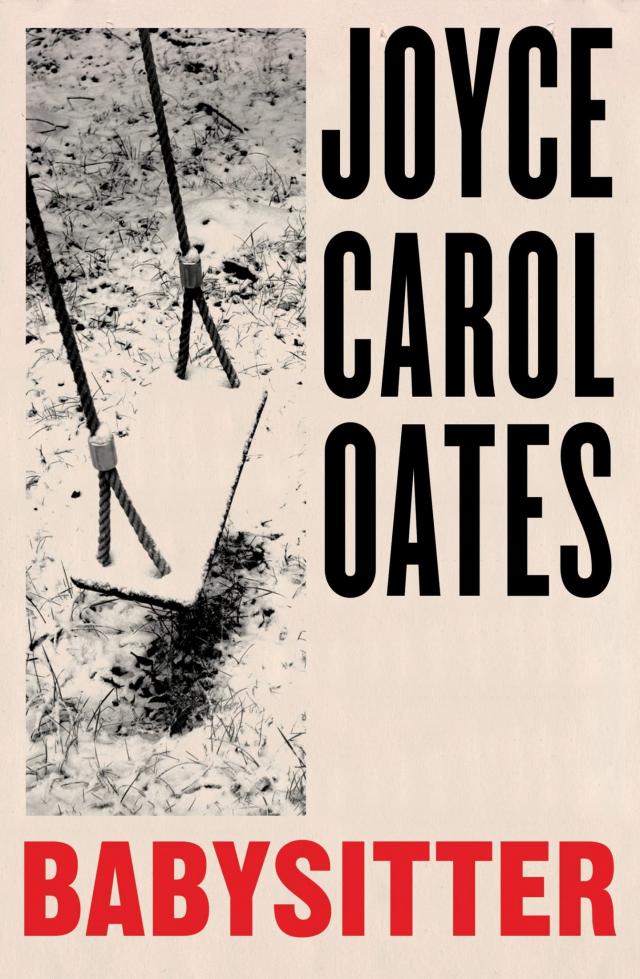
Cover design by Emma Pidsley
Cover photograph © plainpicture/Christine Basier
Joyce Carol Oates asserts the moral right to be identified as the author of this work
A catalogue record for this book is available from the British Library
Information on previously published material appears here.
All rights reserved under International and Pan-American Copyright Conventions. By payment of the required fees, you have been granted the non-exclusive, non-transferable right to access and read the text of this e-book on-screen. No part of this text may be reproduced, transmitted, down-loaded, decompiled, reverse engineered, or stored in or introduced into any information storage and retrieval system, in any form or by any means, whether electronic or mechanical, now known or hereinafter invented, without the express written permission of HarperCollins
Source ISBN: 9780008536817
Ebook Edition © August 2022 ISBN: 9780008536831
Version: 2022-07-06
Dedication
For Dan Halpern
Epigraph
Things don’t happen, it depends upon who comes along.
PAUL BOWLES
There is only one question: Of what am I capable?
Y.K.
Contents
Cover
Title Page
Copyright
Dedication
Epigraph
I
She Asks Herself Why
Do Not Disturb
I Am
When We Died
Only This Once
The Calendar
First Touch
Fever
Empty Ballroom
Lost
Sin
Before Babysitter
Conscience
“Give Mommy a Kiss”
Beautiful Clothes
You Like This
The Adored One
II
When I Died
Infection
Waiting
Breathe
“Children Not Loved & Not Deserved”
Armed
Happiness
Sexual Rival(s)
“Stupid C__t”
Rehearsal
Asks Herself: Why?
Never Look Back to See Where a Smile Has Gone
Predator, Prey
Starboy
Ponytail
Broken
Death Sentence
III
Disguise
No Tears!
“Suspect”
“No Help”
Abduction
Vigil
The Tip
Beautiful Boy
Never Say No
The Intruder
Evidence
Alive!
IV
Mistletoe 1977
“I Am So Sorry”
Dry Heat, September
Kiss Mommy
The Lover: The Call
The Lover: The Assignation
Armor
Pearls
A Door Closes. A Door Opens.
Fairy Tale
Home Invasion
A Loaded Gun
“Suicide”
Lone Lake
The Stone
The Lover. The Stalker.
“Mikhail”
The Emissary
Delivery Boy
Negative
Zink Jewelers Estate & Loan
“For Sale”
“Bless Me, Father”
Do Not Disturb
Acknowledgments
About the Author
Novels by Joyce Carol Oates
About the Publisher
I
She Asks Herself Why
Because he’d touched her. Just her wrist.
A brush of his fingers. A sidelong glance.
Because he’d asked Which one are you?—meaning Which man’s wife?
Because it was a time and a place when to be a woman—(at least, a woman who looked like her)—was to be a man’s wife.
Do Not Disturb
On the sixty-first floor of the hotel tower he awaits her.
No name for him that is likely to be a true name. Very little about him that is likely to be true. Enough for her to know—he, him.
She is the sole passenger in the elevator, which is a sleek glass cubicle rising rapidly and silently into the atrium as into the void.
Below, the crowded hotel lobby sinks away. Beside her, open floors and railings fly downward.
A sleek new way of elevating, so different from the larger, slower-moving, cumbersome elevators of her childhood.
In those elevators, often there were uniformed operators who wore gloves. In elevators like these, you are your own operator.
Lingering in the elevator a faint aroma, is it cigar smoke?
It is December 1977. Smoking in the public areas of private hotels has not yet been banned.
She feels a thrill of vertigo, nausea. Cigar smoke as faint as memory. She shuts her eyes to steady herself.
Her sleek Italian leather handbag, she carries not slung from her right wrist as usual but carried snug beneath her right arm, and steadied and supported by her left hand, for it is perceptibly heavier than usual.
Still, the handbag is so positioned that its gleaming brass label shines outward—Prada.
By instinct, unconscious, vanity’s gesture even on this day—Prada.
Is this the final day of her life, or is this the final day of a life?
Of course she has memorized the number: 6183.
Could be a tattoo at her wrist. His claim on her.
Claim. Doom. She is not a poet, she is not a person adroit or comfortable with words, yet these words seem to her soothing like smooth cool stones laid over the shuttered eyes of the dead to bring them peace.
His room. In fact it’s a suite, two spacious rooms overlooking the Detroit River where he stays when he visits Detroit.
Though it is possible that he has different rooms for different visitors. She would not know this, he has never confided in her.
At the sixty-first floor the cubicle stops with a hiss and a mild jolt. The glass door slides open, she has no choice but to step out. Something has been decided, she has no choice.
Gripping the handbag beneath her arm. Has she no choice?
Wondering is he awaiting her, near the elevator? Eager for her arrival?
She doesn’t see anyone. In neither direction, any human figure.
You can still turn back.
If now, no one will know.
Facing the row of elevators, a glass wall overlooking the riverfront, the river, a fierce white sun. A foreshortened view of Woodward Avenue far below, soundless traffic.
Why isn’t clear. Why she has come here, risking so much.
Never ask why. The challenge is the execution—how.
Making her way along a windowless corridor following the room numbers in their ascent: 6133, 6149, 6160 … So slowly do the numbers rise, she feels a thrill of relief, she will never arrive at 6183.
Underfoot a thick plush carpet, as rosy as the interior of a lung. The far end of the corridor has dissolved. Closed doors to the horizon diminishing in size as they approach infinity.
No reason for her to approach 6183 simply because the person awaiting her inside the room has summoned her, if she wishes she can turn back.
… as if you’ve never been here.
Never left home.
Who would know? No one.
Yet, she doesn’t turn back. Feels herself drawn forward inexorably.
If you inhabit a riddle the only way to solve the riddle is to push forward to the end.
As the sleek glass cubicle ascended swiftly and unhesitatingly to the sixty-first floor, so she makes her way to the suite that is his.
A faint odor of cigar smoke in her hair, in her nostrils that pinch with nausea so remote as to be merely residual, memory.
What is she wearing? A costume she has chosen with care, white linen is always discreet, a silk shirt, red silk Dior scarf gaily at her throat.
Elegantly impractical high heels, Saint Laurent kidskin sinking into the carpet. If she must suddenly turn and run, run for her life, the tight-fitting shoes and the carpet will impede her.
One of those dreams in which she is a child again. She runs, runs. Her feet sink into something like sand, soft-seeming but not soft.
Never making any progress. Each time she has run.
Each time, he looms behind her. Daddy’s strong hands threaten to seize her, lift her by her ribs …
A man’s claim, a doom.
The room numbers accelerate. It is a fact of life to which we never quite adjust ourselves, how out there moves at its allotted speed, no matter our wishes in here.
Approaching 6183 she begins to shiver. It is always the same, she has been here before, that vibrating sensation of a vehicle that is being driven too fast, dangerously fast, in blinding rain, through deep puddles lifting like waves
The nape of her neck rests against a very cold stainless steel table, there is a drain just beneath. Her eyes stare open, unseeing. Only when your eyes are unseeing do you see all.
Yet, she presses on. In the Saint Laurent heels it is still December 1977, she has not yet entered the room for the final time. She is determined that she will come to the end of the riddle.
The brass plaque on the doorframe is 6183, each time it has been 6183.
And the sign hanging from the doorknob, scripted silver letters on lacquered black—the identical warning sign:
PRIVACY PLEASE!
DO NOT DISTURB
I Am
I am a beautiful woman, I have a right to be loved.
I am a desirable woman, I have a right to desire.
When We Died
When we died, our (beautiful) (naked) bodies became inert matter.
When we died, our final, strangled screams were trapped in our throats.
(It would be said that, if you lay beside us in death and if you put your ear to our throats, and if you were worthy, you could hear a faint echo of this final scream.)
When we died, our torment ended. For mercy awaits us all.
When we died, none of you who had begat us were anywhere near.
When we died, we died alone, in terror. Because you were nowhere near.
When we died, ask yourself why did you have children if you don’t love us.
Ask why.
But when we died, our bodies were prepared lovingly for death as none of you would have prepared us.
When we died, our bodies were carefully bathed, the smallest bits of dirt removed from every crevice of our bodies and from beneath our (broken) fingernails, and the fingernails cut with cuticle scissors, rounded and even; as our hair was washed with a gentle shampoo, combed and neatly parted in such a way to suggest that whoever had so tenderly groomed us postmortem had not known us “in life.”
When our bodies were cleansed and as pure as our souls, we were lovingly “memorialized”: photographed.
Where the human eye would betray us and soon forget us, the Eye of the Camera would render us immortal.
After days of captivity (the shortest, three days; the longest, eleven days), our bodies were transported from the place of captivity beside the northern lake in the pine woods to be displayed in public places in Oakland County, Michigan.
Three of us, in snow. Two of us, in the season after the snow had melted, laid on the ground on white terry-cloth towels.
Again, in our “resting places” we were photographed: a (tender) way of saying goodbye.
A casual glance, you’d think that we were large dolls or child mannequins laid on the ground, very still.
Our arms were crossed over our chests, our legs crossed at the ankles as an angel might cross his legs out of modesty.
Our eyes were shut at last in the peace that “passeth understanding.”
(A gentle but forceful thumb on the eyelids—several times required before the eyelid remains shut.)
It would be said that unless you lay close beside us you could not see the blood-tinged ligature around our throats, so tight did it bind our throats.
Our clothing had been laundered and (here was a surprise) even ironed, neatly folded and placed beside our small still naked bodies as if the one who had perpetrated such acts had an intention to be magnanimous, to keep nothing in his possession that was not his.
Because you had been careless and undeserving of us, we were taken from you, and later, our bodies were “returned”—such acts so carefully performed, the one who perpetrated them would never be apprehended nor would you have any name for him that was not a foolish made-up name by a publicity-seeking newspaper reporter—Babysitter!
When we died, our (beautiful, naked) bodies would never advance in time—never age as yours will age. Always the eldest among us would be thirteen, the youngest ten.
And always we will belong to the one who loved us so much he could not bear such love like an avalanche or a flood that overwhelms and suffocates. And our gratitude will expand to infinity that through this love he has transformed us from children of no significance—about whom no one much cared, and whom no one much mourned—to become his.
Only This Once
H’lo, ma’am! Welcome to the Renaissance Grand.”
Broad smile as ma’am enters the opulent seventy-floor hotel. Uniformed doorman, skin the hue of sandstone, exceptionally white teeth bared at the sight of the (white) woman beautifully dressed.
Recognizes Hannah, if not by name: rich man’s wife from one of the (white) suburbs, or a guest at the hotel.
(The very doorman who will shoo away riffraff, any-color-skinned Detroit homeless-beggar riffraff not wanted in the Renaissance Grand or anywhere near.)
Graciously Hannah thanks the uniformed man without seeing him, rarely does Hannah meet the gaze of uniformed persons, hoping not to see in the corner of her eye the white-flashing smile fade as she moves past him, hoping not to feel the man’s scorn for her, contempt. For surely Hannah is imagining this, must be mistaken.
Never look too closely into the motive of a smile.
And—Never look back to see where a smile has gone.
Hannah’s father had been a joker with an aphorism for every life situation. Though you never knew if you were meant to laugh at his words or wince.
And take care, where you smile.
And so not even a furtive glance backward as Hannah makes her way through a corridor of bright-lit boutiques where her stylish high heels rap sharply on the marble floor, turns a corner, escalator, rising into an immense hotel lobby—a vast open atrium lifting out of sight, no ceiling within view, if indeed there is a ceiling for possibly the Renaissance Grand dissolves into the sky over Detroit ever shifting from hard bright blue to dreamlike and vaporous beset by storm clouds massing over the Great Lakes like brooding thoughts that come to no end … Harp music wafts through the airy expanse, an elusive Irish melody that quivers at the brink of recognition. Terraces of waxy-white Easter lilies sharply sweet-smelling, arterial-red tulips, blue hyacinth. At midday the lobby is moderately crowded. Guests displaying ID badges, a convention of computer programmers, another of hairstylists. Murmur of voices like those of an audience at intermission. Undertone of something pulsing, pumping like an artificial heart. The very air dazzles, blinds. A beautiful woman in beautiful clothes is so accustomed to being seen, her ability to see is impeded.
Except today Hannah doesn’t want to be seen. Doesn’t want to be identified. Dark designer sunglasses cover much of her flawless face.
Flawless is worth the price. Any price.
She vows.
Unfaithful to her husband, and to her children. Never will this happen a second time.
Of course: No one will know. Only her, and him.
Through the slow-revolving doors of the Renaissance Grand Hotel, which move of their own volition hastening the woman to her fate. A vast mechanism has been set in motion many millennia ago, she has no choice but to obey.
Approaching the concierge. Licking her lips to speak rehearsed words.
“Excuse me? There should be a message for ‘M.N.’ …”
The concierge looks blank, uncomprehending. Hannah must repeat her request in a more assertive voice.
“… ‘M.N.’ A message …”
Hannah speaks with composure. Here is a woman certain that something very special is waiting for her, she has only to utter the proper words.
Thrilling to one so little practiced in subterfuge! Y.K.’s plan is to leave a note for Hannah with the concierge but not a note addressed to her, that’s to say to H.J., but rather to (fictitious) M.N.
In some quarters in Detroit, the name Jarrett is known: corporate wealth, philanthropy. Her husband’s family, residents of Grosse Pointe. Not likely but still there’s the very real possibility that the concierge would recognize the name, discretion is advised for an adulterous woman.
Since handing her car key to the Renaissance Grand parking attendant Hannah has been inhabiting a role not her own, initials not her own, and so a script not her own—but only this once. She tells herself.
Which one are you?—Hannah is eager to learn.
She’d expected a sealed envelope from the concierge but to her surprise, possibly her mortification, there is just a sheet of hastily folded hotel stationery.