The lost pope, p.1
The Lost Pope, page 1


This book is a work of fiction. Names, characters, places, and incidents are the product of the author’s imagination or are used fictitiously. Any resemblance to actual events, locales, or persons, living or dead, is coincidental.
Copyright © 2023 by Lascaux Media LLC
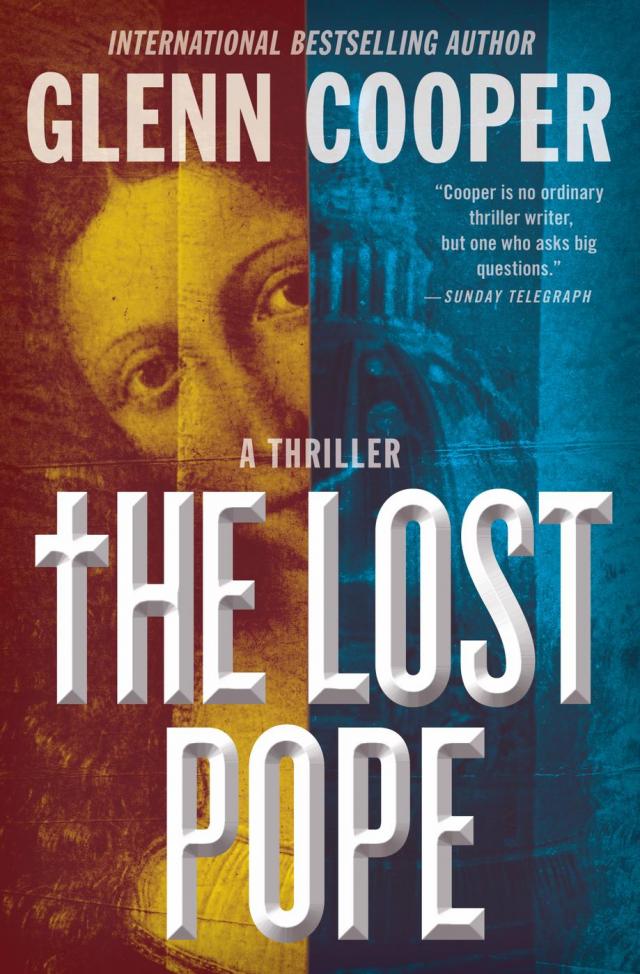
Cover design by Ben Denzer. Cover images: Saint Mary Magdalene, c.1524 (oil on panel) Luini, Bernardino (c.1480-1532) from Bridgeman Images; Vatican and background texture from Getty Images.
Cover copyright © 2023 by Hachette Book Group, Inc.
Hachette Book Group supports the right to free expression and the value of copyright. The purpose of copyright is to encourage writers and artists to produce the creative works that enrich our culture.
The scanning, uploading, and distribution of this book without permission is a theft of the author’s intellectual property. If you would like permission to use material from the book (other than for review purposes), please contact permissions@hbgusa.com. Thank you for your support of the author’s rights.
Grand Central Publishing
Hachette Book Group
1290 Avenue of the Americas, New York, NY 10104
grandcentralpublishing.com
twitter.com/grandcentralpub
First Edition: June 2023
Grand Central Publishing is a division of Hachette Book Group, Inc. The Grand Central Publishing name and logo is a trademark of Hachette Book Group, Inc.
The publisher is not responsible for websites (or their content) that are not owned by the publisher.
The Hachette Speakers Bureau provides a wide range of authors for speaking events. To find out more, go to www.hachettespeakersbureau.com or call (866) 376-6591.
Library of Congress Cataloging-in-Publication Data
Names: Cooper, Glenn, 1953- author.
Title: The lost pope / Glenn Cooper.
Description: First edition. | New York : Grand Central Publishing, 2023.
Identifiers: LCCN 2022053121 | ISBN 9781538721261 (trade paperback) | ISBN
9781538721278 (ebook)
Subjects: LCGFT: Thrillers (Fiction) | Novels.
Classification: LCC PS3603.O582627 L67 2023 | DDC 813/.6--dc23/eng/20221115
LC record available at https://lccn.loc.gov/2022053121
ISBNs: 9781538721261 (trade pbk.), 9781538721278 (ebook)
E3-20230406-NF-DA-ORI
Table of Contents
Cover
Title Page
Copyright
1
2
3
4
5
6
7
8
9
10
11
12
13
14
15
16
17
18
19
20
21
22
23
24
25
26
27
28
29
30
Discover More
About the Author
Also by Glenn Cooper
Acclaim for Glenn Cooper
Explore book giveaways, sneak peeks, deals, and more.
Tap here to learn more.
1
Northern Oasis, Egypt, 67 CE
Brown was her color and the color of this place.
Her eyes were brown, and though her hair was graying, it still showed streaks of its original bronze. When she was young, her skin was light enough to go pink as a newborn mouse at the blush of love, but the sun had been baking it for over fifty years, rendering it the shade of tiger nuts. Her old linen robe, her second skin, was the same nut-brown even after she washed and beat the cloth.
Her coloration matched the arid land, for it too was brown beyond the green fertility of the oasis. Near to the oasis, the soil was dark as cedar bark, but as one moved away from its spring, the terrain lightened from copper to mustard to the bleached tan of the desert sands. The cluster of houses she came upon were companions of the earth, rising organically from the desert floor, their walls of limestone blocks, rough and tawny.
She arrived by mule when the sun was burning near the horizon and northerly winds were whipping fine sand into the air. One of her fellow travelers knocked on the rough door and stepped aside for her.
An old man showed himself and, in Aramaic, asked who she was.
The woman responded, “I am Mary.”
The man, Isaiah, looked at her hard and said, “My hearing is poor. Did you say Mary?”
She lowered her hood, revealing sunken eyes and cracked lips, and said, “Yes, I am Mary. Mary of Magdala. I seek sanctuary.”
Old eyes widened. “From whom do you flee, My Lady?”
“All of them,” she said. “Christians, Jews, Romans, all wish me dead. I am told this is the house of Leah.”
Isaiah escorted Mary and her three male companions to the largest house and asked them to wait in a dimly lit room of generous proportions. The floor was hard-packed dirt. Wooden bowls were stacked on a long dining table. The shutters had been closed to keep the swirling sands at bay, but fine yellow grit penetrated the gaps, coating the table and benches, and the gusting wind set the candles dancing and flashing.
A woman rushed in from an adjoining room. Mary thought she must have been sleeping because her blinking, foggy eyes searched the chamber before settling on her. This woman was younger than Mary, taller, with finely chiseled, patrician features. She had the look of a lady who once might have draped herself in mantles of silk, but here and now she wore a coarse gown that brushed the tops of bare feet. Mary’s days of vanity were long gone, but this woman, with her unlined, lovely face, made her bitterly feel her years.
The woman bowed deeply and said, “I am Leah. Is it true you are Mary Magdalene?”
“I am.”
Leah cried, “The Blessed Matriarch!” and tears moistened her cheeks.
“I have traveled long and far to meet the deacon Leah,” Mary said, using the honorific Greek word, diakonos. “You are known to the Christian world.”
Leah dropped to the ground and kissed Mary’s feet. “Blessed Lady, your presence in my house is a gift from the Lord.”
Mary pulled her up by the shoulders and gazed tenderly at her face.
“Tell me, why have you come to my house?” Leah asked.
“I am old, and I am weary of running for my life. The Lord knows my days are numbered. I want my story told before I die. I would have you tell it.”
Hearing of visitors, the community of some twenty souls spilled from their houses and peered through the cracks in the shutters until Leah invited them inside. Then, one by one, the adults fell to their knees, and they too kissed Mary’s feet while their children watched in wide-eyed curiosity. After hasty preparations, the visitors were served a simple meal of bread, boiled vegetables, and diluted wine, and apologies flew over the lack of meat. Mary expressed gratitude for the hospitality on offer, but Leah dispatched a lad to buy a goat so they might have a feast on the morrow.
At the communal table, Leah asked Mary to give the blessing.
“This is your house,” Mary said. “The blessing should be yours.”
The travelers were not pressed into conversation, for it was evident they were hungry and weak. Yet, fortified by food and drink, one of Mary’s men, Quintus, a brawny young fellow with long ringlets of golden hair, responded robustly to a boy of ten who could no longer contain his curiosity at the muscular presence.
“Where are you from?” the boy asked.
“Me? I am from Rome. Do you know where that is?”
The boy shook his head.
“The lad was born here,” Leah said. “This place is all he knows.”
“Perhaps you will see it one day, boy,” Quintus said.
A man at Leah’s side sneered across the table. “I can tell by your accent that you do not speak your born tongue. I think maybe you were a Roman soldier,” he said, dipping the last word in poison.
“That is true, brother,” was the cheerful reply. “I was a Praetorian guard who served the emperor. It was three years back when I met Simon Peter and Mary. Mary hated me before she loved me, for I was Simon Peter’s jailer.”
Mary reached out to touch Quintus’s hand lightly. “Oh, how I love him now.”
“When I heard Simon Peter speak of the Christ, he opened my eyes as never before,” Quintus said. “He baptized me in the name of the Father, the Son, and the Holy Spirit, and I abandoned my post. Renouncing my past was easy.” His lips curled into a smile. “Learning Aramaic was hard.”
Leah returned the smile. “Our children were born Christian, but the rest of us are converts, Jews from Jerusalem.”
Mary looked up from her bowl and said, “It was Paul who converted you, was it not?”
“Yes, it was Paul, seventeen years ago. We congregated with him for a time, and when he departed Jerusalem for Antioch, Jacob, my husband, founded our own Christian house. From the beginning we suffered vile persecution at the hands of the authorities, and then one night the Romans took Jacob away and executed him. It fell upon me to lead the house. I persuaded my brethren to leave for Egypt, and we settled here, in this far-flung place, so that we might worship the Lord in peace. For us, it began with Paul. A day does not pass when I do not think of him and pray he is well.”
Sadness fell over Mary’s face like a veil. “Paul is dead, dear lady. Nero beheaded him in Rome, three years after he cru cified Simon Peter. We heard this from a Christian traveler who stayed with us in Antioch.”
Her words cast a pall over the room, and the women began to sob, all but Leah, who nodded solemnly and said, “The Lord has surely welcomed Paul to his side in Heaven. We forgive his executioners, and we will pray for their souls.”
When they had eaten their fill, Leah invited Mary to walk with her. Swathed in shawls, they ambled, hand in hand, through a grove of olive trees, the stillness of the cool night broken by cricket song and the occasional bleating of the newly purchased goat.
“It is terrible you had to flee,” Leah said. “My heart aches for you.”
The woman’s empathy touched Mary. “For much of my life, I was so loved and cherished. It has come as a shock to become despised.”
She felt Leah’s hand tighten around hers. “Who despises you, Blessed Lady?”
“First, it was the Romans. After they killed Simon Peter, we feared we too would be taken to Nero’s Circus for the cruel pleasures of the mob. We left Rome hastily for Antioch, where we had dwelled before. We rejoined the Christian community there, and we established our house of prayer among them in the Kerateion, the Jewish district. I am pleased to say we convinced many a Jew to follow the path of Jesus Christ, but therein lay a problem. The rabbis were angered, and we learned that brutes had been pressed into foul service to murder us. And so we fled once again to Galilee, my homeland, where the Jewish and Roman war had subsided.”
“Pilgrims have told us there are many Christians in Israel now,” Leah said.
“That is so, and among them are elders who can remember the days when Jesus walked the Earth, teaching and making miracles. Oh, it was good to be home again. For well nigh a year, we were happy there, and crowds thronged to hear us preach the word of the Lord. Then one dark day, we received an emissary from Rome who caused us to flee once again.”
“Who sent this emissary?”
“The wretch, Linus. Word reached him of the adulations heaped upon our ministry, and his message to me was a terrible one. Cease your ministry or die by the sword. So-called Christians prepared to carry out his orders. We could understand why Romans and Jews wanted us dead, but our fellow brothers in Christ? It was too much to bear.”
“Envy must have darkened Linus’s heart,” Leah said. She squeezed Mary’s hand again. “My poor lady. May I tell you something? You have been my inspiration. Not Simon Peter. Not Paul. You. If not for your life and deeds, I could not have found the strength to establish this house and lead this community. When I was a young woman, I felt my voice stifled by the rabbis and the elders. They wanted us only to keep house and make babies. We could not recite the Torah. We could not worship with men as equals. When I became a Christian, I learned of your life and how precious you were to Jesus and his ministry. Though we never met, it was you who gave me the courage to preach the word of our Lord after they killed my Jacob.”
It had been a good while since Mary felt the flutter of joy in her breast. This warm hand in hers was precious flesh. It had been an arduous journey from Jerusalem across the scorching desert to reach the oasis. Many wanted to follow her, but Mary insisted that families should not be uprooted and sent to an uncertain fate. At her final meal with her flock, she hugged each member and wept with them, and before dawn on the Jewish Sabbath day, she bade farewell to her homeland. Only Quintus and two other stalwarts accompanied her, and truth be told, there was nothing Mary could have said or done to keep the faithful Quintus from her side. Mile after grueling mile, Mary rocked on the swayback of her mule and felt her life force draining, and she was sure that death would come to her in Egypt, the ancient land of pharaohs that Moses had fled. But the melancholy that befell her on the journey was at once washed away by the cold, clean, anointing water that was this woman, Leah.
“You and I are much alike,” Mary said, her voice strengthening. “We have both lost loved ones to the wickedness of Rome. We both had the fortitude to take our places at the head of the table. We are truly sisters in Christ. There is no time to waste. In the morning, I would begin my account of my life in the service of Jesus of Nazareth.”
Leah said, “I will listen in rapt attention, Blessed Matriarch. We have papyrus, and we have ink. Isaiah will be your scribe. He can write in Greek, the language of the world, for Christians everywhere need to know about you and your acts. In the years to come, they will sing the praises of the three pillars of our faith—Jesus Christ, our Lord and Savior, Simon Peter, the rock upon which the Church was built, and Mary of Magdala, the mother of the Church.” She let go of Mary’s hand and clasped hers together in prayer. “We shall call your story the Gospel of Mary.”
2
The present
Although most of the passengers on Delta flight 124 from Boston to Rome were American, Portuguese was the language that ruled the roost that night.
Cal Donovan estimated that three-quarters of his fellow travelers were of Azorean descent. As the plane streaked over the Atlantic, they burst into traditional Azorean folk songs every few minutes, creating an atmosphere more like a soccer match than an international flight. Cal had given up on sleep. Although business class was a little less raucous than economy, the curtains separating the cabins did nothing to dampen the festivities. Not that he minded. He was in a partying mood himself.
It wasn’t every day you were heading to the inauguration of one of your closest friends to become the next pope.
The flight attendants discovered that Cal spoke Italian like a native, and one of them leaned over and said in a husky Milanese accent, “There seems to be a problem with your glass.”
“And what problem would that be?”
“It’s empty. Same again?”
He answered with a smile.
She returned with another Grey Goose on the rocks and declared the problem solved.
“Temporarily,” he replied.
“You had an accident?” she said, pointing at the walking cast poking from under his trouser leg.
“It was a fight, actually. You should have seen the other guy.”
She took it as a joke and went about her business. It wasn’t. The other guy was dead.
Most people with a broken leg gain weight from inactivity. Cal had lost a few pounds, and for the first time since he was a skinny kid in the army, his cheeks were hollowed out. He wasn’t the type to dwell on emotions or blame a poor appetite on stress. He just cinched his belt a notch and got on with things.
If anything, a lighter Cal was even more handsome than his recent cover shot in The Improper Bostonian’s issue on Boston’s most eligible singles. His jawline was sharper, and his dark eyes sunken deeper were even more penetrating. He seemed to have something of the night about him.
The lavatories in business class were occupied, so he headed to the rear, unaware that a priest had left a mid-cabin seat to follow him. When he finished up and unlocked the door, the priest, a portly middle-aged fellow with a toothy grin, was waiting for him in the galley.
“Professor Donovan,” he said.
Cal couldn’t place him. “Yeah, hi, how are you?” he said, hoping the fellow would identify himself.
“You probably don’t remember me. I’m Father Manny Cardoza. We met a few years ago when you gave a lecture in New Bedford on the Portuguese Inquisition. You were there with Cardinal Da Silva—oh my goodness, it’s still so fresh—I mean the Holy Father.”
The best Cal could muster was a vague recollection of a sea of nuns and priests inside an overheated community center. “Oh yes, Father Cardoza, it’s good to see you again. It is fresh, isn’t it?”
Only five days had passed since the cardinal protodeacon had appeared on the Benediction Loggia of St. Peter’s Basilica, leaned into a microphone, and addressed the massive crowd at St. Peter’s Square. “I announce to you a great joy! We have a pope! The Most Eminent and Reverend Lord, Lord Rodrigo, Cardinal of the Holy Roman Church, Da Silva, who takes to himself the name John the Twenty-Fourth.”
On the second ballot of the conclave—the shortest conclave on record—Cal’s dear friend Rodrigo Da Silva became the two hundred sixty-seventh pope of the Catholic Church, the second born in Portugal, and the first American pope.
“You’re limping. You were injured?”
“I fell in a library. Occupational hazard.”
“At Harvard?”