The case of the rolling.., p.1
The Case of the Rolling Bones, page 1


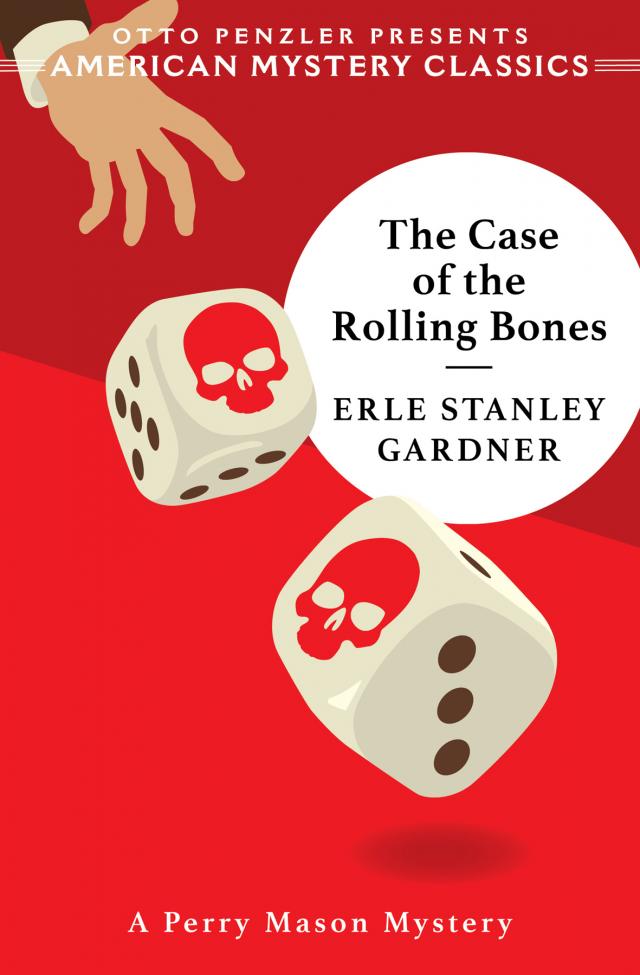
THE CASE OF THE
ROLLING BONES
ERLE STANLEY
GARDNER
Introduction by
OTTO
PENZLER
AMERICAN
MYSTERY
CLASSICS
CONTENTS
Introduction
Chapter 1
Chapter 2
Chapter 3
Chapter 4
Chapter 5
Chapter 6
Chapter 7
Chapter 8
Chapter 9
Chapter 10
Chapter 11
Chapter 12
Chapter 13
Chapter 14
Chapter 15
INTRODUCTION
SOME YEARS ago, I was having lunch with two friends, Hollywood writers who were born and raised on the East Coast, became best friends in junior high school, and started collaborating on writing mystery fiction when they were still in high school. They liked the idea of writing for television, which turned out to be a good decision, as Richard Levinson and William Link went on to become two of the most success writers in the history of television.
In addition to creating such TV series as Columbo, Mannix, Ellery Queen, and Murder She Wrote, as well as being acclaimed for their made-for-television movies, they were great fans and surprisingly knowledgeable about all kinds of detective stories but they were especially devoted to Golden Age American writers, most notably Queen, John Dickson Carr, and Erle Stanley Gardner. Link even collected first editions by all three authors.
Although Queen and Carr were generally regarded as the greatest plotters of their time among American writers, Levinson and Link argued against the notion that Gardner was inferior to either of them. They may have been right.
I have been rereading quite a few books by all three writers over the past few years as I wanted to pick the best of their work to be reissued in the American Mystery Classics series, especially since I’ve been writing introductions to many of the books. While Queen and Carr are famous for their fair-play tales of observation and deduction, Gardner’s prolificity and enormous popularity has slightly obscured his enormous talent for creating baffling scenarios with deftly hidden clues.
In the typical Perry Mason case, innocent people accused of murder, the most likely suspects with all evidence pointed directly at them, go to Mason to be rescued from their apparently hopeless situation. These tend to be high profile murder cases, making headlines, and inevitably leading to the public humiliation of District Attorney Hamilton Burger.
If this seems formulaic, if it seems predictable, it is. Even if the ending is almost certainly a foregone conclusion, Gardner’s genius is showing how Mason gets to the finish line. If a Perry Mason novel were food, it would be chicken soup or macaroni and cheese. Comfort food for the soul.
The Case of the Rolling Bones opens with a clear case of blackmail, though the person being blackmailed claims he isn’t. One of his checks for $20,000 is cashed, even though the banker calls to tell him the woman cashing the check is “flashily dressed,” which he regards as highly suggestive. As there are complications, a hearing is set before a judge, who learns that the check-writer is now in a sanitarium, having been forced to enter against his will.
It is not long before the police are searching for a someone wanted for killing the same man in two different states—thirty-three years apart. The confounding puzzle of what happened to the dead man’s toes is a challenge, though the knife in his back appears to have little connection to the mystery of his toes. The judge wants answers to these puzzles and threatens Mason with disbarment if he fails to come up with convincing explanations for the various elements of the case.
On several occasions, Erle Stanley said, “I’m no writer.”
There were numerous voices who felt differently. In 1934, only a year after his first novel, The Case of the Velvets Claws, was published, G.K. Chesterton wrote admiringly of his work. Sinclair Lewis, in an article on writers in 1937, wrote, “…the magicians are the authors of literate detective stories: Agatha Christie, Francis Iles, Erle Stanley Gardner, H.C. Bailey.” In the next decades, the Time magazine reviewer of a Perry Mason novel quoted Evelyn Waugh, a close friend of Graham Greene, as saying he wished he could “write whodunits like Erle Stanley Gardner and Margery Allingham.”
To talk about Gardner, it is inevitable that large numbers come into play. Here are a few:
• 86—Number of Perry Mason books; eighty-two novels, four short story collections.
• 130—Number of mystery novels written by Gardner.
• 1,200,000—The number of words that Gardner wrote annually during most of the 1920s and 1930s. That is a novel a month, plus a stack of short stories, for a fifteen-year stretch.
• 2,400,000—The number of words Gardner wrote in his most productive year, 1932.
• 300,000,000—The number of books Gardner has sold in the United States alone, making him the best-selling writer in the history of American literature.
What cannot be quantified is what magic resided in that indefatigable brain that made so many millions of readers come back, book after book, for more of the same. Not that it was exactly the same.
Although the Perry Mason novels seemed to have had a formula, the series changed dramatically over the years. Gardner started his career as a writer for the pulp magazines that flourished in the 1920s and 1930s. Authors were famously paid a penny a word by most of the pulps, but the top writers in the top magazines managed to get all the way up to three cents a word. This munificent fee was reserved for the best of the best of their time, some of whom remain popular and successful to the present day (Dashiell Hammett, Raymond Chandler, Cornell Woolrich), some of whom are remembered and read mostly by the modest coterie that avidly reads and collects pulp fiction (Carroll John Daly, Arthur Leo Zagat, Arthur J. Burks). One who earned the big bucks regularly, especially when he wrote for Black Mask, the greatest of the pulps, was Erle Stanley Gardner.
Gardner had learned and honed his craft in the pulps, so it is not surprising that the earliest Perry Mason novels were hard-boiled, tough-guy books, with Mason as a fearless, two-fisted battler, rather than the calm, self-possessed, figure that most readers remember today. Reading the first Mason novel, The Case of the Velvet Claws, published in 1933, and those published as little as ten years later, it is difficult to remember that they were written by the same author. Both styles, by the way, were first-rate, just different.
Gardner was born in Malden, Massachusetts, in 1889. Because his father was a mining engineer, he traveled often as a child. As a teenager, he participated in professional boxing as well as promoting unlicensed matches, placing himself at risk of criminal prosecution, which gave him an interest in the law. He took a job as a typist at a California law firm and after reading law for fifty hours a week for three years, he was admitted to the California bar. He practiced in Oxnard from 1911 to 1918, gaining a reputation as a champion of the underdog through his defense of poor Mexican and Chinese clients.
He left to become a tire salesman in order to earn more money but he missed the courtroom and joined another law firm in 1921. It is then that he started to write fiction, hoping that he could augment his modest income. He worked a full day at court, followed that with several hours of research in the law library, then went home to write fiction into the small hours, setting a goal of at least 4,000 words a day. He sold two stories in 1921, none in 1922, and only one in 1923, but it was to the prestigious Black Mask. The following year, thirteen of his stories saw print, five of them in Black Mask. Over the next decade he wrote nearly fifteen million words and sold hundreds of stories, many pseudonymously so that he could have multiple stories in a single magazine, each under a different name.
In 1932, he finally took a vacation, an extended trip to China, since he had become so financially successful. That is also the year in which he began to submit his first novel, The Case of the Velvet Claws. It was rejected by several publishers before William Morrow took it, and Gardner published every mystery with that house for the rest of his life. Thayer Hobson, then the president of Morrow, suggested that the protagonist of that book, Perry Mason, should become a series character and Gardner agreed.
The Mason novels became an immediate success so Gardner resigned from his law practice to devote full time to writing. He was eager to have privacy so acquired parcels of land in the Southwest and eventually settled into the “Gardner Fiction Factory” on a thousand-acre ranch in Temecula, California. The ranch had a dozen guest cottages and trailers to house his support staff of twenty employees, all of whom are reported to have called him “Uncle Erle.” Among them were six secretaries, all working full time, transcribing his dictated novels, non-fiction books and articles, and correspondence.
He was intensely interested in prison conditions and was a strong advocate of reform. In 1948, he formed the Court of Last Resort, a private organization dedicated to helping those believed to have been unfairly incarcerated. The group succeeded in freeing many unjustly convicted men and Gardner wrote a book, The Court of Last Resort, describing the group’s work; it won an Edgar for the best fact crime book of the year.
In the 1960s, Gardner became alarmed at some changes in American literature. He told the New York Times, “I have always aimed my fiction at the masses who constitute the solid backbone of America, I have tried to keep faith with the American family. In a day when the prevailing m ystery story trends are towards sex, sadism, and seduction, I try to base my stories on speed, situation, and suspense.”
While Gardner wrote prolifically about a wide variety of characters under many pseudonyms, most notably thirty novels about Bertha Cook and Donald Lam under the nom de plume A.A. Fair, all his books give evidence of clearly identifiable characteristics. There is a minimum of description and a maximum of dialogue. This was carried to a logical conclusion in the lengthy courtroom interrogations of the Perry Mason series. Mason and Gardner’s other heroes are not averse to breaking the exact letter of the law in order to secure what they consider to be justice. They share contempt for pomposity. Villains or deserving victims are often self-important, wealthy individuals who can usually be identified because Gardner has given them two last names (such as Harrington Faulkner).
Mason’s clients usually have something to hide and, although they are ultimately proven innocent, their secretiveness makes them appear suspect.
Clues sometimes take a back seat in the Perry Mason books, with crisp dialogue and hectic action taking the forefront—a structure clearly adopted from his days as a pulp writer. Crime and motivation are not paragons of originality as Gardner wanted readers to identify with his characters.
Much like the Sherlock Holmes and Nero Wolfe stories, the Perry Mason novels also feature certain other characters on a regular basis. The most prominent is Della Street, Mason’s secretary and the love of his life. Knowing that Mason would not allow her to work, she has refused his marriage proposals on five separate occasions. She has, however, remained steadfastly loyal, risking her life and freedom on his behalf; she has been arrested five times while performing her job.
Also present at all times is Paul Drake, the private detective who handles the lawyer’s investigative work. He is invariably at Mason’s side in times of stress, though he frequently complains that the work is bad for his digestion.
Hamilton Burger is the district attorney whose office has never successfully prosecuted one of Mason’s clients. In a large percentage of those cases, the client was arrested through the efforts of the attorney’s implacable (albeit friendly) foe, Lieutenant Arthur Tragg.
Although Mason is invariably well-prepared, he is so skilled at courtroom procedure that he can think on his feet and ask just the right question to befuddle a witness, embarrass a prosecutor, and exonerate a client.
The staggering popularity of the Perry Mason novels inevitably led to him being portrayed in other media, including six motion pictures in the 1930s, a successful radio series in the 1940s, and a top-rated television series starring Raymond Burr that began in 1957 and ran for a decade. More than a half-century later, it is still a staple of late-night television re-runs.
—OTTO PENZLER
New York, April 2023
1
PERRY MASON stared at the morning mail with evident distaste. He raised his eyes to where his secretary was standing at his elbow, and said, “Gosh, Della, can’t you scare me up a good mystery?”
Della Street said, “I’ve handled all the routine mail. This is the important stuff which needs your personal attention.”
Mason pushed the mail to one side. “Shucks, Della, I hate letters. Letters are inanimate. I like people. People are animate. I like to puzzle with human problems.”
Della Street regarded the discarded mail with solicitous eyes, and steeled herself against the magnetism of Mason’s boyish grin. “After all,” she said, “you can’t eat dessert all the time, Chief. You have to have some bread and butter.”
“Not dessert, Della,” Mason said. “I want meat, red meat, and lots of it. Come on, be a good girl, and tell me about the clients.”
Della Street sighed. “A Miss Leeds, a Miss Milicant, and a Mr. Barkler are waiting in the outer office. They’re together, but Miss Leeds wants to talk with you for a few moments before you see the others.”
“What’s it about, Della?”
“A rich man whose relatives want his money.”
“I don’t like rich people,” Mason said, pushing his hands down in his pockets. “I like poor people.”
“Why?” she asked, her voice showing her interest.
“Darned if I know,” Mason said. “Rich people worry too much, and their problems are too damn petty. They stew up a high blood pressure over a one-point drop in the interest rate. Poor people get right down to brass tacks: love, hunger, murder, forgery, embezzlement—things a man can sink his teeth into, things he can sympathize with.”
“I told them I thought you wouldn’t be interested,” Della Street said, “that you specialized in trial work.”
Mason sunk his chin on his chest and frowned thoughtfully. At length, he said, “I’ll see Miss Leeds anyway. She has my curiosity aroused. Three people come together. One person wants to see me before the other two. . . . Send her in, Della.”
Della Street looked pointedly at the pile of mail.
“I’ll answer it this afternoon,” he promised. “Let’s see Miss Leeds.”
She slipped through the door to the outer office to return in a few moments with a young woman whose quick, nervous step was indicative of an impatient temperament.
“Phyllis Leeds,” Della Street said.
Miss Leeds crossed rapidly over to Mason’s desk, giving the lawyer an impression of vivid blue eyes which studied him in swift appraisal.
“Thank you so much for seeing me, Mr. Mason,” she said as Della Street withdrew.
Mason bowed. “Sit down,” he said. “Tell me what it’s about.”
She sat down on the extreme edge of the big leather chair across from Mason’s desk, and said, “I can only keep the others waiting a minute or two. I want to give you the sketch.”
Mason opened his office humidor, extended a tray containing four of the better-known brands of cigarettes.
“Smoke?” he asked.
“Thanks,” she said. As Mason held his match, she took a deep drag, exhaled streaming smoke from her nostrils, then, with a quick, nervous gesture, whipped the cigarette from her lips, and said, “I want to see you about my Uncle Alden—Alden E. Leeds.”
“What about him?” Mason asked.
“I have two cousins and two uncles living. Uncle Alden was the black sheep of the family. He ran away and went to sea when he was only fourteen. No one knows where he went or what he did. He doesn’t like to talk about his adventures, but he’s been all over the world. When I was fifteen, he came back here to settle down. I think the family were inclined to look down their noses at him until they found out that Uncle Alden was exceedingly wealthy.”
“How old is your Uncle Alden?” Mason asked.
“Seventy-two, I believe. He was the oldest of the boys. I’m living in his house, manage most of his financial affairs, and his correspondence.”
“Go on,” Mason said.
Phyllis Leeds said, “I’ll have to hit the high spots. Uncle Alden has never married. Recently he met Emily Milicant. . . . She’s waiting in the outer office. He fell for her hard.
“The relatives are furious. They’re afraid they’ll lose out on the money. They want to have Uncle Alden declared incompetent.”
“And how do you feel about it?”
“I feel that it’s Uncle Alden’s money and he can do with it just as he pleases.”
“You’re friendly with Emily Milicant?”
“Not particularly.”
“But you’d be glad to see them married?”
“No,” she said, “I don’t think I would, but I do want Uncle Alden to be free to do what he wants.”
“And what,” Mason asked, “did you want me to do?”
“Isn’t it the law that a person can manage his own property unless his mind becomes so affected that other people can take advantage of him?”
“Something to that effect,” Mason said.
Phyllis Leeds said, “They’re trying to show that he can be imposed upon, and there are certain things they must never find out.”
“What for instance?”
She said, “That’s what I want Emily Milicant to tell you. But before she told you, I wanted you to—well, get the sketch. I think she wants to marry Uncle Alden. You’ll have to make allowances for that. Ned Barkler is one of Uncle Alden’s closest friends. He knew Uncle up in the Klondike years ago. I asked him to come along.”