

The dragon lensman, p.1
The Dragon Lensman, page 1


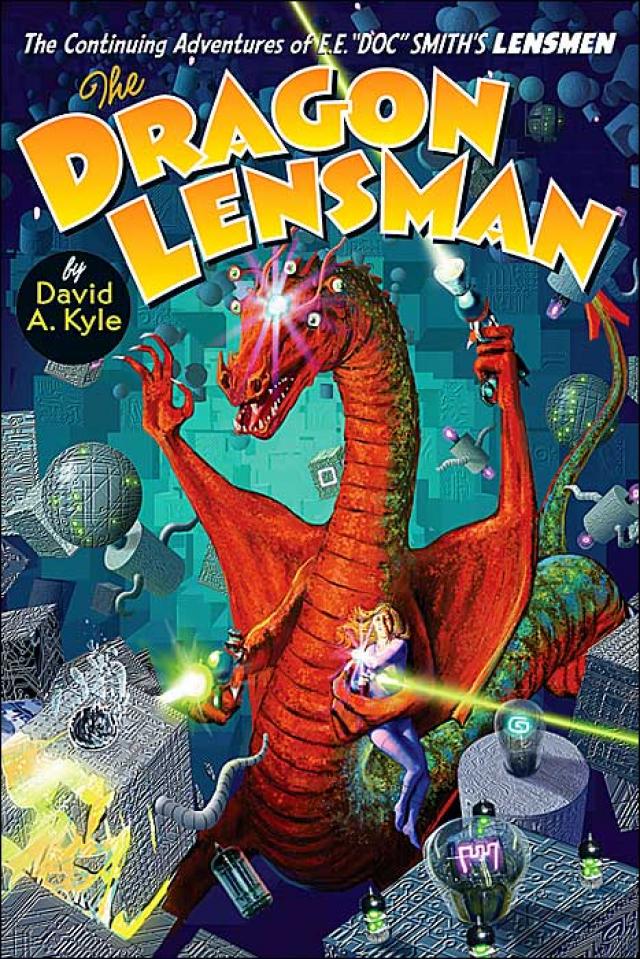
The Dragon Lensman
An Astonishing New Adventure in the Lensman Series
Created By E.E. "Doc" Smith
By David A. Kyle
Introduction
When David Kyle told me he was writing the story of Worsel the Velantian as the first book in the continuation of the Lensman series, I was pleasantly surprised-though, if truth be told, a bit apprehensive. Bantam Books had approved his original outline, and the Smith heirs had given their consent to the effort-but, I thought, better no additional Lensman stories than poor Lensman stories.
More than two decades ago, as Fantasy Press, I published the original hard-back editions of the Lensman tales. I was responsible for the expansion of the original four books into the seven that now make up the series. With the publication of The Vortex Blaster I thought, with regret, that I had enjoyed my last excursion into the Universe of Arisia and the Lens. At one time Doc Smith had considered writing the stories of two of the non-human Lensman-Worsel of Velantia Three and Nadreck of Palain Seven-but because of a lack of market, with the specialty science fiction book publishers faltering or out of business, he had abandoned the idea.
Now David Kyle was writing the saga of Worsel, the Dragon Lensman. The passing years bad not dimmed my interest in the Universe of the Galactic Patrol-but could Dave pick up the threads of another writer's creation? Could he recreate the atmosphere and characters of E. E. "Doc" Smith. It was a tall order-and I was skeptical.
In February 1979 I was a house guest of the very hospitable Ruth and David Kyle at Hobe Sound, Florida. There I read the manuscript of The Dragon Lensman-and I was surprised and delighted! Not only had Dave captured the style of a Doc Smith epic, not only had he blended his own original concepts into the Lensman series, but he had written an exciting, first rate science fiction novel, fully able to stand on its own merits.
Were he able to read it, Doc, I'm sure, would be pleased. In The Dragon Lensman, through David A. Kyle, E. E. "Doc" Smith has returned to literary life!
Lloyd Arthur Eshbach Myerstown, Pennsylvania March 1979
Foreword
For all those of you who have previously read E. E. "Doc" Smith's accounts of the Galactic Patrol and the Arisian-Eddorian conflict, most of this Foreword is redundant.
You are hereby waved on to the last three paragraphs beginning with "The chronicler . .
" For those of you who are newcomers, or whose memories have clouded with the years, a few words of background are certainly desirable.
Billions of years ago Mankind began to evolve on a small planet of the star Sol. Billions of years before that, Tellus, also known as Earth, had been created in the time of the great Coalescence. And billions of years before that event, our Milky Way galaxy, also known as the First Galaxy, was inhospitable to life, almost barren of planets and virtually deserted.
The life-spores of Man existed before all these things, incredibly far back for uncountable eons. The ancestral source was the race of the Arisians from the beginning of Time, Visualizers of the Cosmic All, future guardians of Civilization.
Fully as ancient, nearly equal in macrocosmic mind power, and as evil as the Arisians were good, were the Eddorians of the Second Galaxy. Whereas the Arisians were of our own space-time continuum, the Eddorians were not, coming on their wandering planet to the Second Galaxy from a different, horribly alien plenum. They were dedicated to a continuing search for more worlds to sate their lust for dominance. Their ambition was at last to be glutted by the Coalescence. In that cataclysmic event their enslaved star island passed, end to end, through our own galaxy. The stupendous interstellar forces which were unleashed thus created billions of new worlds. The inevitable conflict between the Arisians and the Eddorians, the prototype confrontation between Good and Evil, had arrived. The struggle began for the lives and souls of the many races that were evolving.
As Civilization grew, the Elders of Arisia surreptitiously encouraged the new life forms to resist the tyranny and to shape their independent ways toward perfection.
In the universal deceit which developed around the rise of the Eddorian-inspired Boskonian outlaws, the greatest secret of all was kept by the Arisians. Their immortal enemies, the Eddorians, were kept forever ignorant of their existence. The Arisians were the covert and incognito patrons of those opposing the evil Eddorians; they were the real, formidable counterforce in the eons-long contest with Boskonia and its masters.
Four widely-scattered planets with advanced life forms were the nucleus of the resistance in the First Galaxy: Tellus, known as Earth or Terra, Velantia, Rigel Four, and Palain Seven. Each, subtly encouraged by the Arisians, developed four dissimilar races, but it was Tellus which became the focal point for the organized force against Boskone and its puppet-masters. From Tellus came the formation of the Galactic Patrol, to be the instrument of Eddorian destruction. Also from Tellus came the Kinnison and Samms families leading to their zenith, the union of their foremost leaders, Kimball Kinnison, the Gray Lensman, and Clarrissa MacDougall, the Red Lensman.
Within generations of the First Lensman, Virgil Samms, many Lensmen had been recruited into a special corps of Patrolmen. They were outstanding military leaders and scientists, possessing extraordinary natural, non-mutated abilities. The Lensman name came from the peculiar semi-living Lens each one wore, usually on a wrist, a unique gift obtained from Mentor of Arisia. These incredible instruments, radiant crystal complexities, were badges of honor, forgery-proof identification, and amplifiers of psychic powers. They were awarded only to those chosen by Mentor itself, the amorphous fusion-entity of the four intellectually greatest Arisian Molders of Civilization.
The psychical match to the quintessential individuality of the Lensman was exact-so perfect, in fact, that it released latent parapsychic or psi powers, telepathy in particular.
Only the original recipient of the Lens could wear it-for anyone else it brought instant death.
The best Lensmen eventually were chosen for the highest honor which the Patrol could offer: Unattached status. Known as Gray Lensmen from the plain leather uniforms they now wore, unlike the black-and-silver-and-gold ones of the rest of the officers and men, these distinguished fellows of the Service were free agents. With their freedom for independent action they were the personification of the Patrol itself, accountable to no one but the highest authorities.
Although Kimball Kinnison was not the first Gray Lensman, he was, despite his youth, one of the outstanding ones. His demonstrated ability led to his being recalled to Arisia by Mentor to receive the next level of training as a Second Stage Lensman. Kimball was the first of four to come from each of the original planets, even ahead of Worsel the Velantian, whose mind actually was better developed and trained, and of vastly greater power. The Tellurian, however, was chosen for greater capacity and more varied growth, especially for the force of his driving will, so characteristic of his race.
As the legion of Lensmen grew with its special leaders, so did the scale of the conflict, until, finally, both galaxies and their neighboring star clusters were involved.
The climax came at last. Kimball Kinnison, as the fighting leader of the Galactic Patrol, the military arm of the Galactic Council which by now represented all of Civilization, directed the decisive battles by the Grand Fleet against the massive forces of the Boskonians. The culmination of the years of galactic struggle came with the giant dogfight of spaceships which was The Battle of Klovia. The Boskonian conspiracy was considered destroyed. Kimball Kinnison, the newly-appointed Galactic Coordinator, and his bride Cris were taking on their new responsibilities for Civilization. Peace was spreading through the two galaxies.
Only Mentor knew that the Eddorians bad not been defeated, merely delayed, in their goal to conquer the galaxies and to make them their playthings.
The chronicler of these events has been, up to now, the famous research historian of the Galactic Patrol, E. E. "Doc" Smith. His efforts have been monumental; a half dozen books by him have traced the rise of Tellurian culture and the formation of the Patrol, all part of the struggle to protect and advance Civilization in the Milky Way. His reports have been presented in his inimitable way as popularized novels. More than a decade ago Doc Smith, a warm-hearted and virile man, passed on to "the next plane of existence" to join the Arisians. Since then no books describing the exploits of the fabulous Lensmen have been written, although there really has been no need, because the end of the terrible Boskonian threat was told and the evil Eddorians were shown to have been obliterated.
Doc Smith, the historian, did his work well-and thoroughly-to lead us to the plateau of the evolution of the Universe with the coming of the Children of the Lens.
There is, however, a period in the history, as reported by the doctor, which has not been documented. A score of years lie between the marriage of Kinnison to his Cris and the emergence from childhood of their offspring. There was in these decades no "energy stasis"-that which always moves forward just to stand still inevitably leads upward and downward simultaneously. Historical events were taking place-but they become history only when they are recorded and reported.
The well-established historical research department which E. E. Smith so successfully created is still at work collecting and assembling facts and eye-witness accounts. There is a wealth of material available for further tales of the Patrol and its personnel. This book is the first one written without the direct supervision of the doctor. Your new historian knew "Doc" for many years, having met him in his space-roamer's garb of "North west Smith of Earth," at the Second Worldcon in Chicago, Tellus-and, having had him for a lifetime as a guide, appreciates that he was unique. Let no one be deluded, least of all your present historian, into thinking that this new series of books will be indistinguishable from the presentations of the original histories. Unique "Doc" was, and unique he will remain. But the spirit will not be changed-the entire historical research department will see to that. This historian, whose responsibility is not taken lightly, pledges fidelity to the "E. E. Smith way" knowing that The Galactic Roamers will not tolerate anything less.
David A. Kyle Tellus
Prologue
After the destruction of Onlo and the fall of Thrale and the "cleaning up" of Lyrane VIII, with the Boskonians no longer fomenting trouble in the First Galaxy, the Galactic Patrol was prepared to become a police force instead of a military machine. The Patrol's four greatest operatives, the illustrious Second Stage Lensmen, were confronted with their most difficult tasks-making adjustments to peace. Each one faced his problem in his own way, representative as he was of his own distinctive race and culture. Kimball Kinnison, the Tellurian, humankind's incredible hero, had little choice but to accept the responsibility of being Galactic Coordinator. Nadreck, the Palainian, frigid-blooded poison-breather with his metabolic extension into the fourth dimension, carried on his psychological research and pursued his personal death feud against the escaped Kandron of Onlo.
Tregonsee, the hard-shelled Rigellian, profound meditator on the Cosmos, "put away his Grays" and explored the galaxies with his superior sense of perception, completely committed to his "Project Quicksilver."
The fourth Second Stage Lensman, Worsel, the Velantian, the biggest, smartest and most ferocious of all the million Patrolmen, remained in heart and in soul-and on active duty--a Gray Lensman.
Worsel was a frightening apparition to anyone who had never met a Velantian before. At first glance he seemed grotesquely hideous, a nightmarish reptile, all fangs and claws.
The day he arrived at Pok, the Planetoid of Knowledge, to begin the most incredible of his adventures, he frightened the old soldier-scientist assigned to meet him.
Two utterly different kinds of Galactic Patrolmen met at that moment in the docking-port reception chamber when he slithered, then leaped, from his personal spacecraft. Most Patrolmen were fighting men, accustomed to deadly battle in the far depths of space, but some were laboratory soldiers, forever sheltered in their quiet isolation, at war only with facts and figures. Worsel was the epitome of the superlative warrior, one of the unique quartet of Lensmen, the elite of the elite; the other was an elderly scientist, still non-combatant even in his Third-and-Final Life-Restoration. The old man in the youthful body was content to end his days on the Pok research team in his endless quest for knowledge. He had never met a Velantian; he had never met a Second Stage Lensman; now he met both in the living flesh of a single creature.
The actual meeting was the most excitement he had had in his life, more exciting by far than even his appointment as Curator of Pok. And now he was terrified by the encounter.
No books, no three-D pictures had prepared him for what he saw: the incredible appearance of the reknowned hero who looked and smelled of the violence that had swirled, and still swirled, around the Galactic Patrol.
The human was in the twilight of his life, but the Velantian Lensman, suggesting a cross between a winged pterosaur and a long-necked Tyrannosaurus Rex with brains, was at the peak of his magnificent physical and mental powers. Like a serpentine dragon, the creature emerged from his polished shell, metal door clanging against metal wall, and loomed before the man. The twelve-foot ceiling was touched by a monstrous reptilian head. The walls were crowded by a massive body with its multiple arms, two conventional but two bat-winged, with clawed thumb and hooked fingers. The face seemed to be entirely sharp white teeth. Several bright eyes tilted down toward him on the ends of waving stalks, each glittering eye fixed on him. One of the pair of regular limbs reached out to him, muscles rippling along scaly forearm, claws retracted at the end of a sinewy palm and long slender fingers. The Curator shrank back, even as he reached out his own fingers for a timid welcoming handshake.
That the saurian wore a GP uniform, so scanty it was more like a harness, was reassuring, though the conspicuous gray leather of a Second Stage Lensman was immensely intimidating. This snake-thing was the most remarkable Lensman among a most remarkable group in the Civilized Universe. And yet, for all its potent might, it was most honored by the good entities of the billions of planets and most feared by the bad, not for its titantic strength, but for its intellect. Here was Worsel, within touch, the greatest pragmatic thinker in the Galactic Patrol-such greatness left the old scientist's mind numb. His whole body, in fact, was numb.
Then he knew that the numbness was the spell of the extraordinary power of the dragon's telepathic mind. Worsel, who did not speak, was in his mind, greeting him, reassuring him, making him feel at ease. The dragon which had come to Pok was not a plebeian Occidental one, symbolizing evil, but a patrician Oriental one, intrinsically benevolent.
The human being, for the first time in his life, felt that he himself might be a member of an inferior race-and to his surprise he was pleased to consider such an unthinkable idea.
Thus Worsel, the Dragon Lensman, came to Pok.
Chapter 1
Section 60
Two figures stood facing each other. Both were sleek and powerful, both stood twenty feet tall, both were mighty engines of destruction. One was alive, a dragon, and one was not, a machine.
The dragon was Worsel, Lensman, sitting half on his haunches, half on the base of his tail, horny hands on slim hips, soft palms and taloned fingers turned outward. His narrow head on lithe neck was cocked; a large grin of sharp and gleaming teeth split his jaws. A pair of his many extensible eyes was part way out on their stalks, moving slowly up and down in admiration.
"You," Worsel said to the war machine, "are a beauty." He did not say so out loud; he spoke mentally, as was his custom, for his brain was as impressive and potent as his body. In fact, even some of his alien friends believed he could not talk at all. Worsel reached out and, above the war machine's jointed hips and below the cluster of gun snouts, patted the smooth curves of its dureum shell body, his claws drumming a quick tattoo on the mental skin. He brought his snout within an inch of the oval perception-lens of the robot's head, his breath misting on the cool glass and plastisteel. Worsel, stirring another pair of eyes into use, peered now into each sensor lens and orifice, concentrating the prodigious power of his mind on the brain of the machine.
He found it simple, perfect-and dead. Yet intuition told him he was getting close to some kind of revelation.
"Not you," Worsel said. "You're no troublemaker right now." He clicked his teeth and ran his slender tongue along the sharp edges and up over his lips. "You could be, though, you could be-or another potent thing like you," he said. "Too bad you aren't what I'm searching for; I wouldn't be wasting any more time. And it would be fun, too, to take you apart-over your objections."
Worsel reared back gracefully, swinging his tail gently around in a manner more mammalian than reptilian. He stretched his neck and looked beyond the huge soldier robot to the smaller, non-anthropomorphic war machines. They were all cold and lifeless, like the robot, though far less sinister, relics of a past of faded power and menace. True, they were operational, some even armed, but not one had either the wit or the ability to turn his own key or to press his own button. No, he was getting closer, but the mystery that he pursued did not hide among them. Yet somewhere in The Great Hall of the Machines into which his investigation had led him he knew he would soon find-something.
What was it he sought? He didn't know-there were only the reports, the strange beliefs that something-some thing-was amiss in Pok. At first he considered the request frivolous.
A Lensman used to intergalactic problems didn't go mouse hunting. Only his sentimental attachment for Pok had brought him here. But almost from the moment of his arrival he had sensed the strangeness in the atmosphere. The scientists were nervous; the Patrolmen were tense; now he himself was aware of some great event or danger. He was exceedingly glad he, had come.






