

L a 46, p.1
L.A. 46, page 1


Jerry eBooks
No copyright 2015 by Jerry eBooks
No rights reserved. All parts of this book may be reproduced in any form and by any means for any purpose without any prior written consent of anyone.
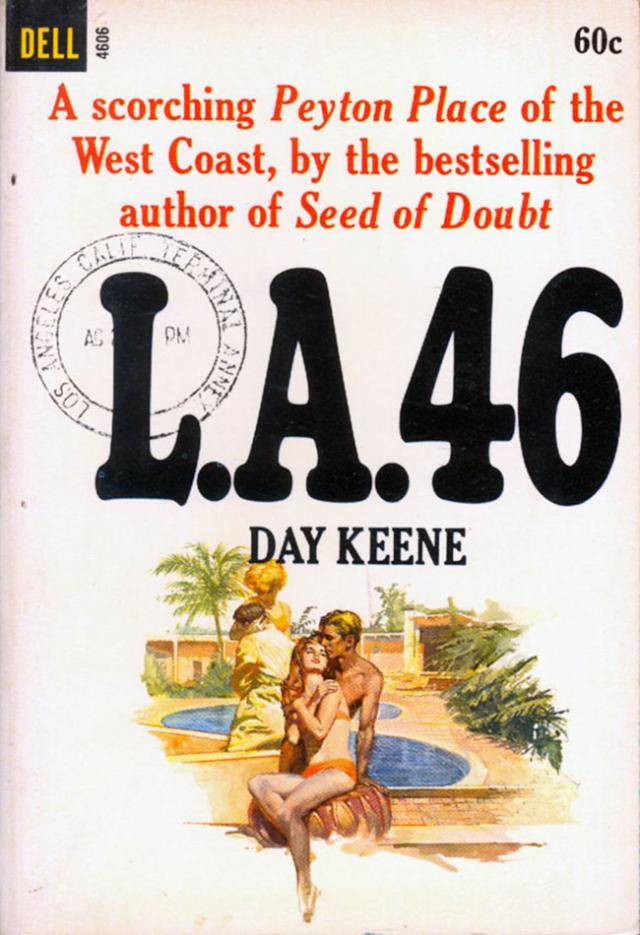
L.A.46
DR. JACK GAM:
The life of Hollywood’s most famous star was in his hands, and one of its most winning courtesans was on his mind.
RUBY MORGAN:
She had a past she wouldn’t talk about, and a future she’d do anything to get.
EVA MAZERIC:
She found a man she could love, and hid a secret that could destroy them both.
MARTY ROMERO:
A famous athlete whose personal life was no match for his public image.
GRACE ARNESS:
A beautiful model who pursued a strange kind of love.
LA.46
The big explosive novel of a handful of strangers whose lives intertwined in a shattering moment of crisis and passion.
Published by
DELL PUBLISHING CO., INC.
750 Third Avenue, New York 17, N.Y.
Copyright © 1964, Day Keene
Dell Publishing Co., Inc.
All rights reserved
This is a work of fiction and all characters
and events in this story are fictional,
and any resemblance to real persons
is purely coincidental.
First printing—February, 1964
Printed in U.S.A.
“In the beginning, God created the heaven and the earth” and “man in His own image, in the image of God created He him; male and female created He them. And God blessed them, and God said unto them, be fruitful and multiply and replenish the earth . . .”
GENESIS
1
VIEW APARTMENTS
$275 UP SGLS & 1 BDR/NEW BUILD-
ING, DLX/PRI PATIOS/Air cond/
Pool/subt. gar/ Marble baths/tub & stall
shower / elev / Luxury furn / conv / shpg
/transp
CASA DEL SOL
7225-35 Villa Way
Po 9-3827
It was the season for rain, but for the fifth week in a row no substantial fall of rain materialized and the heat lay heavy on the dusty eucalyptus and the few remaining olive trees lining the street.
To the long dead vaqueros who once grazed stunted Spanish steers on the sparse vegetation of the holly-covered hills, the heat and lack of moisture would have been a natural phenomenon. Por Dios. When one lives on a desert one knows there are years when the cold and the rains do not come. Eso es natural. Mañana. Next month, next year, it will rain.
Mr. Hanson wasn’t philosophical. The unseasonable heat made his feet swell. Perspiring as heavily as he did, no matter how he padded the leather strap of his bag it chafed his shoulder. There were days, and this was one of them, when he could wish that Don Felipe de Neve, one time governor of California, his small escort of soldiers, the eleven original families, and three priests, hadn’t marched from San Gabriel Mission to found (with appropriate solemn rites and ceremonies, at least so the history books said) El Pueblo de Nuestra Senora La Reina de Los Angeles de Porcincula.
If Don Felipe could come back, undoubtedly he would be very proud of the transformation that had taken place during the last hundred and seventy-two years. However, the dead Don Felipe didn’t have to carry the mail. Hanson did.
The aging postman paused for a breather in front of the apartment building next to the Casa del Sol. He’d seen a few changes himself. In his forty-two years with the postal department, his route had grown from a homey area of single dwellings in which everyone knew each other. He’d even had two orange groves, one olive grove, and a chicken ranch on his route. Now it was a district built almost solid with multi-units peopled by strangers. And they said this was just the beginning.
He shifted his bulk from one foot to the other, then removed his gray fiber sun helmet and wiped the sweat from its leather sling as he admired the relatively new Casa del Sol.
If you liked apartment buildings, it was a nice looking building. Of pseudo Moorish architecture, its thirty-four ultramodern units topped by a two-bedroom penthouse were built around a paved inner court containing a large, heated, swimming pool and an attractively landscaped private garden. Rising from the crest of the hill, it gave a permanent view of the city from the windows of the second and third floor apartments and the penthouse. It was in a choice rental location and rentals were correspondingly high.
Considering his own take-home pay, Hanson wondered as he’d wondered a hundred times how young couples paid the high rentals. The answer to that was obvious. In most instances, both the man and the woman worked. And what with supermarket checkers earning a hundred twenty-five dollars a week, second-rate fighters like Marty the Wonder Boy getting fabulous fees for allowing their glass jaws to be televised, and pretty little rips like Colette Dupar charging and getting from fifty to a hundred dollars a tumble, almost anyone could afford to live anywhere. Then, too, the turnover, especially in furnished units, was tremendous.
He transferred his attention from the building to the trees and shrubbery highlighting the entrance. Despite the prolonged drought, the traveler palms were doing well. So were the bougainvillaea and hibiscus and sun azaleas and bird of paradise plants. He couldn’t say as much for the struggling dichondra. Nowadays the patches of grass along his route always made him a little sad. Time was when grass had been something for children to play on. Now it was utilized mainly by French poodles and dachshunds and cocker spaniels from neighboring apartment buildings whose owners or managers permitted pets but who, wisely, had substituted white or colored chipped gravel for lawns in front of their own buildings.
As Hanson watched, the new tenant in Apartment 23 in the Casa del Sol, he couldn’t recall his name—he was a retired captain of Chicago police and subscribed to The Illinois Policeman and the National Peace Officers’ Journal—Johnson, Captain Johnson, that was his name, walked through the massive stone arch of the building. He was smoking a big cigar and stood pretending he wasn’t admiring the physical attributes of the attractive young brunette wearing tight white shorts and a skimpy halter, who, in turn, was gazing off into space, pretending she was totally unaware of what the French poodle on the other end of the leash she held was doing.
Hanson returned his sun helmet to his head and his handkerchief to his hip pocket. It was a good thing that when he was a young man the female of the species had been at least a trifle more discreet about displaying the natural charms with which a kindly Providence and puberty had endowed them. Not that he hadn’t seen plenty in forty-two years of carrying the mail. Come to think of it, there wasn’t anything he hadn’t seen. Even now, with only a year to go for his pension, he still got a kick out of seeing the younger female tenants come to their doors to sign for registered or postage-due mail wearing little or next to nothing, under the erroneous opinion that all mailmen were eunuchs and that, along with snow, nor rain, nor heat, nor gloom of night, not even a pair of pretty breasts or a well-turned backside could stay these couriers from the swift completion of their appointed rounds.
It would be interesting to know what would have happened if he had attempted to take advantage of a number of situations. Unfortunately, now that he was sixty-four such speculation was purely rhetorical.
He delivered the mail to the building in front of which he was standing, then climbed on up the hill to the Casa del Sol, unstrapping the packet of first class mail he’d sorted at the station.
It was comparatively cool under the open arch shading the foyer. As he unlocked the banks of mailboxes the news that he was in the building spread. He was surrounded almost immediately by those tenants, at this time of day mostly female, who had been relaxing in the pool or sunning in the lanai.
As he racked the mail, Hanson smiled at or nodded to those he knew by sight. Plump Mrs. Katz had bleached her hair. Colette was wearing a new red bikini that barely covered the more salient features of her stock-in-trade. The pretty little teen-ager from Apartment 34 was still playing hooky from high school and waiting nervously to snag the notice from her teacher before her sister or brother-in-law got it. Mrs. Leslie was looking for a letter from her daughter, Mrs. Eden for one from England. In spite of his past reputation as producer and director, Mr. Melkha was obviously finding it difficult to connect with another studio. The only other male in the group, Marty the Wonder Boy, better known to the police and the postal department as Mauricio Romero, was still sporting a discolored eye from his (rigged, Hanson was willing to bet) recently televised ten-round fight with the fourth-ranked contender.
There were a half dozen letters for Dr. Gam. As many for John Johns, the television personality. Mrs. Fine’s son had written her, at long last, probably for money.
From years of practice, Hanson flipped the letters into their respective slots like so many playing cards . . . Mr. Richard Eagan . . . Mr. and Mrs. Ernest Katz. . . Miss Colette Dupar . . . a half dozen letters, all of them bills, addressed to Mrs. Malloy the manager of the building . . . one for Miss Lili Marlene, the stripper at the Purple Parrot . . . Miss Grace Arness . . . Miss Patty Paul. . . three letters for the airline pilots in Apartment 21 . . . two for Captain Johnson, one of them his pension check . . . one apiece for Mr. and Mrs. Barry Eden . . . Mr. Mauricio Romero . . . Mr. and Mrs. Harry Morton.
When he finished distributing the first class mail, Hanson set a self-addressed, returned, book manuscript for the free-lance writer in Apartment 30 on the ledge over the boxes, then sorted the periodicals, stalling a little as he did, hoping that young Mrs. Mazeric might come down for her mail and save him a trip.
He glanced at the letter he’d set aside. It was postmarked West Berlin, addressed to Miss Eva Hoffman, 3780 Willow Place, Anaheim, California, and forwarded from there with the penciled notation—“Try Mrs. Paul Mazeric, 7225 Villa Way, L.A. 46.”
He didn’t recall ever hearing the blond girl’s maiden name, but the letter was probably for her. She and her husband were one of a number of refugee couples on his route. He liked the young matron. He liked Mrs. Mazeric very much. His fat face brightened as he thought of her. She was as pretty as a little red and yellow wagon. More, in spite of her slight accent, unlike some refugees he’d met, while she might have spent most of her childhood in various European displaced persons’ camps, she was as American as apple pie.
2
When she finished dressing for her two o’clock appointment with Jack Gam, Eva slid open the sliding glass doors, walked out onto the small private patio adjoining the apartment, and stood gripping the wrought iron rail as she looked out over the city.
It was warm, uncomfortably so, but there was no smog. She’d heard that on a real clear day you could see Catalina. It was possible, but she never had. She could see the toylike clusters of buildings that were the beach cities and beyond them the blue of the ocean. Closer by, she could see the Beverly Hills business district and in the other direction the tall white spires of the La Brea towers rising out of The Miracle Mile.
That was what she needed, a miracle. Time was when she’d felt that she was a part of all that she could see. Now she wasn’t so certain. She felt suddenly alien, as she had ever since Mr. Hanson had delivered the letter from Miss Hilda Schmidt Both, God help her, meant well.
She lowered her eyes to the four-block-distant boulevard. There was a normal flow of traffic. In spite of the heat, the sidewalks on both sides of the boulevard were dotted with pedestrians, all of them moving restlessly toward some predetermined goal. For some reason, probably because the letter had awakened memories she had hoped were dead, the dwarfed figures on the boulevard reminded her of the boy in the last camp she’d been in before her transfer to Camp Ein und Zwanzig.
That had been after Tante Gertrude died, when loneliness had been added to anxiety.
“Be a good little girl,” the camp officials had told her. “Be patient. We’re doing our best to try to locate any surviving members of your family.”
Be good. Be patient. What else could she be?
Because, even then, she’d had an insatiable desire for knowledge, because she preferred to read whatever books she could find in the camp library to playing with dolls, or engaging in the intimate games and practices the other girls engaged in after school hours, they’d thought she was a little queer. And because at that period she hadn’t begun to display any of the signs of budding womanhood, the boys had paid no attention to her.
Eva got a cigarette from the end table in the apartment and returned to the railing. Then, overnight, her small body had begun to burgeon. And one summer day when she’d been eleven, with the heat lying on the treeless camp as hot as the California sun now shining on her, she’d sought relief by taking a cold shower in the temporarily deserted woman’s washroom. It was then she’d had her first—Eva sucked hard at the cigarette she was smoking—“adventure” was as good a word as any.
She’d been soaping her upper body and the faint golden sheen portending imminent puberty, when she looked up to see a boy, a new boy in camp, regarding her from an open window.
“You know something, kid,” he complimented her in German. “You’re kinda little and skinny, but you’re pretty. Just like a little “blond doll.”
“Danke,” she thanked him. Then she made herself modest with her hands while she waited for him to go away.
But instead of going away, the boy looked over his shoulder, and climbed through the window and walked over to the shower stall.
“Very pretty,” he said as he examined her at closer range.
As she remembered, she’d been slightly flustered but more pleased by his compliments and attention, the first she had received since Tante Gertrude had died, than she’d been embarrassed.
“Danke,” she thanked him again.
Then the boy, Eva judged he must be about twelve and almost as shy and nervous as she was, took the soap from her hand and offered to help her soap herself, and because she hadn’t known how to stop him, she let him. But after he’d soaped her budding breasts and her backside and down between her thighs, he got so excited he dropped the soap and he reached up and turned off the water and got into the shower stall with her.
“What’s your name?” he asked.
“Eva Koszeg,” she said.
Then he asked how she would like to be his girl and before she could answer he kissed her on the mouth and ran his hand down between her legs again and a moment later she felt his hot, hard flesh pressing against her as he begged her to stand with her feet farther apart.
Eva closed her eyes at the memory. And, incredible as it seemed now, because it was the first time she’d ever been kissed by a boy and perhaps a latent something in her had been awakened by his caresses, but mostly because she was lonely and glad someone was paying some attention to her, she’d done what he asked her to do.
While she had stood frightened and ignorant but passively willing, desperately wanting to belong in some way to someone, the boy, as homeless and lonely as she was—two babes wandering in a modem purgatory not even Dante could have imagined—had tried to have intercourse with her up against the metal wall of the shower stall. But because she was still a virgin he’d had trouble effecting an entrance and before he could they heard the click of heels on the wooden walk outside the building. Frantic, she tried to push him away, but the boy gripped her buttocks and held her tight to him and kept right on with what he was doing until he breathed hard one last time. Then, making himself decent, he scrambled out of the window, leaving her to face the woman who had walked in through the washroom door.
Once her first fierce surge of gratitude or whatever it was had been broken, she’d been so ashamed she wished she could die. She’d fully expected the woman to report them both to the camp commandant. But the woman had merely looked from her flushed face to her stained thighs, then at the open window, and smiled.
“Have a good time?”
Eva opened her eyes. Now, thanks to the letter that had come in the morning mail, this was the sort of thing she was going to have to tell an almost total stranger.
She reentered the air-conditioned apartment, closed the sliding door, and washed her face in cold water. Then, after putting on fresh makeup, she made certain the seams of her stockings were straight, dabbed the lobes of her ears with perfume, touched the cleft between her breasts with the stopper, and searched through the top drawer of the dresser until she found a pair of short mesh gloves that harmonized with the dress she was wearing.
She hoped she was doing the right thing. She thought she was. She had to talk to someone who could and would advise her as to the legal, moral, and genetic aspects of the situation. And she’d been lucky that Dr. Gam’s secretary had been willing to give her an appointment on such short notice.
It wasn’t, Eva supposed, the sort of thing one normally took to a psychiatrist. But, aside from the pudgy obstetrician who had confirmed her suspicion she was pregnant, Gam was the only doctor she knew. Even if he was a fellow tenant, he’d always been very proper toward her, and if she insisted on paying his regular fee for psychiatric consultation the coming session in his Beverly Hills office should be on an entirely impersonal basis.
She debated writing Paul a note and decided to leave word with Mrs. Katz that she would be back in a few hours.
After the early childhood she’d known, she hadn’t expected much of life. She might have known the past months were too good to be true. When she’d learned that she was pregnant it had been, to her, a sign that God had forgiven her for any mistakes to which she might have been a party in the past. She wasn’t particularly religious, but she’d even taken a taxi down to the Church of the Blessed Sacrament on Sunset Boulevard, and while she hadn’t mustered enough courage to go to confession, she had lighted a candle to and thanked the Blessed Virgin. She’d prayed:






