

Broken city, p.1
Broken City, page 1


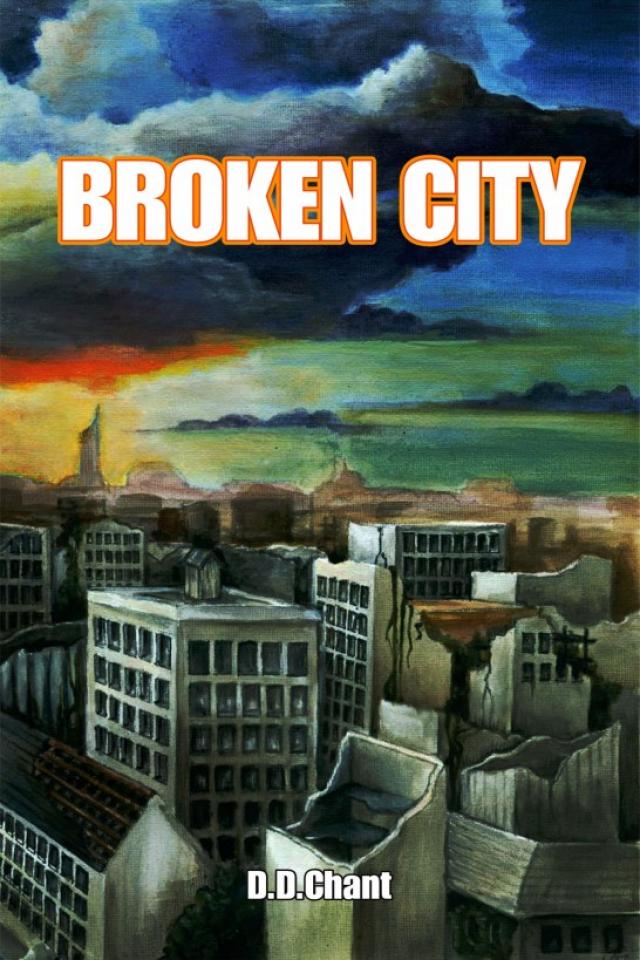
BROKEN CITY
Broken City Series
Book One
By
D.D. Chant
Broken City (Broken City, #1)
Copyright © 2010 by D.D. Chant
Smashwords Edition
All rights reserved in all media. No part of this book may be used or reproduced without written permission, except in the case of brief quotations embodied in critical articles and reviews.
This is a work of fiction. All names, characters, locales and incidents are products of the author’s imagination and any resemblance to actual people, places or events are coincidental or fictionalised.
For Granddad
3 John v 14
Chapter One
Deeta
When I was a little girl my Grandmother used to tell me stories. My favourite was about the time her family moved to Devon. It seemed so idyllic, I sometimes wonder if it could have been like that, or if time had coloured her memories. If it had I can’t blame her.
I am sitting on the roof of our building as I think about all of this, behind the barricades of course. No bullets, stray or otherwise, can hit me from here. It always makes me a little sad to look across the blackened structures and smoking rubble that is our city.
I’m told that once it was beautiful. I can never really see it as anything but a harrowing reminder of atrocities that should never have been able to happen, that so called normal people should not have been able to commit.
Yet they did and they still do.
I never saw it at the height of its magnificence; it’s golden years, when it seemed so strong and unbreakable. My father talks of it sometimes. He says it’s important that we know, that we don’t remain ignorant of what happened. Mother never speaks of before. She’s a little afraid, I think, to look back at what she had. Her life was so comfortable, so carefree, so different from the struggle we face now.
Of course, we learnt the particulars in our lessons with Uncle Jep when we were children. I understand how it all came about and how, after it had happened, everything was in disarray. The thought of hunger had driven people into a mad panic almost before the full extent of the damage had become known. There had been looting, angry mobs, and so much violence. Murders had been casual happenings in the street, committed over the barest necessities needed to sustain life.
You are asking, no doubt, what the government was doing while all of this happened.
The answer is nothing.
There was nothing they could do.
The police force had been one of the first casualties to organisation. People had gone crazy and there was no way to control them. It didn’t take long for the police to stop trying. The hospitals had gone on a little longer, but once their supplies ran out they too had become empty, desolate monuments to the past.
In desperation the government turned to the army, hoping that some sort of order could be established. However, it was too late. The army had split into factions, the military bases turning into private militia under the commanding officer of each base. They were in the enviable position of having control of vast resources. With the promise of food and stability in a world in which both had become luxuries, soldiers agreed to stay and obey orders. When base commanders received orders from government those orders had been ignored, and each base had acted purely in its own interests.
Yet their supplies had not lasted forever.
Thirty years was a long time, and now they were just tribes the same as any other.
“Don’t sit so close to the barricade, Deeta.”
Even before I look up I know to whom the voice belongs.
“You worry too much, Tom.”
Tomasz shakes his head, a worried frown creasing his forehead.
“It isn’t possible to worry too much.” As he sits down beside me I feel his holster brush my arm. As used as I am to guns I shiver, and Tom looks down at me sharply.
“If you’re cold we’d better go back in,” he offers.
“No, I’m fine.”
I like Tom. He used to notice me when I was a kid and it was condescension on his part to pay me any attention.
“What are you doing up here anyway, Deeta?”
I laugh and shrug my shoulders, gesturing towards the skyline.
“Obviously I came up to look at our lovely view.”
He raises his left eyebrow, the one with a scar above it.
“Has Keya been difficult again?”
When we refer to Keya being difficult, we mean bad tempered. I could use a more fitting adjective, but I am too much of a lady. However, on this occasion it was not Keya’s sharp tongue that had sent me scampering to the rooftop.
Tom takes out his knife and begins to sharpen it.
“You’re an odd sort of a girl aren’t you, Deeta?” His eyes are concentrated on his work, but I know better than to think that that means he’s in any way preoccupied.
Tom has a way of putting things so you’re unsure if he regards what he’s just remarked on as good or bad. Lots of people don’t like it, it makes them nervous of him, but I think it’s cool. No matter how hard I try though, my attempts at emulating him have only been met with laughter, much to my embarrassment.
We sit awhile not speaking, in silence but for the scrape of the knife against metal. In the distance the sound of a skirmish disturbs the illusion of tranquillity. Bitterly I reflect that even sitting together peacefully we cannot forget the need to fight.
“When do you go out next, Tom?”
“When we need to.”
At this stage most people would think that Tom was being offish with them.
I am not most people.
You see, Tom really believes that he has answered my question. It simply hasn’t occurred to him that I require something more of him.
I sit quietly, watching him fold his knife away.
“What’s it like out there?”
I’ve asked this question many times before, and I guess I’m asking the wrong person. He answers me in exactly the same way he always does.
“More of the same.” He stands, surveying the scene before us. “Believe me, Deeta: you’ve got the best of it staying here.”
That’s exactly what Dad says but I want to know they’re right, not just believe.
Of course you don’t know what I’m talking about, do you? We live in a tower block in the City. I suppose you could say it is our village, and we only leave it when we have to. When we need something from outside our Guard and the Hunters go ‘out’ to get it.
I will never go ‘out’.
The fifty-eight floors of this building are, to all intents and purposes, my world. I will never leave it. I was born here, I will marry here, I will have my children here, and I will die here. My life, from beginning to end, will have no impact on anyone outside. To them I might never have existed.
I sigh gustily.
“I wish I could see it, Tom, just the once.”
“It would do you more harm than good.”
Tom looks down at me where I sprawl, and in his eyes I can see sympathy.
Those who join the Guard are specially selected for their durability. Only those who have suffered a significant loss in their lives, or have in some way endured hardships difficult to bear, or those like Tom who’ve spent some of their lives on the streets, may join.
Those of us who have not experienced anything like that are protected, against ourselves and against what we would see out there. My father says that the City is full of brutality and horror, and that I wouldn’t survive its harshness. That’s why I’m deemed unsuitable; because it’s thought that I’ve not had the necessary conditioning to endure the difficulties I’d face.
I scramble up from my position on the floor.
“It’s not fair, Tom! What’s so wrong with me that I can’t go?”
It’s a rhetorical question so I’m rather surprised when he pushes the hair back from my face and tilts my chin up. His dark blue eyes scrutinize me carefully but I know that, although he has taken in every feature, it isn’t me he sees.
“Sometimes I can see Tara looking at me straight out of your eyes.”
His look, burning with an intensity that’s foreign to me, lasts for several moments. Finally he shakes his head and releases me.
“You can’t go out there, Deeta; you’re too soft. It would kill you to see what the City has turned into.”
I turn away, looking out over the distance, as a hot blush of embarrassed shame floods my cheeks and neck.
“I didn’t mean it like that. It’s a good thing, Deeta. You’re what we all should be, but what circumstance has twisted into something else. Against all the odds you’ve remained free of all the savagery out there.” He waves his hand in a gesture that encompasses the outside world. “You’re untouched by it all.”
I feel stung by this statement, and my head jerks round toward him. He’s calm, trying to make me understand what he means. I know he’s unaware that his words have hurt me.
“I guess you’re right, Tom.” I stand, feeling the tears beginning to smart behind my eyes. All I want is to leave before they start their inevitable course down my face. That would only make him feel bad, and he doesn’t deserve to. I know he didn’t mean to upset me.
I think I only take four or five steps before I feel his hand encircle my wrist and pull me round to face him. I suppose I must have looked wounded, maybe even accusing, because he seems stricken. It’s as though he only just realises what he has said and all its implications.
“Am I free f
I hold his gaze only briefly, and then my head sinks in shame. It was a spiteful thing to say. Of course Tom doesn’t think that Tara’s loss didn’t sadden me. However, my loss was insignificant compared to his and Nella’s. Tom lost his girlfriend and Nella lost her sister.
“I – I didn’t mean to sound horrid about it, Tom.”
Tom shrugs his shoulders, dismissing what must be for him an incredibly difficult subject.
“Come on it’s freezing out here.”
Tom walks back to the door, and I take a last look over the City.
-------
The different tribes in the City started to appear not long after the break down. Families began to group together for safety and take in orphans. My father says that when the violence began after the break down, most of the casualties were men. He said that the women were often forced into lives that were worse than death, but I’m not sure what he means by that and I’ve never quite had the guts to ask him.
The City was overrun with orphans, or street kids, as we call them. With the constant fighting, and different tribes dying out or being wiped out, there is always street kids. Some join the bigger tribes, looking for safety. Some start, or join, gangs.
The gangs are different from tribes; they’re semi-nomadic and very violent. My father always gets really sad when he talks about them; he says that they never really have a chance. They survive in the only way they know how; by using violence and fear to take what they want.
Tom was an orphan, though I don’t think he was ever part of a gang. Professor Jepsjon took him in when Tom was just a boy, after the professor had lost his own wife and child. He says that he saw something in the frightened boy that called out to him in kinship.
Everyone remained curiously unsurprised when Tom came home from one of his trips ‘out’ with a child, a little boy of three or four. I wasn’t surprised exactly; Tom had good reason to feel strongly about the street kids, having been one himself. I was pretty sceptical as to whether he could look after him, though. That was foolish of me, as Tom can do pretty much everything - and I’m not exaggerating.
The building that we live in belongs to our tribe. As tribes go we’re pretty small, and we try to be non-combatant. Our territories are quite remote, which helps, and mostly no one bothers us.
The upside to being a small tribe is that we have lots of space. If we wanted to we could go days without seeing anyone, just by keeping to our own floor.
The Grey family lives on the floor above us. I’ve mentioned Keya already. She’s Mr and Mrs Green’s only child, and their pride and joy. I can see why, I guess. She’s a redhead beauty that has most of the single men in our building falling over themselves to please her.
Tom doesn’t think much of her. He says all the beauty in the world couldn’t make her bearable to live with. I told my sister Clare about it, and she said something about protesting too much. She doesn’t know Tom very well; he doesn’t waste words, especially not on lies.
The Clarks live on the floor below us. They’re kind of a big deal as their family started our tribe. Their son, Jamie, is considered one of the best warriors. I don’t like him very much, he’s always bragging about how great he is. He’s very big and muscular, good looking too I suppose. Between you and me, I think he’s a can short of a six-pack. Ralph, his brother, is much nicer. He’s only two years older than me and great fun. He’s always laughing, joking, and helping people. Ralph’s kind, and in our world kindness like that is rare.
Nella lives on the floor below them with her Aunt Lea. Most people think Nella’s insane, but that’s just because she cracked several of Jamie’s ribs when he asked to marry her. She’s my age and has been going ‘out’ since she was fifteen. I’ve heard that she and Tom make a formidable team.
Dad sent me down to her for combat lessons a few years ago and we’ve been firm friends ever since. She says I have a beautiful form, and graceful efficiency, but I think she’s just being careful not to hurt my feelings. I always feel a bit gawky in her presence.
She’s a very quiet girl around people, not because she’s shy or anything but because she’s reminded of what she’s lost. Her father died ‘out’ and her mother died a few years later, leaving her and Tara, her twin sister, to their Aunt Lea’s care. She and Tara were allowed to join the Gaurd when they reached fifteen, and placed under Tom’s supervision.
Tom says that Tara wasn’t made for the world outside. He said that after their first expedition ‘out’, but no one paid any attention to him because Tara was an excellent member of the team. It made it all the more tragic when she died in a skirmish with another tribe.
Everyone liked Tara, she was gentle and kind. Tom, I think, was in love with her. I can understand why he thought Tara was special. Her good qualities had been crowned with the kind of beauty that inspired poets.
I cried when she died; hot and painful tears, the sort I hope never to cry again. Nella didn’t cry for days. When she finally did break down I thought her tears would never stop.
------
Sometimes I wonder how Tom and Professor Jepsjon manage the children. Ricky, the bedraggled little street kid that Tom bought home all those years ago, is now a responsible fifteen year-old. He has been replaced in the mischief stakes by Dec, an energetic eleven year old that Tom brought back as a baby. He takes everything I say as a challenge, and yet he can be so good. His round chubby cheeks, so much like the cherubs in Professor Jepsjon’s bible, seem constantly at odds with his actions. Yet I find the cheek of the boy is somehow endearing. Most of the time I find myself laughing at him, when I know I really ought to remonstrate.
And so now there are five of them. Ricky is the eldest. Roydon is next at thirteen and his mind is firmly fixed on any fun that he and ten year old Dec can manage. Carris, eight and into anything the boys are into, and Tarri, four. Tom brought her home as a baby shortly after Tara died and we named her for the friend we missed so much.
A soft hand pulls my thoughts back to the present.
“Tarri, I’ve only just put you to bed!”
“I’m thirsty, Aunty Deet.” Her voice is sweetly pleading.
“I’ll bet you are. No doubt when you’ve had a drink and are safely tucked up in bed again, you’ll discover that you need another blanket or that your hands are sticky: I know you cod fish, even though you’re in disguise.”
I lift her on to the side and press the glass of milk into her eager hands. She watches me preparing dinner as she sips it, her large brown eyes soft and thoughtful.
“Aunty Deet, why don’t we go out?”
The knife slips from my deadened fingers and clatters on the floor. I was ten before I asked that question, she is only four.
“Because we’re safer here in the compound.”
I look at her black curly hair and her sweetly dimpled cheeks, realising that she will one day do something I never can. When she’s older, she will enter the guard and see the world beyond the compound. She has the strength and curiosity that will make her the perfect asset.
The idea fills me with dread.
She’s just a child. A small, helpless child that I have loved and cared for ever since Tom brought her home, the tiniest of bundles hidden safely in his jacket and quietly sharing his warmth.
I realise that I have been staring at her for a longish time and smile.
“Are you ready to try napping again?”
She drains her glass and I swing her on to my hip, taking her back to her room. As she snuggles beneath the blankets she turns to me, her face a picture of contemplation, before suddenly asking me a question.
“What’s it like outside?”
“More of the same.” I smile as I hear myself using the familiar phrase, and kiss her warm soft cheek.
I find Dec and Roydon sprawled across the sitting room floor when I leave the girls’ room. Their faces are intent and serious, and an old chess board sits between them.






