

Project brainfire, p.1
Project Brainfire, page 1


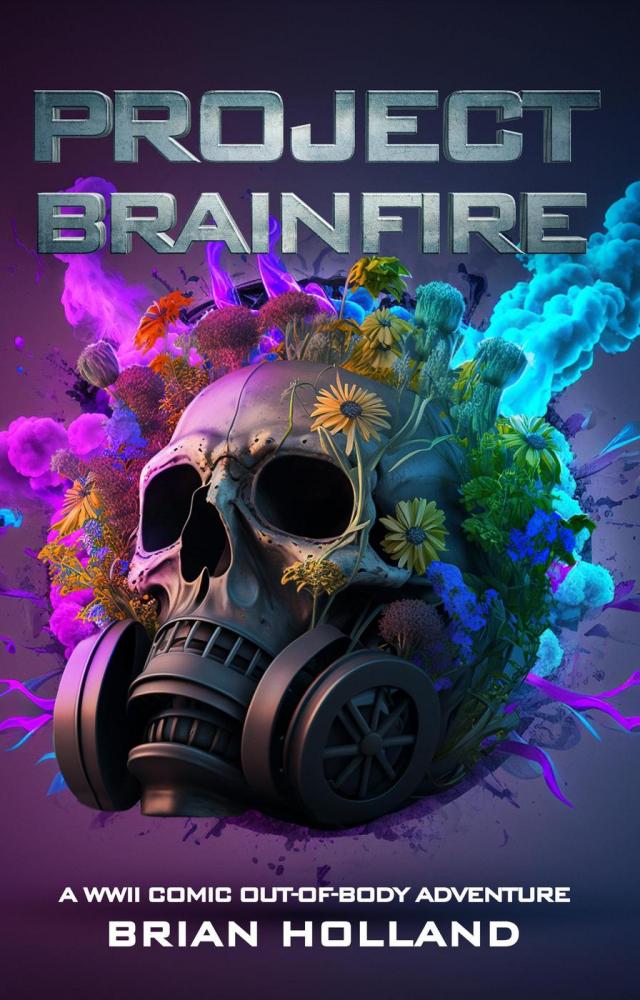
Project Brainfire: A WWII Comic Out-of-Body Adventure
Brian Holland
Published by Brian Holland, 2023.
This is a work of fiction. Similarities to real people, places, or events are entirely coincidental.
Project Brainfire: A WWII Comic Out-of-Body Adventure
First edition May 2023
Copyright © 2023 Brian Holland
ISBN: 978-1-7389187-0-6
Edited by James McHugh
Cover design by AmbientPixelDesign
Written by Brian Holland
Table of Contents
Title Page
Copyright Page
Dedication
Prologue | The Valley of Kings, 1943
Chapter 1 | War Surplus
Chapter 2 | The Nazi Express
Chapter 3 | Snuffed Out
Chapter 4 | Off in a Cloud
Chapter 5 | Party Favors
Chapter 6 | Somebody’s Mental Around Here
Chapter 7 | The Whiz Kid Sticks It To Gerry
Chapter 8 | Herr Bun in the Oven
Chapter 9 | Sweet Dreams
Chapter 10 | Uncle Jack’s Precision Balls
Chapter 11 | Stukamania
Chapter 12 | The Fickle Fins of Fate
Chapter 13 | Turn of a Card : Fall of a Dreidel
Chapter 14 | An Ill Wind For Wagner
Chapter 15 | Fuhrer on the Brain
Chapter 16 | Back in a Flash
Chapter 17 | Sturm und Drang
Chapter 18 | Love’s Ghostly Mansion
Chapter 19 | An Endless River in Falling Rain
Chapter 20 | Snow-White and the Six Goons
Chapter 21 | The Sandbagman Cometh
Chapter 22 | Come Fly With Me
Chapter 23 | Fool’s Picnic
Chapter 24 | Dead Men Don’t Play Piano
Chapter 25 | Buck Rogers Sings The Scarabs
Chapter 26 | The Reich Stuff
Chapter 27 | Just Another Bot Dream
Chapter 28 | Something Gold—Something Nu
Chapter 29 | Hanky Panky
Chapter 30 | Sudden Death Replays
Chapter 31 | Bombs Away!
Chapter 32 | End of the Line
Epilogue | Canton, Ohio, 1965
About the Author
For RAD and Qman & Sgirl
Prologue
The Valley of Kings, 1943
The blazing eye of Ra faded into scarlet behind the rocky Theban hills, resurrecting the shadow beings who creep across the Valley of Kings by evening, then merge in death once more with the darkness of night.
Just as the annual inundation of the Mother Nile brings life-sustaining water to the dry Egyptian croplands, so the daily setting of the sun in the west brings the cool of the evening—a merciful respite from the sun god’s pitiless stare which heats the ancient valley by day into a natural stone oven.
For Abdul, the deepening evening brought no such mercy. He raised his powerful arm from the hand-powered bellows he was working and wiped the sweat from his brow, then resumed the endless pumping. The ashen coals flared to a glowing cherry red. Abdul glanced at the distant horizon and noticed the sky to the west was turning the same red as the fire, then dropped his eyes quickly and continued pumping the bellows forcefully. He could hear the murmuring voices of his masters approaching and knew it was best to appear hard at his labor.
“With a thousand workers like Abdul, Germany could double its industrial output,” a good-humored German voice spoke.
“And with a million, Herr Major, we might even win the war,” a second German voice said with a sarcastic laugh.
Abdul stood quiet, pretending not to hear them coming. Like his father, and his father, and his father before him, Abdul was a tomb robber by trade. In the family business, the less one heard, the longer one lived.
The Major’s voice became more serious as he stepped up to Abdul and handed something to him. “This is the last of them. Professor Schwartz found it buried in the sand behind the large statue.”
Abdul grasped the golden statue of a hawk-headed man and slipped it carefully into the molten pool bubbling in the crucible.
By mid-afternoon the following day, the busy crucible had been drained into the forms for the last time, and the chill of the night had cooled the molten gold into glistening ingots.
Working in the shade cast by an eight-foot crate, Abdul knelt over a shallow wooden box, struggling to jam the last of the gold bars into it. He plucked out a handful of packing straw, but still the bar refused to nestle in beside the others like it. Absorbed in his difficult task, he did not hear the Major saunter up beside him.
“Perhaps we should not have found that last statue. It seems the others refuse to make room for it,” the Major said, more amused than concerned. “Well, our schedule does not allow for such lack of cooperation,” he said curtly. “Why don’t you just nail the box shut and keep that renegade bar, Abdul.”
“Keep it?” Abdul asked more suspicious than surprised.
“Yes. Keep it. We have the larger pieces for the cultural heritage of the Reich. And, what shall we say, a few of the more insignificant ones set aside for the SS officers responsible for this operation. Yes, you keep it. We shall all prosper from our endeavors.”
“Such generosity is unknown to me,” Abdul said, quickly tucking the heavy bar into the worn leather bag containing his few possessions.
The Major pondered something curiously for a few moments, then spoke again. “So, you do not fear the curse?”
Abdul hammered down three nails, securing the lid of the box tightly. “I do not know of any curse.”
“The inscription,” the Major said. “The inscription on the base of the statue. Professor Schwartz tells me it says ‘He who plots against the sanctity of Horus shall perish at the hands of a Fool’.”
Abdul’s penetrating stare met the Major’s curious eyes. “Tell me, Major. Are you German SS officers fools?”
The Major smiled wryly. “No. Most certainly not.”
A wide grin split Abdul’s face. “Then I fear no curse.”
“Nor do I, Abdul. Nor do I,” the Major said, then turned and walked away.
A few minutes past four that afternoon, a German transport plane heavy with extra fuel and pilfered golden treasure taxied across the flat scorching desert.
The blazing eye of Ra stared down upon the aircraft as it lifted skyward through a gritty fog of propeller blown sand and slowly banked northward.
Chapter 1
War Surplus
Harold Douglas Barton. Private First Class. United States Army. Lost.
Harold brought his tired feet to a dead stop in the middle of the dirt road. He peeled off his sweaty helmet and curiously examined a dent notched in it earlier that morning by a German machine gun slug then carelessly tossed the helmet into the ditch. It was too damn hot in Sicily for a helmet.
Just after sunrise that morning, his patrol had penetrated the west flank of the Sicilian village of Rozina. Barton’s unit had engaged the enemy at seven hundred fifty hours. By eight hundred hours, only Barton was left alive. Now, after hours of walking, he realized he was getting nowhere near the American lines. He was getting nowhere but lost.
Harold reached for his canteen. In the blistering heat, a long drink of water was going to taste like champagne. He would drink most of it and sprinkle the rest on his face. But there was no water. There was, instead, a perfectly round hole clear through his canteen.
Another near hit.
He tossed the useless canteen into the ditch. What the hell kind of war was this where all the enemy could hit was his helmet and his canteen? Either shot could have dropped him like the rest of his outfit. But luck, or fate, or whatever controls the trajectory of a hot slug had spared him. Spared him for what? Harold Barton didn’t know. All he knew was that he had to keep moving across the deceivingly quiet Sicilian countryside, hoping that whatever directed the slug into his canteen instead of his guts would also direct him back to the American side of the war.
Harold resumed his listless pace. His shoulders and back ached from the weight of his combat gear. What is precious when confronting a German pillbox in the heat of battle becomes mere dead weight when walking mile after mile down a Sicilian back road under a relentless sun.
He was about to dump his load of grenades when he stopped himself with a strange thought. In all the drills and procedures they had put him through in boot camp, never once had he been allowed to toss a live grenade. Why not toss one now? Maybe he was closer to his base of operations than he thought. Sure. The blast would attract the attention of an Allied platoon. They would come to investigate the noise and Harold Barton would be joined up with the good ol’ US Army again.
Maybe it would be fun to see what a live grenade could do. They were his grenades. After all, the Army had given them to him to use on the mission. He was still on the mission, sort of, so they were still his grenades.
He carefully lifted a grenade from the sack. It felt heavy in his hand, like his dad’s old pipe wrench. He pulled the pin and heaved the grenade into the shadows of the woods alongside the road. He dropped to the ground, wrapped his arms around his head, and braced himself for the shock wave.
For fifteen seconds, he lay prostrate with muscles tensed. No blast. Thirty seconds. Still no blast. After nearly a full minute had nervously passed, he cautiously raised one side of his head, and peeped over his elbow in the direction of the grenade.
Finally realizing th ere would be no blast, Harold staggered to his feet and slapped the dirt from his uniform. Germans who could only hit his helmet and canteen and American grenades that didn’t explode. What the hell kind of war was this?
He had to find out. He grabbed another grenade, pulled its pin, and tossed it to nearly the same spot as the first one, then flopped to the ground again. Five seconds. Ten seconds. Fifteen seconds. Twenty seconds. What in hell is goin’ on here, anyhow? Uncle Sam was two for two on duds. He tried a pair of grenades next, pulling their pins and repeating the entire process.
Duds. Four for four.
Down on one knee, he yanked the haversack open and dumped the eight remaining grenades into the dirt. Eenie, meenie, miney, moe. Which potato’s set to go? He set them out single file left to right. Methodically he lifted each one, pulled its pin, and quickly threw it sideways into the woods. All eight were primed and ready to blow. But none blew. They had sent him into combat with a dozen dud grenades to kill Germans who couldn’t shoot straight. That was the kind of war this was.
Harold hoisted his rifle off his shoulder and flipped the safety. Damn rifle better shoot. BLAM! The slug whizzed through the underbrush and echoed off into the distance. At least the rifle ammo was the real McCoy. He shouldered his Garand and continued down the road, leaving the cluster of grenades behind as his personal epitaph to the war.
After about an hour of making good time, thanks to the loss of a dozen lead eggs, Harold approached a steep hill. He crouched down in a panic. Something was winding its way up the far side of the hill. Something loud and rumbling and heavy. Maybe a tank.
He darted into the woods and nestled himself safely behind a thick pine. The roaring on the hill became louder. A turret gun barrel poked into sight over the hill’s crest, followed immediately by a full front view. It was a German tank. A big one, rolling along at quite a clip. Maybe if he just stayed low, it would pass by without incident. It certainly wasn’t Harold’s duty to engage an enemy tank single-handed, with no larger ordnance than his rifle. It would be a standoff. They would not see him, nor would he bother them. Each would continue on his way to meet another day.
Maybe not. He heard the engine cut and the sound diminished to a dull roar. Whatever kind of tank it was, it was stopping now about fifteen yards in front of him, on the far side of the road. They had spotted him. No. That was impossible.
The tank shuddered to a halt and sat idling like a huge steel cat waiting for a mouse. A mouse named Harold Barton? He didn’t know.
The hatch swung open and up popped the top half of a German officer. He scanned the area, muttered something in German down into the tank then crawled out, stepping on the treads and bouncing to the ground. Another German officer slid out the hatch and skillfully sprang down to join the first.
Harold steadied his rifle. The Germans seemed oblivious of him. They exchanged brief conversation, stretched their legs, then chuckled to themselves as they sauntered off into the woods
The tank sat idling, its hatch wide open, and its two Kraut operators vanished into the woods. This was Harold Barton’s big chance. He was no match for a fast-moving, heavy German tank. But a parked panzer, its crew off in the woods and its hatch wide open, amounted to a birthday invitation. Happy Birthday, Harold Barton! If he could get inside before the Krauts could get back to their war machine, he would have one German tank at his command, and two Nazi officers caught flat-footed.
It would also be much easier making it back to his side of the war in a tank. There was probably food and drink in there. Maps, too. In German, yes, but better than none at all. The possibility of all these advantages gave Harold the spur of courage he needed. He dashed toward the tank, keeping it visually between himself and the spot where the Germans had exited into the woods.
The sickeningly sweet stench of the tank’s hot diesel exhaust burned its way up his nose. He climbed the steel monster’s side and hoisted himself over the giant treads, then gingerly maneuvered his way down through the hatch, twisted around and dropped down feet first, flopping heavily to the floor.
He madly surveyed the interior. No one but Harold Barton was inside.
He grabbed the hatch and pulled himself up high enough for a last look for the Germans. He spotted them about fifty feet into the woods. Both of them were hunched down, their pants down around their boots like fallen flags. So that was why they had suddenly stopped in the middle of Harold Barton’s corner of nowhere. Even the SS had to crap! Caught ‘em with their pants down this time, Barton!
Just as Harold was about to slide back down inside the tank, one of the Germans shouted something in his direction and pointed at him. The two jumped to their feet and, in a run, attempted with little success to pull up their trousers.
Harold gave the gamboling pair a crisp Nazi salute, then dropped from sight. He slammed the lid down behind him and locked it tight. Flopping himself down into an uncomfortable canvas and metal tubing seat, he fumbled with various levers and foot pedals in an attempt to get the tank rolling. The engine roared, but failed to connect its massive power to the drive train. Must be a clutch and gear system in all these controls. He pushed a boot down on a random pedal while easing the lever that had made the engine howl. Just like Dad’s Olds. He felt motion, but the tank was still going nowhere. It was the turret cannon turning overhead. Have to deal with that later. He pulled another lever. The whole tank jerked forward and lurched down the road.
The two Germans had their pants back up now and were hopping up and down in front of the tank. Harold watched them shouting at him through the front viewer. He pushed the accelerator all the way down. The growl became deafening as the obese machine picked up speed.
As he rumbled past the Germans, he saw one of them grab a grenade from his side, then heard it clunk as it hit the top of the tank. A lucky toss. It had wedged in between the circling turret and the body of the tank.
KABLOOOOM!
No wonder the Germans were doing so well. They had live grenades.
The explosion rocked the tank and made Harold’s ears ring, but the trusty panzer lumbered along, unhindered by the attack on her by one of her own. These mothers were made to claw their way through hell. How could you expect a grenade to do anything? Even if it was a live one?
A few hundred yards of experimentation at the controls, and Harold knew which levers worked the steering, which connected and disconnected the clutch, and which controlled the acceleration and braking of the huge machine.
The turret was a different story .It was still rotating slowly overhead, as if the gun crew inside could not decide in which direction the enemy lay. How to shut it down? Which lever had started it going in the first place? This one. The lever that controlled the turret was no longer taut. From the play in it, Harold deduced that something had been damaged by the grenade blast. What the heck. No one was expecting him to do any heavy shooting. All Harold had to do was to drive the thing back to his side of the war.
He crouched his way to the rear. There were enough rounds for the turret cannon to take on half the Allied forces. Have to be real careful with them suckers. He lifted one out of its protective wooden crate. So that’s what a tank shell looks like. He slid it back into its container, gently patting it with respect.
Food. There must be something to eat around here.
Under a German field coat, he found several large brown paper bags with their tops rolled down. He opened one, peered in then cracked a big smile. This is more like it. He hoisted one of the thick salami sausages out of the bag then cut away the crisp casing with his knife.
Munching large bites, he rummaged through the other bags. Wine. How thoughtful. He spotted a corkscrew and yanked open a bottle. The Reich thinks of everything. Chomping salami and gulping down wine, he continued to probe the tank for more spoils of war.
Neatly stacked at the very back were a dozen or so flat wooden crates, each about a foot-and-a-half square and six inches deep. He cut off another slab of salami, then wedged his knife blade under the top panel of one of the mysterious boxes.
The nail creaked as the corner of the lid lifted. Very interesting. He set the wine and sausage down. Both hands free now, he wrenched open the crate. Inside was something packed in straw. He brushed away the top layer from what it was hiding. What the....






