World made of glass, p.1
World Made of Glass, page 1


This book is a work of fiction. Names, characters, places, and incidents are the product of the author’s imagination or are used fictitiously. Any resemblance to actual events, locales, or persons, living or dead, is coincidental.
Copyright © 2023 by Ami Polonsky
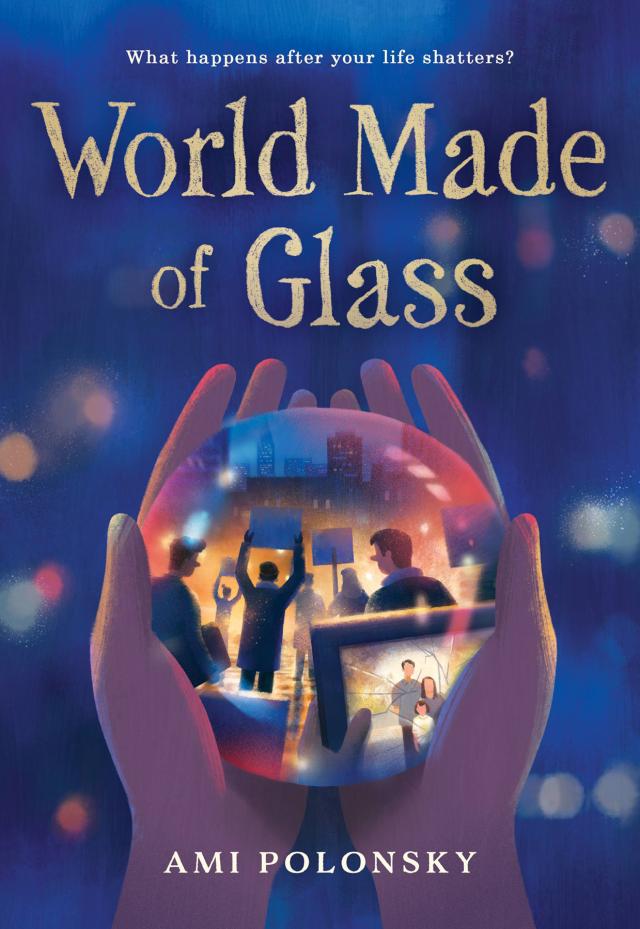
Cover art copyright © 2023 by Ileana Soon.
Cover design by Patrick Hulse. Cover copyright © 2023 by Hachette Book Group, Inc.
Hachette Book Group supports the right to free expression and the value of copyright. The purpose of copyright is to encourage writers and artists to produce the creative works that enrich our culture.
The scanning, uploading, and distribution of this book without permission is a theft of the author’s intellectual property. If you would like permission to use material from the book (other than for review purposes), please contact permissions@hbgusa.com. Thank you for your support of the author’s rights.
Little, Brown and Company
Hachette Book Group
1290 Avenue of the Americas, New York, NY 10104
Visit us at LBYR.com
First Edition: January 2023
Little, Brown and Company is a division of Hachette Book Group, Inc. The Little, Brown name and logo are trademarks of Hachette Book Group, Inc.
The publisher is not responsible for websites (or their content) that are not owned by the publisher.
Little, Brown and Company books may be purchased in bulk for business, educational, or promotional use. For information, please contact your local bookseller or the Hachette Book Group Special Markets Department at special.markets@hbgusa.com.
Library of Congress Cataloging-in-Publication Data
Names: Polonsky, Ami, author.
Title: World made of glass / Ami Polonsky.
Description: First edition. | New York : Little, Brown and Company, 2023. | Audience: Ages 10–14. | Summary: “Iris opens her eyes to hard truths and the power of her voice when her father dies of AIDS in 1987”—Provided by publisher.
Identifiers: LCCN 2022007802 | ISBN 9780316462044 (hardcover) | ISBN 9780316462259 (ebook)
Subjects: CYAC: Fathers—Fiction. | Grief—Fiction. | AIDS (Disease)—Fiction | Prejudices—Fiction. | LCGFT: Fiction.
Classification: LCC PZ7.P7687 Wo 2023 | DDC [Fic]—dc23
LC record available at https://lccn.loc.gov/2022007802
ISBNs: 978-0-316-46204-4 (hardcover), 978-0-316-46225-9 (ebook)
E3-20221116-JV-NF-ORI
Contents
Cover
Title Page
Copyright
Dedication
Chapter One
Chapter Two
Chapter Three
Chapter Four
Chapter Five
Chapter Six
Chapter Seven
Chapter Eight
Chapter Nine
Chapter Ten
Chapter Eleven
Chapter Twelve
Chapter Thirteen
Chapter Fourteen
Chapter Fifteen
Chapter Sixteen
Chapter Seventeen
Chapter Eighteen
Chapter Nineteen
Chapter Twenty
Chapter Twenty-One
Author’s Note
Acknowledgements
About the Author
Also by Ami Polonsky
For Daniel, Ben, and Ethan
Chapter One
Dad. Is. Dying.
I pushed through the after-school crowd in the hallway, repeating the sentence to myself: Dad. Is. Dying. Dad. Is. Dying. With each word, I planted one of my hot-pink Converse into the center of a scuffed floor tile. No stepping on cracks. I didn’t used to be the superstitious type, but these days, new worries popped into my mind constantly. Maybe repeating the thought over and over again would help me to understand it.
Dad. Is. Dying, and just this morning, Mom said it wouldn’t be long now.
Dad. Is. Dying. The words pounded through my mind on loop as I passed the lunchroom and nurse’s office. Rounding the corner by the gym, I almost ran into Ms. Staffio. Startled, she hopped to the side to avoid me.
“Iris!” she exclaimed. I was probably imagining it, but she seemed disgusted, as if nearly bumping into me could contaminate her. Then she patted her already-neat bun. “Pay attention to where you’re going, please.” She forced a smile and adjusted the teacher’s edition of our science textbook under her arm. “I was just on my way to make some photocopies, but I was hoping to see you. I wanted to ask you something.”
I took one more step to complete my thought (Dying.) before responding. “’Kay,” I said.
She looked at me strangely, and for a second, I thought I saw a flicker of something different in her eyes. Sympathy? But no. It couldn’t be. Nobody, not even my best friends, knew that Dad was sick.
“You’re off to Philanthropy Club, I presume?”
“Yeah,” I answered.
“Wonderful. The gerbils’ cage really could use a cleaning. Will you pass that along to the group? I mean, unless you have something more philanthropic on the agenda.” I couldn’t tell if she was being sarcastic. Everyone knew that Philanthropy Club was the after-school activity you joined if your parents insisted that you “get involved” and you had nothing better to do.
Ms. Staffio smoothed her hair again and adjusted the already-perfect collar of her white blouse. Everything about her was so judgmental, and even though I’d gotten really good at not caring what people thought about me and my family, I wondered what was going through her mind.
That Iris, I imagined her thinking in her snooty tone, she looks so disheveled. Someone ought to take her in for a bangs trim—her hair is dangling into her eyes. And on the topic of her eyes, why are they so droopy and bloodshot? It’s like she hasn’t slept in ages. Must be that odd family of hers. Must be because her dad is, you know… gay. In my mind, she’d whisper the last word, gay, because it was so unthinkable.
Well, if those were Ms. Staffio’s thoughts, she would have been right about my appearance. I hadn’t been able to find my hairbrush that morning, and my bangs were hanging into my eyes because for weeks, everyone at home had been too distracted by Dad dying to take me to his barber on the corner for a bangs trim. And my eyes were bloodshot from not sleeping enough, because when your dad is sick, the nightmares claw at you until you wake up, and half of your mind is in your bedroom, and you’re looking out your darkened, eighth-story window over Greenwich Village, dotted with streetlights and car lights and sometimes a two a.m. siren, but the other half of your brain has never seen this bedroom before. Has never seen a bedroom at all, actually. The window glass might not even be there, and it’s probably not, and if you roll over, you’ll be falling through eight stories of thin, too-cold March air to the sidewalk below.
“Iris!” Ms. Staffio said, as if it wasn’t the first time she’d tried to get my attention.
“Yeah?” I asked. The perimeter around the tiles appeared to be shrinking. Moving closer to my shoes. I clenched and unclenched my toes.
“You’ll clean out the gerbils’ cage today? They’re starting to stink. Extra garbage bags are in the cabinet.”
“Oh yeah,” I told her. “The gerbils. Sure.”
She tilted her head to the side as if exhausted by our conversation, or at the very least, confused, and walked away.
I gave up stepping in the centers of the tiles.
In Mr. Inglash’s room, Toby and Will were already at the back table. They were weird and annoying, and I loved hanging out with them. Being in the same room as my closest friends made the tightness in my stomach disappear. I allowed myself to forget about how condescending Ms. Staffio was as I joined them.
“No way,” Toby was saying emphatically while wiping his always-stuffy nose with the back of his hand, his eyes wide with enthusiasm about whatever he and Will were debating. “There is no way that a half-eaten Charleston Chew with your slobber cooties all over it, a baggie of probably stale pretzels, and mini muffins are worth an unopened two-pack of SnoBalls. How gullible do you think I am?” He caressed, and then kissed, his package of pink Hostess SnoBalls.
“Significantly gullible,” Will replied. “And can I point out that you’re making out with your after-school snack?” he continued, grinning, as he leaned back in his chair and rested his shoes on the table next to his Charleston Chew. He poured the entire bag of mini muffins into his mouth and suppressed a cough.
Dad’s sickness loosened its grip on my shoulders as I watched Will attempt to chew. Slobbery bits of muffin escaped his mouth, falling onto his lap. He picked them up one by one and poked them back between his clenched lips.
I pretended to gag. “I hope you know CPR and the Heimlich, Toby,” I said, “because if he chokes, no way am I saving him.”
“Hello to you, too,” Toby said, wiping his nose on the back of his hand again. Will rocked back on his chair legs, waved, and continued chewing.
Grinning, I ran over to the classroom window and cranked it open. Cold March air tumbled in. “Mallory!” I screamed into the void. “Why did you have to move?” Toby, Will, and I laughed as a bunch of kids on the playground turned to look in my direction.
“I feel so sorry for you that she’s in Philly now,” Will said as I relatched the window. “Like, seriously, seriously sorry.” He rubbed his buzz cut. Will was the only African American kid in our grade. Since becoming friends with him, Toby, and Mallory the year before, I’d wondered how he felt being one of the only kids at our private school who wasn’t white, but that wasn’t the kind of thing anyone ever talked about. So for now, I just wondered how he had managed to chew that entire package of mini muffins in one swoop without choking.
I smiled at him, glad that he hadn’t needed the Heimlich over muffins. “Thanks,” I told him. “I feel sorry for me, too.” Mallory, the fourth seventh-grade misfit, former member of the Philanthropy Club, Dungeon Master, and my best friend, had moved to Philadelphia over winter break. We talked on the phone every Sunday after dinner, and I’d seen her a few times when she and her family had come into the city, but I couldn’t bring myself to tell her that Dad was sick.
Toby ripped open his SnoBalls, pink coconut spilling onto the table, and motioned to one of them. “Go ahead,” he said.
“Yes! Come to Papa,” Will sang, pulling a SnoBall in two, handing one piece to me, and shoving his half into his mouth.
I licked the sugary pink coating off the white marshmallow exterior. I was usually able to forget about the whole dying thing for a while at Philanthropy Club, and I was pretty sure that Mom suspected this, which was likely why she still insisted that I go, even though what I really wanted to do after school was race home to Dad and J.R.’s apartment.
“Oh, Ms. Staffio wants us to clean the gerbils,” I told Will and Toby.
“Clean the gerbils?” Toby asked, laughing, as he took a giant bite. Pink coconut stuck to the tip of his nose, and I wondered if his snot had served as glue.
“Hey,” Will chimed in. “Do you have a toothbrush? We can lather the gerbils up in the science-room sink and scrub them with a toothbrush, and then put them in, like, little robes—”
“Did you just ask me if I had a toothbrush?” Toby interrupted. “Sure, I brought my toothbrush to school, and I want to use it to clean Stiffio’s gophers.”
Will cracked up. “Gophers?” he asked. “Man, they’re gerbils!”
“What’s the difference?” Toby asked, hopping up and grabbing the G encyclopedia from Mr. Inglash’s bookshelf. I wandered back to the window, wishing again that Mallory were still here. I wondered, if she hadn’t moved, would I finally be able to tell her about Dad? She wasn’t the type to judge anybody, but still, I didn’t know.
I licked sticky goo from my fingertips while peering out at the now-empty playground. Will’s and Toby’s voices faded into the background, and just like when I woke up from a nightmare, I was halfway in the real world and halfway disconnected.
“A gopher is a burrowing rodent with fur-lined pouches on the insides of its cheeks,” Toby read. Outside the window, some of the dirty snow piles still lingered, like Manhattan didn’t know whether it was winter or spring. I remembered being little, when it was just me, Mom, and Dad. Back before everything got so complicated. Mom and Dad loved each other then. They still love each other, I reminded myself.
A gust of wind shook the empty swings and rattled the windows as Toby went on. “Man, if I had little fuzzy pockets in my cheeks, that would be so awesome! I’d fill them with jawbreakers and nobody would ever know! Or Hot Pockets! Look up gerbils. I want to know if gerbils have furry mouth pockets.” They both cracked up some more. Across the street was Gramercy Park, its trees just starting to bud, and beyond it, past Union Square, was NYU, where J.R. worked and where Dad used to, back before he got too sick to do anything.
“A gerbil is an old-world burrowing desert rodent,” Toby read. “What the heck? An old-world rodent? Are Stiffio’s gerbils time travelers?”
I turned back to Toby and Will, trying to smile. They could have gone on forever, talking about mouth pockets, Hot Pockets, rodents, and time travel. I wished I could care about that kind of stuff again.
I looked through the little window in the doorway to where Mr. Inglash was saying something to the top of some kid’s head, but by the time he came in, the blond mop of hair had disappeared. “It’s the philanthropic clubbers!” he announced, pushing his glasses up on his nose, the fluorescent lights bouncing off his shiny, bald head. He was the dorkiest and best teacher in the school. A while back, Mallory, Will, Toby, and I had made a banner that said 7TH-GRADE ENGLISH WITH INGLASH in bubble letters to hang above the blackboard. That was the type of philanthropy project we could manage. The sign was still there.
“What’s on the agenda for the day?” Mr. Inglash went on. I liked that he took us seriously, even though we never had anything on our agenda beyond random projects and playing Dungeons & Dragons when we were done. It was almost like he was waiting for the day that we’d finally announce our plans to save the world. I was kind of waiting for that day, too.
“We’re going to go clean Ms. Stiff”—I caught myself, and Mr. Inglash hid a smile—“Ms. Staffio’s gophers. I mean, gerbils. I mean, not the animals. Their cage.”
“Then we’ll probably try to play DnD with a bad DM and only two players, which definitely isn’t fun…,” Toby chimed in as I glanced at the clock, no longer distracted by Will, Toby, and the Philanthropy Club. I wanted to get home to see how Dad was doing.
Mr. Inglash looked thoughtful for a minute. Then he pushed his glasses up onto his nose again. “I’ll talk to Ms. Staffio for you,” he said. “Skip the hamster cage for the day.” Will, Toby, and I burst into laughter.
“Gerbil,” Toby corrected, still laughing.
“Ah, yes. Gerbil. Iris?” he asked. “Help me out with something?” I looked at Will and Toby, shrugged, and joined him in the empty hallway, where afternoon sunbeams slanted through the windows.
“So,” Mr. Inglash said sort of awkwardly once he closed the classroom door. “I’m just wondering—I mean—what I’m trying to say,” he stammered, “is how are you doing?”
I saw myself reflected in his thick glasses and thought of how I imagined myself in Ms. Staffio’s eyes. Mr. Inglash wasn’t like her. He actually cared. Looking down, I noticed that I was standing on the edges of the floor tiles, and I adjusted my shoes so they weren’t touching the cracks.
After Dad had found out that he had AIDS, I’d overheard him and Mom talking in his and J.R.’s apartment about whether they should let my teachers know that he was sick. “She’ll need support,” Mom had said curtly. I’d stopped outside the door, key in hand, and pressed my ear to the metal to listen. It had been this past September, which was near the end of Mom’s angry phase and a full year after she and Dad had separated.
“They’ll treat her like a leper,” Dad had said with finality. Mom had probably agreed, so that was the end of that conversation. As far as I knew, nobody outside of Mom, Dad, my grandparents, J.R., and their new friend Bob knew that Dad had AIDS; nobody else knew that he was dying. Sure, people knew Dad was gay and that he and Mom had gotten divorced because of it at the beginning of sixth grade, and plenty of them cared way too much about that, but that was their problem, not mine.
“Iris?” Mr. Inglash prodded.
“Oh, I’m fine, I guess?”
Unless people at school had somehow found out? Why had Mr. Inglash pulled me into the hall to see how I was doing? I started to feel nauseous from that SnoBall. Marshmallows always made me feel sick.
You could talk to him about it, a small voice in my head told me. He wouldn’t treat you like an outcast. He’s Mr. Inglash. Suddenly, the thought of telling Mr. Inglash about Dad—about the AIDS and the dying—felt like such a relief. But before I could open my mouth, he began to speak again.
“Glad to hear that things are fine, Iris. That’s real good. So listen, there’s a new student. I thought you might see if he wanted to join the Philanthropy Club. He’s kind of reluctant to get involved, and I’m trying to help him make some connections.”
I closed my eyes for a second and envisioned the window beside my bed in the middle of the night. In my mind, the outside air was thick. Humid. The way the air in the hallway suddenly felt. There was no glass on the window. No screen. If I rolled over, I’d fall.
At the end of the hallway, the mop of curly hair reappeared. Beneath it was a boy. “I’ll go talk to Ms. Staffio,” Mr. Inglash said. “About the gerbils.” For a minute, it seemed like he was going to pat me on the shoulder, but instead he clasped his hands behind his back. Then he disappeared around the corner.
I looked the new kid over as he approached. Mr. Inglash was right; the boy didn’t seem to want to be in this nearly empty after-school hallway at three fifteen on a Thursday afternoon. His hands were stuffed into his blue jeans pockets, and he took his time walking over, like he might swerve at the last minute and head for the front doors instead.