

Soft serve, p.1
Soft Serve, page 1


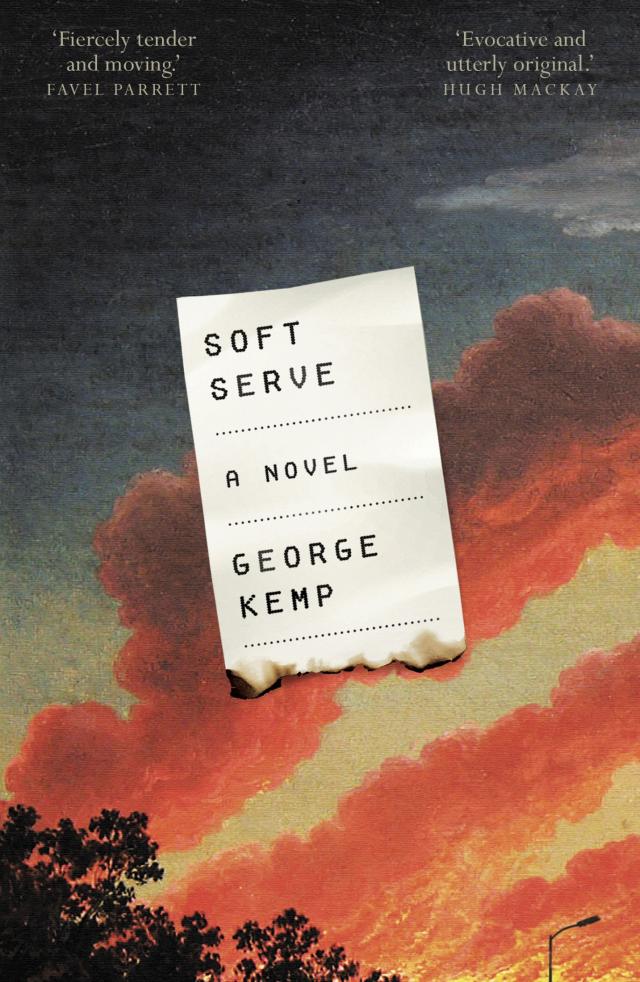
Praise for Soft Serve
‘Full of spark and love, Soft Serve is fiercely tender and moving.’ Favel Parrett
‘A scorching novel about small-town grief, queer yearning and the rituals that keep us connected. George Kemp’s debut is full of complicated humanity, dark laughs and endless compassion – and makes him one to watch.’ Benjamin Law
‘Soft Serve is an irresistible debut; it will thaw the hardest heart. George Kemp delivers a tale of first love, loss and the inexorable pain of growing up.’ Eleanor Limprecht
‘This exquisite book grabbed my heart and held it long after it ended. Every character is drawn with the greatest affection, exploring the beauty and fragility of loss and love.’ Heather Mitchell
‘A new and glorious voice has arrived on the Australian literary scene – compelling, lyrical, evocative and utterly original.’ Hugh Mackay
George Kemp is a writer for stage, page and screen, based on Gadigal land. He was selected to be part of the Faber Academy in 2023–24, during which he completed the first draft of Soft Serve. His award-winning play Shack has been performed frequently around the country and internationally, and is included on the new NSW Drama Curriculum. George has had a successful career as an actor across Australia and England, in productions such as Rosencrantz and Guildenstern Are Dead and Cyrano de Bergerac (Sydney Theatre Company) and national and international tours of The Play That Goes Wrong and Peter Pan Goes Wrong. He is also a passionate educator and mentor of actors and writers and is currently Resident Artist at Australian Theatre for Young People. Soft Serve is his debut novel.
Book club notes are available at www.uqp.com.au
for my mum
the bravest person I know
and for little will
who taught us that life is short, so find the joy
borkin: [Sighing] This life of ours … human life is like a flower gloriously blooming in a meadow: along comes a goat, eats it up – no more flower.
Anton Chekhov, Ivanov
Wake
The reheated samosas tasted like the reheated sausage rolls and the reheated sausage rolls tasted like the reheated party pies but it didn’t even matter. Shock takes away all the senses.
Or maybe that’s grief. Taz died a week ago. Probably too long to still be feeling shock.
The funeral had felt short. The priest’s lawn bowls final was later that afternoon, so the service had the distinct sense that he was squeezing it in.
About two dozen photos cycled through on a screen off to the side: Taz dressed in a Superman t-shirt on his third birthday; his signature pose at the top of the rock jump; his Year 10 formal, all braces and nervous hands. That’s where they stopped before the loop began again. Snapshots of a short life lived to the full – or, at least, to the fullest allowed by this place, contained within its airy borders. Air so charged it might as well be an electric fence.
But Taz had flown over the fence. That’s what made this so bloody depressing.
Taz’s mum, Pat, sat big-cat still, with her breath held tight and her glazed eyes staring straight ahead. Her brown and grey frosty-tipped hair, normally worn fringe down and spiked up at the back, today drooped lank, the spikes seemingly too tired to stand up anymore. Her simple black dress with lace on the shoulders hung loose on her frame, and she thumbed its hem as the priest began rushing through some poem like he was doing everyone a favour.
Taz’s friends Fern, Ethan and Jacob sat at the back. Fern and Ethan had finished high school only two weeks ago and Jacob, Fern’s older brother, was twenty. The three of them huddled together on a pew, each trying desperately to focus on anything other than the coffin: the clasp of the necklace on the woman in front, the bird pecking at the stained-glass window, the leaf blower droning on somewhere outside.
The singing was when everything fell apart – something about having to breathe. The congregation, suddenly the worst choir in the world, mumbled through Taz’s favourite song (‘Hotel California’) accompanied by wails and sniffs.
At the wake in the hall, nobody knew what to say. The emotions were too big to fit inside Jacob, Fern and Ethan. Surely this was supposed to be an adult thing. Wordless and planless, they drifted away as a group. They felt drawn into town, down the hot wide street, through the park with the rotunda where Taz had made everyone jump off the sculpture and swim in the fountain on the last day of Year 10.
Nobody leading, nobody following. They crossed the new set of traffic lights (this was a place where one felt the excitement of a new set of traffic lights going up in town, as well as the sadness about the excitement of a new set of traffic lights going up in town) and then the carpark, before finding themselves sleepwalking through the sliding doors of the Maccas near the highway.
The smell of fries, warm and thick, enveloped them like a doona. The pull of something known, something comfy, was what had drawn them there. They needed it to smother this new feeling of lightning-strike fuck-off pain.
Jacob stood in line, wondering how everyone else could be so stupid as to be going about their regular lives on a day like today. Tradies and roadtrippers sat around chatting and munching as though everything hadn’t been ruined, irrevocably. Jacob reached into his pocket for his wallet and undid the velcro to take out five bucks.
Three soft serves, please.
Would you like anything else today?
Yeah, for my mate to still be alive.
…
…
That’ll be three bucks.
He wandered back to the booth, holding the three soft serves like a round of beers, his school shoes embarrassingly clacky on the tiles. Too old to be wearing school shoes, he thought. Fuck.
He handed a soft serve (Taz’s favourite) to Fern and to Ethan. They sat in silence for a long moment and then, somehow, as with any nonsensical made-up ceremony, they all just knew what to do.
They lifted the cones into a feeble, sugary pyramid. Ice cream melted through their fingers.
To Taz.
Part One: Morning Shift
The damn side-door key doesn’t fit. Its little teeth are becoming blunt.
Or maybe it’s the heat. It’s five am and already it’s twenty-six degrees. The radio on the way in said today would be big. Be alert. Sparks. Heat. It sounded to Pat like one of those shit star-sign things from the magazines, like you might unexpectedly fall in love with a co-worker at the photocopier or something.
Flames closing in from the north. Today looks to be worse than yesterday.
She had to chuckle. Yes. Worse than yesterday: they’d got that right.
The lock finally clicks, and Pat lumbers onto the brown tiles. As usual, the ammonia from the closing shift hits like a hospital, but it soon wears off – especially today, with the smoke sneaking in from outside. The whole place smells like a bomb. She doesn’t even go to her locker as she normally would. Today will be far from normal, so she just pops her handbag under the counter.
She always fills up the soft serve machine first, to get it out of the way. She takes the large plastic bag, bursting like a big white belly, and hoists it onto her shoulder as if she’s a farmer. She snips the corner and the liquid folds itself into the machine, sweet and pure. It’s often at this moment, when she’s forced to be still and wait, that the thoughts creep in.
She disposes of the empty bag and begins to turn everything on. She flicks switch after switch, powering up herself as much as the restaurant. It’s how she turns from husk to human for the day. She’s come to rely on this mini-ceremony: the touch, the robotic beeps – using her senses to suppress her feelings. Electric jolts to start her up. She would never admit to anyone that sometimes at home, on a day without a shift, she will perform this ritual – shuffling sleepily and slippered around the empty house, releasing a ragged, keening howl, flicking pretend switches as the sun peeps over the edge of the earth.
The young employees often say she’s such a selfless manager, always volunteering to open the store. Let them believe that, she thinks. They don’t need to know everything.
When she had the job interview here eighteen months ago, she was asked what her strengths and weaknesses were. Well, my strength is that I’m still here and my weakness is that I’m still here, she deadpanned. Possibly a tad bleak for the twenty-year-old hiring manager with the pocky face and shiny hair-gel, who blinked back at her and then nervously ventured: What about punctuality?
She wanders over to the till and cracks the rolls of coins on the edge of the counter. She winces each time, then pours the coins into their trays. The order of the till pleases her: each coin and note snug in its subplot. Everything as it should be. But pocket money and pensions account for the only cash that customers use these days.
Her phone pings. Here we go, saw this coming, she thinks. Yep, it’s Casey.
Can’t make it today. Asthma.
A wry smile. Casey, with her t-shirt-and-wristband activism. Casey, who handed in a CV that listed attention to detail as a skill. Twice. Casey, with her clomping Doc Martens, who will take any weather event as a reason not to come in. The vaping social warrior brought down by a cough caused by the smoke, while Pat sludges through this oil-thick anniversary of Taz’s death for the second time.
She admonishes herself for these thoughts as she scatters ice into the drink station, pinching a cube to rub along the back of her neck. She finds herself thinking like this sometimes. She can’t believe how much the kids cry. People old enough to drive or vote or die in a war, crying at work for all sorts of reasons: a speeding fine, an overdue assignment, a retrograde moon rising. She perceives in them a blurring of the big things and the small things, a growing inability to distinguish between being challenged and being overwhelmed. Christ, the other day she even heard Casey using the word burnout while wiping down the surfaces with all the intensity of an unwell sloth.
Pat can count on one finger the number of times she’s cried at work: December the ninth, 2005, in the toilet, when she learnt she was pregnant. Alone in a bathroom stall, crying tears of happiness. A direction. The funnel for her hitherto-scattered moxie would be motherhood. The father, Mike, was her new boyfriend of two weeks, and they had slept together once. The wedding was held six months later.
Pat has always seen human-ness as one long and necessary unbroken chain of work – from the smoking of mammoth meat, to the building of the pyramids, to the inking of the printing press, to the wiring of the internet. If it’s broken, well, everything might just fall apart. The never-ending relay of progress is made possible only by gumption.
She takes the broom out of the cupboard and pushes it around the floor – an ancient act – weaving between the chairs and tables. Yes, she thinks, she might not be fighting those fires out there, but work requires fuel and for some people that fuel is chicken nuggets. It will take more than a bit of smoke outside for her to drop that particular baton, thank you very much.
Ping. Another one. She pauses her sweeping to check the new text. Gabe.
So sorry Pat. Can’t come in. Been helping Mum prepare the horses all night.
The emojis seem unnecessary, but that’s okay, she thinks. Gabe’s dad, Stan, tripped backwards over one of their border collies four months after they bought their property. He lay there, staring at the ceiling, and waited for someone to come home. The tea from his mug pooled on the ground in small brown paddocks, and ants came to nibble at the blood seeping out of his ears. He’s been in a wheelchair ever since.
They live out past the highway, and trail rides are their family business. An image floats into Pat’s mind of young Gabe out there, with his bowl cut and braces, flailing in the orange wind like a tiny Man from Snowy River as he helps his Driza-Bone mum, Alice, round up their horses. The picture jumbles together with the surreal shots of the fires on the news over the past few days.
Pat finishes her sweeping and puts away the broom. She tightens her apron, folds her arms and surveys her plastic queendom. She moves back to the drink station and takes a cup, pushing it into the ice dispenser. The ice cubes crunch and jingle into the paper cup, and she presses the Diet Coke button – click – making it gush its alternating brown and white liquid into her cup. The machine stops itself – click – when the cup is full. Autopilot. Almost everything is automated now. Sometimes she wonders if the store could run itself, wonders why she’s even here.
With her Coke in both hands like a mug of morning tea, she makes her way to the entrance of the children’s playground. It’s attached to the side of the restaurant, open air but covered by a large shadecloth, and surrounded by an eight-foot-high clear plastic wall. She lifts the child lock and pulls herself up, step by step, to the top of the slide. Puffed. This is where she sits every morning, legs dangling over the side, and allows herself this time to remember.
Taz was three weeks premature, as though he was that keen to live life. Once he learnt to walk, he craved height and space – scaling the eagle’s nest at the top of the playground in the park, or walking along the retaining wall outside the bank and reaching down to hold Pat’s hand. She feels closer to him here, on the slide.
Since Taz was born, it was clear to Pat that she couldn’t keep him in a cot, in a playpen, in a classroom – let alone in this town. She knew he would move to Sydney someday. With all his energy focused in that direction, there seemed to be none left for school. He was always drawn outside and Pat knew he wasn’t destined for a lecture hall, so after many a midnight battle in the kitchen, mere months before the end of Year 12, Pat and Mike eventually lost the war. Taz drove away, fresh and light, soon after his eighteenth birthday.
It’s always hard for her to bridge the gap between the real world and the day he died. Something is missing in the middle of it all, like a puzzle piece hiding under the couch. It sounds too silly. In fact, even though everyone knew what had happened, it took her months to be able to say it out loud.
Taz was a day away from completing the ten days of his student certification course, the first step towards becoming a hang-gliding instructor in Sydney. One minute, he was sailing through the air like a seagull with enormous orange wings; the next, on a stretcher being loaded into an ambulance. Dead on arrival. The instructor had survived, but only just. The absurdity of it made Pat ache, the metaphor too stupid and blaring and obvious – spread your wings and go splat.
The months following are lost to time; only important details jut out. Mike went dark and started drinking, disappearing at first in spirit and then in body. Their sandcastle marriage, already heavy and weak, just needed one rogue wave to collapse it. Over the years, she and Mike had silently drifted apart. Nothing dramatic. They were two people who had happened to be in the same place at the same time and made a baby, and it wasn’t long before they had only one thing in common: Taz. Their individual flavours of grief didn’t mix, and they made the mutual decision to get a divorce. Since then, Pat has wondered if this most horrible of things, the death of their son, had given them permission to finally release each other. Mike now lives in Sydney, and they’ve only spoken a handful of times over the past two years.
She catches her reflection in the restaurant’s windows. Her face, which has grown pallid since Taz’s death, is even paler among the singsong primary colours of the playground. Later today, Jacob, Fern and Ethan will be coming in: she knows they have their tradition, holding the ceremony thing with the soft serves. Last year, she rostered herself off – she didn’t think she could handle being around it – but today she pushed through. The thought of the men and women of the Rural Fire Service brought her in. She wanted to do her part to support them if they turned up, hungry and exhausted. She whispers to herself: One thing at a time, Pat, one thing at a time.
She always finishes her time up here by standing and gazing out towards the hills in the distant darkness. This morning those hills are shrouded in an ominous black and grey – maybe the smoke is closer than it was yesterday? She thinks, briefly, of those praying, petrified Romans in Pompeii, the terrestrial in its perpetual losing battle with the mythic. She closes her eyes, spreads her arms and takes a deep breath in. She tastes the smoke on her tongue. Up on the slide, mid-breath, wings stretched wide, she’s interrupted by a voice.
Right there, love?
It shocks her. Someone must have left the bloody sliding doors unlocked last night. Pat feels exposed, like she’s just out of the shower, all squeaky and pink.
Down on earth and looking up at Pat is Lotte, a rough-booted, tattooed pillar of strength. Pat thinks of her as the human embodiment of a community noticeboard. Her warmth radiates through her orange uniform, as if powering it to become high-vis electric. Of course she’s a senior deputy captain in the Rural Fire Service here. How she fits it all on her plate, Pat would never know – a plate that’s crowded with her two kids, her ageing mum, teaching traditional Māori songs at the community centre and coaching one of the high school soccer teams. And there’s the incident back in New Zealand – a drowning at a family gathering; Lotte blames herself for not doing enough. Nobody knows the details; it just floats around the town like black flittering ash.
Pat heard once that Lotte had punched a guy at the pub for saying some dumbarse racist thing, as though his Club Keno culture was superior to hers. Lotte will probably have to save his house today. The cosmos can be a real fucker sometimes, Pat thinks.
Sorry, Pat, Lotte says. Thought you were open ’cause the doors were. Need a hand down?
Nah, all good, I—






